Marketers
A shared team for strategy, copy, design and campaigns, every month.
Website developmentCapability pages, useful proof and a direct path to an enquiry.
BrandingPositioning, identity and sales material that explain why you're worth choosing.
SEO and AI searchGet found on Google and in AI answers by the people who buy what you make.
Performance marketingGoogle, LinkedIn and Meta ads measured on qualified enquiries.
AI automation & CRMEvery enquiry gets an owner and a next step, with human review.
 Two minutes, no email neededFind the one thing to fix firstTake the quiz→
Before You Run B2B Search Ads, Define a Qualified Lead
Define lead quality before launching B2B search ads. Align product fit, sales acceptance, disqualification reasons, and campaign feedback.
A form submission proves that somebody submitted a form. It does not tell you whether your company can supply what they need, whether the project is real, or whether sales should spend time on it.
That distinction needs to be settled before a B2B search campaign starts. Otherwise, marketing can report a good month while the sales team remembers only requests for products you do not make.
Start with a short qualification agreement. It should be clear enough that two people reviewing the same enquiry usually reach the same decision. A complex scoring model can wait.
Define the work you want to win
Begin with the actual order, application, or engagement your company wants. Describe the product family, territory, customer type, and requirements your team can serve. Include material constraints such as minimum production quantities, process limitations, or installation coverage when they genuinely determine fit.
Avoid using company size as a substitute for commercial judgment. A small engineering business might specify your component for a substantial program. A large corporation might be asking for something outside your capabilities.
Your definition should distinguish essential conditions from preferences. An unsupported material requirement may be a firm exclusion. An uncertain order date may simply mean the enquiry needs more conversation.
Separate enquiry, qualified lead, and opportunity
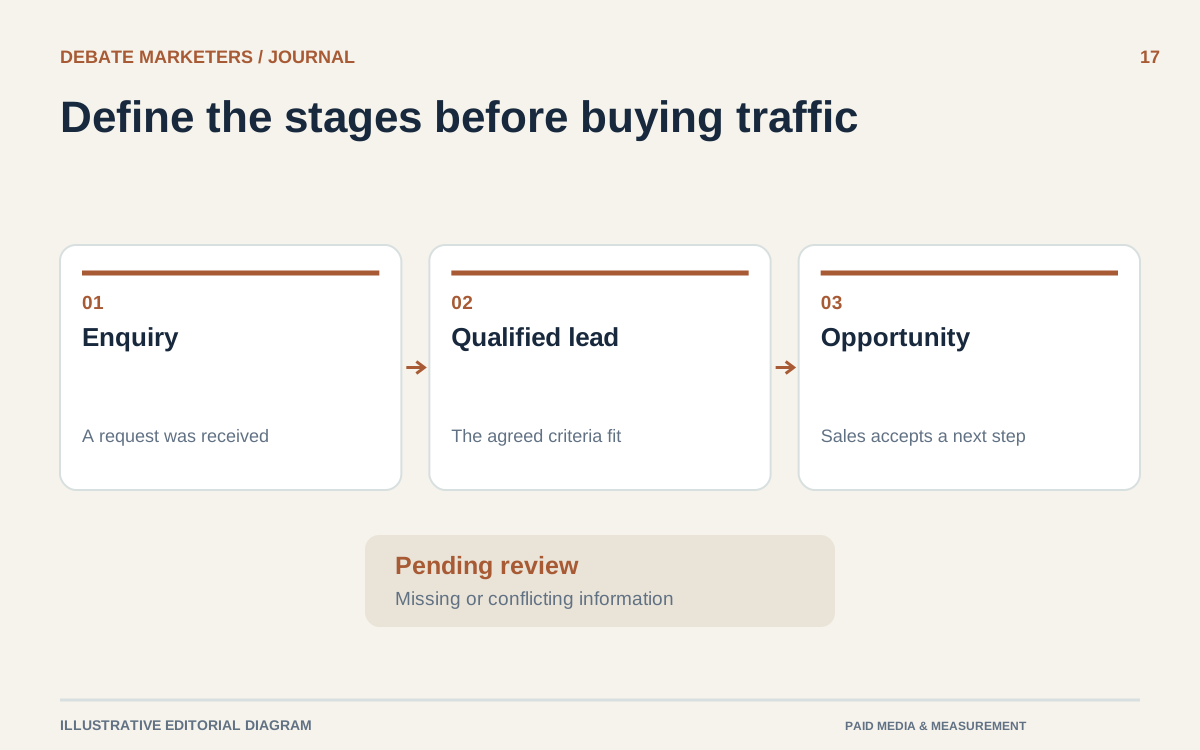
Write an entry condition for each stage. For example, an enquiry is an identifiable request for information. A qualified lead has a plausible requirement within your offer and territory. An opportunity has been accepted by sales as a specific buying discussion with an agreed next step.
These are proposed operating definitions, not universal industry standards. Your team may need a different structure. The important part is that a stage means something observable.
Google Ads supports qualified-lead and converted-lead goals for recording later steps in a lead process, including qualification outside the advertising platform. Those labels still depend on the business defining the underlying event correctly. Google Ads documentation
Decide what evidence is enough
For an illustrative example, consider a manufacturer of custom industrial enclosures. A request identifying the application, material, approximate quantity, and delivery location may justify a technical conversation. A detailed drawing could help, but requiring one immediately could exclude a buyer who is still preparing the specification.
The team might qualify the lead when application fit and a reachable business contact are confirmed. It might create an opportunity only after engineering accepts the requirement and sales agrees on a next step with the buyer.
Neither a corporate email address nor a downloaded brochure establishes that whole sequence. Equally, a personal email address should not automatically erase an otherwise credible enquiry. Let the evidence answer the relevant question.
Give uncertainty its own place
Do not force every record into good or bad. Use a pending-review status when important information is missing. Assign an owner and a date for the next action, so uncertainty does not become permanent storage.
Keep disqualification reasons specific enough to guide change. Useful examples include unsupported product, outside service territory, student research, supplier solicitation, and invalid contact details. A generic poor-quality label hides the difference between a targeting problem and an incomplete conversation.
Preserve the distinction between unqualified and unreachable. If nobody followed up, you do not yet know that the lead lacked fit. That distinction matters when the owner decides whether to change advertising or repair the response process.
Test the definition before the campaign
Take a small, varied sample of past enquiries that you are authorized to review. Have marketing and sales classify them independently, then compare disagreements. Look for the rule that would have made each decision clearer.
This exercise often surfaces useful questions. Does an existing customer's new project belong in the acquisition report? Who owns distributor requests? Can a prototype enquiry qualify when production volume is unknown? What happens when the buyer's location differs from the delivery location?
Resolve the important cases and keep a short exception log. You are building a working agreement, not trying to predict every future order.
Close the feedback loop
Choose who updates the status, when they do it, and how campaign owners receive the result. Review rejected and pending enquiries alongside accepted ones. A campaign cannot learn from sales feedback that exists only in someone's inbox.
Track raw enquiries and qualified leads separately. When the definition changes, record the date and reason; a higher qualification rate after a rule change is not automatically better demand.
Before approving spend, ask one question: could the team explain why a particular lead counted? If the answer is yes, you have a more useful starting point for paid search decisions.
For help connecting lead definitions, landing pages, and measurement, book a conversation with Debate Marketers.
We plan and run admissions campaigns, websites, SEO and AI search, ads and CRM follow-up for schools, manufacturers and growing brands, from teams in New Delhi and Malta.
Published 3 October 2026.
More articles

How to Find Buyers for Export: Marketing and Branding That Win Orders
How import and export companies find buyers in 2026: buyer finder tools, trade data, B2B portals, LinkedIn and AI search, and the branding that wins orders.

AEO and GEO Best Practices for 2026: A Guide for B2B and Retail
What Google, Microsoft and OpenAI say about AEO and GEO, what studies show gets cited, and best practices for B2B pages, product feeds and measurement in 2026.

How to Choose an SEO Agency in 2026: A B2B and Retail Checklist
What to ask an SEO agency, how to score proposals, what AEO and GEO work should cover, what SEO costs in 2026 and the contract terms to agree before signing.
Before You Run B2B Search Ads, Define a Qualified Lead
Define lead quality before launching B2B search ads. Align product fit, sales acceptance, disqualification reasons, and campaign feedback.
A form submission proves that somebody submitted a form. It does not tell you whether your company can supply what they need, whether the project is real, or whether sales should spend time on it.
That distinction needs to be settled before a B2B search campaign starts. Otherwise, marketing can report a good month while the sales team remembers only requests for products you do not make.
Start with a short qualification agreement. It should be clear enough that two people reviewing the same enquiry usually reach the same decision. A complex scoring model can wait.
Define the work you want to win
Begin with the actual order, application, or engagement your company wants. Describe the product family, territory, customer type, and requirements your team can serve. Include material constraints such as minimum production quantities, process limitations, or installation coverage when they genuinely determine fit.
Avoid using company size as a substitute for commercial judgment. A small engineering business might specify your component for a substantial program. A large corporation might be asking for something outside your capabilities.
Your definition should distinguish essential conditions from preferences. An unsupported material requirement may be a firm exclusion. An uncertain order date may simply mean the enquiry needs more conversation.
Separate enquiry, qualified lead, and opportunity
Write an entry condition for each stage. For example, an enquiry is an identifiable request for information. A qualified lead has a plausible requirement within your offer and territory. An opportunity has been accepted by sales as a specific buying discussion with an agreed next step.
These are proposed operating definitions, not universal industry standards. Your team may need a different structure. The important part is that a stage means something observable.
Google Ads supports qualified-lead and converted-lead goals for recording later steps in a lead process, including qualification outside the advertising platform. Those labels still depend on the business defining the underlying event correctly. Google Ads documentation
Decide what evidence is enough
For an illustrative example, consider a manufacturer of custom industrial enclosures. A request identifying the application, material, approximate quantity, and delivery location may justify a technical conversation. A detailed drawing could help, but requiring one immediately could exclude a buyer who is still preparing the specification.
The team might qualify the lead when application fit and a reachable business contact are confirmed. It might create an opportunity only after engineering accepts the requirement and sales agrees on a next step with the buyer.
Neither a corporate email address nor a downloaded brochure establishes that whole sequence. Equally, a personal email address should not automatically erase an otherwise credible enquiry. Let the evidence answer the relevant question.
Give uncertainty its own place
Do not force every record into good or bad. Use a pending-review status when important information is missing. Assign an owner and a date for the next action, so uncertainty does not become permanent storage.
Keep disqualification reasons specific enough to guide change. Useful examples include unsupported product, outside service territory, student research, supplier solicitation, and invalid contact details. A generic poor-quality label hides the difference between a targeting problem and an incomplete conversation.
Preserve the distinction between unqualified and unreachable. If nobody followed up, you do not yet know that the lead lacked fit. That distinction matters when the owner decides whether to change advertising or repair the response process.
Test the definition before the campaign
Take a small, varied sample of past enquiries that you are authorized to review. Have marketing and sales classify them independently, then compare disagreements. Look for the rule that would have made each decision clearer.
This exercise often surfaces useful questions. Does an existing customer's new project belong in the acquisition report? Who owns distributor requests? Can a prototype enquiry qualify when production volume is unknown? What happens when the buyer's location differs from the delivery location?
Resolve the important cases and keep a short exception log. You are building a working agreement, not trying to predict every future order.
Close the feedback loop
Choose who updates the status, when they do it, and how campaign owners receive the result. Review rejected and pending enquiries alongside accepted ones. A campaign cannot learn from sales feedback that exists only in someone's inbox.
Track raw enquiries and qualified leads separately. When the definition changes, record the date and reason; a higher qualification rate after a rule change is not automatically better demand.
Before approving spend, ask one question: could the team explain why a particular lead counted? If the answer is yes, you have a more useful starting point for paid search decisions.
For help connecting lead definitions, landing pages, and measurement, book a conversation with Debate Marketers.
We plan and run admissions campaigns, websites, SEO and AI search, ads and CRM follow-up for schools, manufacturers and growing brands, from teams in New Delhi and Malta.
Published 3 October 2026.
More articles
How to Find Buyers for Export: Marketing and Branding That Win Orders
How import and export companies find buyers in 2026: buyer finder tools, trade data, B2B portals, LinkedIn and AI search, and the branding that wins orders.
AEO and GEO Best Practices for 2026: A Guide for B2B and Retail
What Google, Microsoft and OpenAI say about AEO and GEO, what studies show gets cited, and best practices for B2B pages, product feeds and measurement in 2026.
How to Choose an SEO Agency in 2026: A B2B and Retail Checklist
What to ask an SEO agency, how to score proposals, what AEO and GEO work should cover, what SEO costs in 2026 and the contract terms to agree before signing.
Before You Run B2B Search Ads, Define a Qualified Lead
Define lead quality before launching B2B search ads. Align product fit, sales acceptance, disqualification reasons, and campaign feedback.
A form submission proves that somebody submitted a form. It does not tell you whether your company can supply what they need, whether the project is real, or whether sales should spend time on it.
That distinction needs to be settled before a B2B search campaign starts. Otherwise, marketing can report a good month while the sales team remembers only requests for products you do not make.
Start with a short qualification agreement. It should be clear enough that two people reviewing the same enquiry usually reach the same decision. A complex scoring model can wait.
Define the work you want to win
Begin with the actual order, application, or engagement your company wants. Describe the product family, territory, customer type, and requirements your team can serve. Include material constraints such as minimum production quantities, process limitations, or installation coverage when they genuinely determine fit.
Avoid using company size as a substitute for commercial judgment. A small engineering business might specify your component for a substantial program. A large corporation might be asking for something outside your capabilities.
Your definition should distinguish essential conditions from preferences. An unsupported material requirement may be a firm exclusion. An uncertain order date may simply mean the enquiry needs more conversation.
Separate enquiry, qualified lead, and opportunity
Write an entry condition for each stage. For example, an enquiry is an identifiable request for information. A qualified lead has a plausible requirement within your offer and territory. An opportunity has been accepted by sales as a specific buying discussion with an agreed next step.
These are proposed operating definitions, not universal industry standards. Your team may need a different structure. The important part is that a stage means something observable.
Google Ads supports qualified-lead and converted-lead goals for recording later steps in a lead process, including qualification outside the advertising platform. Those labels still depend on the business defining the underlying event correctly. Google Ads documentation
Decide what evidence is enough
For an illustrative example, consider a manufacturer of custom industrial enclosures. A request identifying the application, material, approximate quantity, and delivery location may justify a technical conversation. A detailed drawing could help, but requiring one immediately could exclude a buyer who is still preparing the specification.
The team might qualify the lead when application fit and a reachable business contact are confirmed. It might create an opportunity only after engineering accepts the requirement and sales agrees on a next step with the buyer.
Neither a corporate email address nor a downloaded brochure establishes that whole sequence. Equally, a personal email address should not automatically erase an otherwise credible enquiry. Let the evidence answer the relevant question.
Give uncertainty its own place
Do not force every record into good or bad. Use a pending-review status when important information is missing. Assign an owner and a date for the next action, so uncertainty does not become permanent storage.
Keep disqualification reasons specific enough to guide change. Useful examples include unsupported product, outside service territory, student research, supplier solicitation, and invalid contact details. A generic poor-quality label hides the difference between a targeting problem and an incomplete conversation.
Preserve the distinction between unqualified and unreachable. If nobody followed up, you do not yet know that the lead lacked fit. That distinction matters when the owner decides whether to change advertising or repair the response process.
Test the definition before the campaign
Take a small, varied sample of past enquiries that you are authorized to review. Have marketing and sales classify them independently, then compare disagreements. Look for the rule that would have made each decision clearer.
This exercise often surfaces useful questions. Does an existing customer's new project belong in the acquisition report? Who owns distributor requests? Can a prototype enquiry qualify when production volume is unknown? What happens when the buyer's location differs from the delivery location?
Resolve the important cases and keep a short exception log. You are building a working agreement, not trying to predict every future order.
Close the feedback loop
Choose who updates the status, when they do it, and how campaign owners receive the result. Review rejected and pending enquiries alongside accepted ones. A campaign cannot learn from sales feedback that exists only in someone's inbox.
Track raw enquiries and qualified leads separately. When the definition changes, record the date and reason; a higher qualification rate after a rule change is not automatically better demand.
Before approving spend, ask one question: could the team explain why a particular lead counted? If the answer is yes, you have a more useful starting point for paid search decisions.
For help connecting lead definitions, landing pages, and measurement, book a conversation with Debate Marketers.
We plan and run admissions campaigns, websites, SEO and AI search, ads and CRM follow-up for schools, manufacturers and growing brands, from teams in New Delhi and Malta.
Published 3 October 2026.
More articles
How to Find Buyers for Export: Marketing and Branding That Win Orders
How import and export companies find buyers in 2026: buyer finder tools, trade data, B2B portals, LinkedIn and AI search, and the branding that wins orders.
AEO and GEO Best Practices for 2026: A Guide for B2B and Retail
What Google, Microsoft and OpenAI say about AEO and GEO, what studies show gets cited, and best practices for B2B pages, product feeds and measurement in 2026.
How to Choose an SEO Agency in 2026: A B2B and Retail Checklist
What to ask an SEO agency, how to score proposals, what AEO and GEO work should cover, what SEO costs in 2026 and the contract terms to agree before signing.
Bring your first priority.
Bring one problem: a brand that's drifted, a website that doesn't sell or enquiries going nowhere. We'll spend 30 minutes finding the first fix.
Projects & shared-team retainers
Bring your first priority.
Bring one problem: a brand that's drifted, a website that doesn't sell or enquiries going nowhere. We'll spend 30 minutes finding the first fix.
Projects & shared-team retainers