Marketers
A shared team for strategy, copy, design and campaigns, every month.
Website developmentCapability pages, useful proof and a direct path to an enquiry.
BrandingPositioning, identity and sales material that explain why you're worth choosing.
SEO and AI searchGet found on Google and in AI answers by the people who buy what you make.
Performance marketingGoogle, LinkedIn and Meta ads measured on qualified enquiries.
AI automation & CRMEvery enquiry gets an owner and a next step, with human review.
 Two minutes, no email neededFind the one thing to fix firstTake the quiz→
Brand Identity Checklist: What Every Brand Needs for Long-Term Success
Discover the ultimate brand identity checklist. Learn how to build a strong brand, with visuals, messaging, and consistency to grow your business.
Why Brand Identity Is the Biggest Competitive Advantage You’re Not Using
Think about the brands you trust most. You probably didn’t arrive at that trust because of a single advertisement or one great product experience. You trust them because every interaction, every visual, every message from those brands felt intentional. That feeling is the result of a clearly defined brand identity.
Most businesses treat brand identity as a design exercise: pick a logo, choose some colours, write a tagline, and move on. But here’s the uncomfortable truth: a logo without strategy is just decoration. A colour palette without meaning is just paint. Your brand identity is the operating system that governs how your business is perceived, remembered, and recommended.
A well-built brand identity checklist does three things that no ad budget can replicate. First, it creates instant recognition in crowded markets. Second, it builds emotional trust that converts browsers into buyers. Third, it provides a decision-making framework that keeps your entire team aligned, from the CEO to the newest intern.
⚡ Debate Marketers Insight Brand identity is not what you say about yourself. It’s what your customer feels about you before they’ve even spoken to you. Every touchpoint either builds that feeling or breaks it. This guide will help you audit, build, or rebuild every touchpoint that matters. |
What Is Brand Identity? The Full Picture Beyond the Logo
Brand identity is the complete collection of elements a company creates to present the right image to its audience. It encompasses the visual, verbal, and experiential dimensions of how a business shows up in the world. Unlike brand image (how customers perceive you) or brand reputation (what customers say about you), brand identity is what you can directly control and shape.
Think of it as a three-layer system: the visible layer (logo, colours, typography, imagery), the strategic layer (vision, mission, values, positioning), and the experiential layer (tone of voice, customer interactions, after-sales feel). When all three layers work in harmony, you get a brand that people not only remember, but choose again and again.
The 7 Core Pillars of Brand Identity
Pillar / Key Question to Ask | What It Covers |
Brand Vision & Mission / | The long-term aspiration (vision) and the practical purpose (mission) that drive every business decision. |
Brand Values / | The 3–5 non-negotiable principles that shape your brand’s behaviour and culture. |
Visual Identity / | Logo, colour palette, typography, iconography, photography style, and design system. |
Tone of Voice / | The consistent personality expressed through writing, speech, and communication. |
Brand Personality / | The set of human characteristics associated with the brand (e.g., bold, nurturing, witty). |
Brand Story / | The narrative origin and purpose that emotionally connects the brand to its audience. |
Customer Experience / | Every touchpoint from first impression to post-purchase follow-up. |
The Ultimate Brand Identity Checklist
Use this brand identity checklist as a working audit tool. For each item, honestly assess whether your brand meets the standard. Anything left unchecked is an opportunity gap waiting to be closed.
☐ | Category | Checklist Item |
☐ | Vision & Mission | Your brand’s purpose is documented in one clear sentence that every team member can recite. |
☐ | Vision & Mission | Your mission directly addresses a real customer need or pain point, not just an internal aspiration. |
☐ | Vision & Mission | Your vision describes the future state of the world your brand is actively working toward. |
☐ | Vision & Mission | Both vision and mission are reviewed annually to ensure relevance as the market evolves. |
☐ | Brand Values | You have 3–5 clearly defined values (not generic words like ‘integrity’ or ‘excellence’). |
☐ | Brand Values | Each value has a behavioural definition: what it looks like in action, not just what it means. |
☐ | Brand Values | Your hiring, firing, and promotion decisions reference these values. |
☐ | Brand Values | Customers can sense your values without you explicitly stating them. |
☐ | Logo & Visual Identity | Your logo works clearly at every size: favicon, social avatar, billboard, and business card. |
☐ | Logo & Visual Identity | You have a documented colour palette with primary, secondary, and accent colours including HEX, RGB, and CMYK codes. |
☐ | Logo & Visual Identity | You use no more than 2–3 typeface families across all branded materials. |
☐ | Logo & Visual Identity | All design elements (icons, illustrations, photography style) follow a unified visual system. |
☐ | Logo & Visual Identity | You have a brand style guide accessible to every team member and agency partner. |
☐ | Tone of Voice & Messaging | Your brand voice is documented with clear ‘Do / Don’t’ examples for different channels. |
☐ | Tone of Voice & Messaging | You have a messaging hierarchy: tagline, elevator pitch, one-paragraph story, and full narrative. |
☐ | Tone of Voice & Messaging | Your messaging directly addresses the top 3 pain points of your ideal customer. |
☐ | Tone of Voice & Messaging | There is a clear distinction between your brand’s social media voice, email voice, and formal communications. |
☐ | Brand Story | Your origin story is authentic and documented in both a short (30-second) and long (2-minute) version. |
☐ | Brand Story | The story positions your customer as the hero, not your brand. |
☐ | Brand Story | The narrative has a clear conflict or problem that your brand was founded to solve. |
☐ | Brand Story | Your story is actively used in onboarding, pitch decks, About pages, and PR materials. |
☐ | Customer Experience | The experience feels consistent whether a customer interacts via website, social media, phone, or in-person. |
☐ | Customer Experience | You have mapped the complete customer journey and identified every brand touchpoint. |
☐ | Customer Experience | Post-purchase communication is as well-branded and thoughtful as pre-purchase marketing. |
☐ | Customer Experience | Customer support responses reflect the brand’s tone and values, not generic scripts. |
☐ | Customer Experience | You actively collect and act on customer feedback to refine the experience. |
☐ | Digital Presence | Your website loads in under 3 seconds and is mobile-optimised. |
☐ | Digital Presence | Social media bios, banners, and content style are visually consistent with your brand system. |
☐ | Digital Presence | SEO metadata (titles, descriptions, OG images) consistently reflect your brand’s voice and visuals. |
☐ | Digital Presence | Your email signature, templates, and automated communications are on-brand. |
📋 Save & Use This Checklist Print this checklist or keep it open during your next brand review meeting. Score each item as Complete, In Progress, or Not Started. Any category with more than one ‘Not Started’ item needs immediate attention. |
How Brand Consistency Affects Customer Perception and Trust
Consistency is not repetition. Repetition is posting the same thing daily. Consistency is ensuring that no matter where, when, or how someone encounters your brand, the feeling is identical. Research consistently shows that brands presenting a unified identity across all platforms see significantly higher revenue growth compared to those with inconsistent presentation.
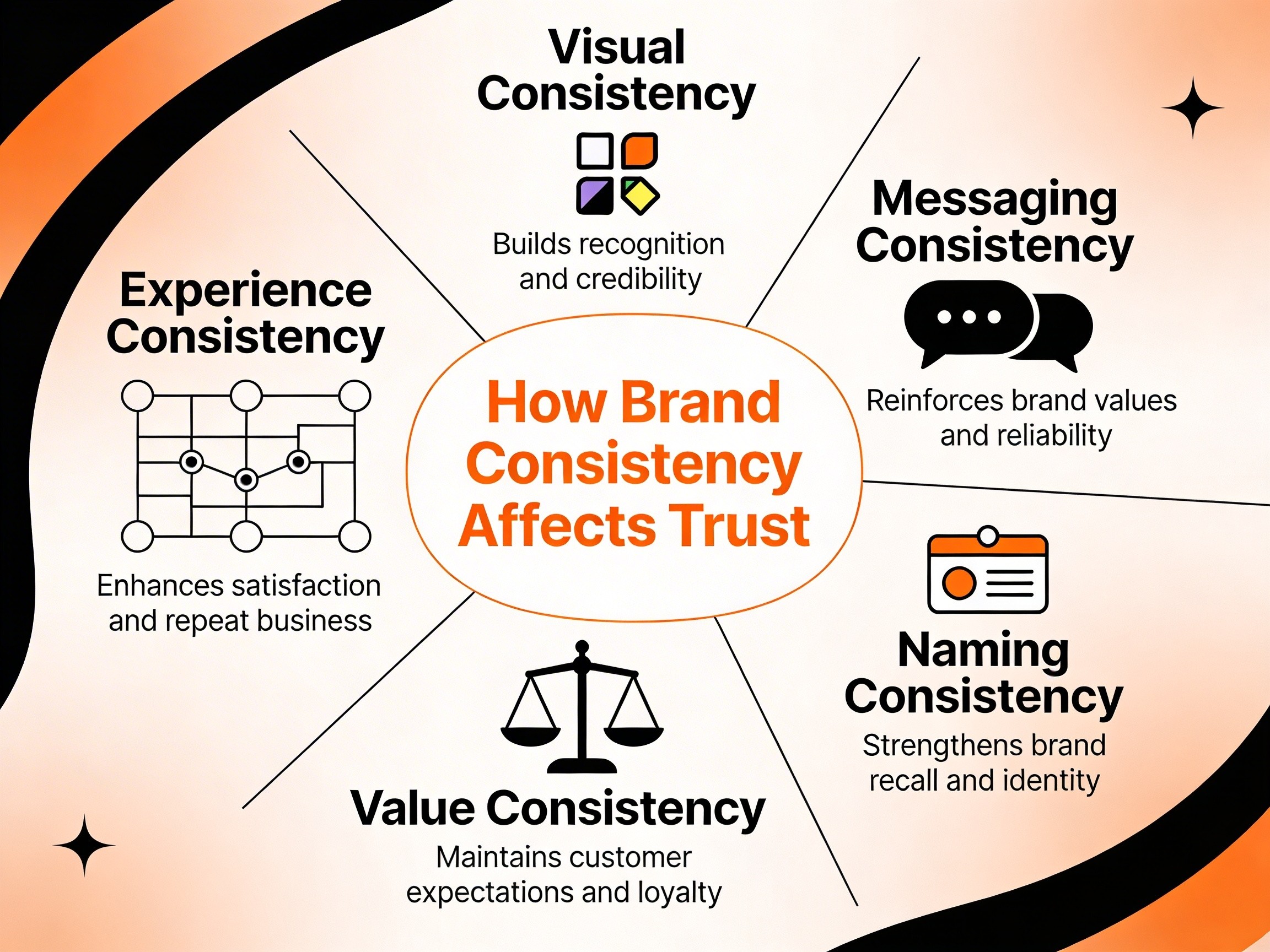
📈 The Brand Consistency Impact Framework
Consistency Type / Business Impact | What It Looks Like in Practice |
Visual Consistency Impact: Customers can identify your brand in under 3 seconds without seeing your name. | Same logo, colours, typography, and imagery across website, social media, packaging, and ads. |
Verbal Consistency Impact: Builds familiarity and trust; customers feel they ‘know’ your brand. | Same tone of voice in emails, social posts, customer support, and press releases. |
Experiential Consistency Impact: Reduces customer anxiety and increases repeat purchases. | Same quality of interaction whether online, in-store, via chat, or on the phone. |
Strategic Consistency Impact: Prevents brand dilution; keeps the brand focused and credible. | All campaigns, launches, and partnerships align with core brand values and positioning. |
Internal Consistency Impact: Creates authentic brand ambassadors who naturally reinforce the brand. | Employees understand and embody the brand in how they work and communicate. |
🎯 The 3-Second Rule If someone sees a piece of your content without your logo visible, can they identify it as yours within 3 seconds? If not, your visual consistency needs work. Try this exercise with 5 of your recent social media posts. |
10 Brand Identity Mistakes That Silently Kill Growth
Every brand makes mistakes during identity building. The difference between brands that thrive and those that stagnate is how quickly they identify and correct these errors. Here are the most common pitfalls we see at Debate Marketers, along with agency-tested fixes.
Common Mistake / Why It Matters | How to Fix It |
Inconsistent Visuals Across Channels Why It Matters: Customers develop trust through pattern recognition. Inconsistency breaks that pattern and creates cognitive friction. | Create a centralised brand style guide with HEX codes, font weights, logo usage rules, and minimum clear space. Use tools like Brandfolder or Frontify for asset management. |
Generic or Meaningless Values Why It Matters: Values guide internal culture. Generic values guide nothing and get ignored. | Replace vague values (e.g., ‘excellence’) with behavioural values (e.g., ‘We ship fast, then refine’). Each value should tell someone how you make decisions. |
Copying Competitor Branding Why It Matters: If you look like everyone else, you become invisible. Differentiation is survival. | Conduct a competitive visual audit. Document what competitors use, then deliberately choose different design directions in colour, typography, and imagery. |
Weak or Missing Brand Story Why It Matters: Humans remember stories 22x better than facts. A missing story means a forgettable brand. | Document your origin story using the framework: Problem Existed → Founder Experienced It → Brand Was Built to Solve It → Customer Is the Hero. |
No Documented Tone of Voice Why It Matters: Without a voice guide, every piece of content sounds like a different person wrote it. | Write a tone-of-voice guide with ‘We are / We are not’ columns and 3–4 real examples per channel. Distribute it to every content creator. |
Designing for Yourself, Not Your Customer Why It Matters: Your favourite colour is irrelevant. Your customer’s emotional response to your colour is everything. | Run customer interviews and surveys before making identity decisions. Test logo concepts, colour palettes, and messaging with real audience segments. |
Ignoring Internal Brand Alignment Why It Matters: Employees interact with customers daily. Misaligned employees create misaligned experiences. | Host quarterly brand immersion sessions for all employees. Make your brand book the first document new hires receive. |
Skipping the Brand Audit Why It Matters: Markets shift. What worked 2 years ago may now feel outdated or misaligned. | Schedule a full brand audit every 12–18 months. Review all touchpoints for consistency, relevance, and alignment with current strategy. |
Overcomplicating the Visual System Why It Matters: Complexity is the enemy of consistency. The more variables, the more chances to go off-brand. | Limit yourself to 2 primary colours, 2 accent colours, and 2 font families. A simpler system is easier to maintain consistently. |
Treating Brand as a One-Time Project Why It Matters: Brand identity is a living system. Neglect it, and it decays. | Assign a brand steward or team responsible for ongoing brand management. Build brand review into your quarterly planning. |
How to Build a Strong Brand Identity: The 7-Step Debate Marketers Framework
Building brand identity is not a weekend project. It is a strategic process that requires research, reflection, and rigorous execution. Here is the step-by-step framework we use at Debate Marketers to help brands build identities that last.
Step 1: Discover Your Brand’s DNA
Before you design anything, you need clarity on who you are, who you serve, and what you stand for. This discovery phase is the foundation of everything that follows.
Conduct 5–10 customer interviews to understand how your audience currently perceives you.
Define your Ideal Customer Profile (ICP) with demographics, psychographics, pain points, and aspirations.
Write a Brand Purpose Statement: ‘We exist to [action] for [audience] so that [outcome].’
Document your 3–5 core values with behavioural definitions.
Tools: Google Forms for surveys, Notion for documentation, Typeform for customer research.
Step 2: Audit the Competitive Landscape
You cannot differentiate if you don’t know what you’re differentiating from. A competitive audit prevents accidental duplication and reveals white space.
Map 5–10 direct competitors and document their logo styles, colour palettes, typography, messaging tone, and brand personality.
Identify the visual and verbal patterns that dominate your industry (e.g., most fintech brands use blue and sans-serif fonts).
Decide where your brand will deliberately break from the pattern to stand out.
Tools: Canva for mood boards, Brandwatch for competitive analysis, SEMrush for messaging research.
Step 3: Craft Your Visual Identity System
Your visuals are the first thing people see and the last thing they forget. Every visual decision should be traceable back to your brand strategy.
Design a logo that works at every size and in both colour and monochrome.
Select a colour palette with strategic intent: primary colours for trust, accent colours for energy, neutral colours for balance.
Choose 2–3 typeface families (one for headings, one for body, one optional for accents).
Define your photography and illustration style: candid vs. staged, warm vs. cool tones, minimal vs. detailed.
Tools: Adobe Illustrator for logo design, Coolors for palette generation, Google Fonts or Adobe Fonts for typography.
Step 4: Define Your Brand Voice and Messaging Architecture
Your voice is how your brand ‘sounds’ in every written and spoken communication. It should be distinctive enough that someone could identify your brand from a paragraph of text alone.
Create a Voice Character Card: describe your brand voice in 3–4 adjectives (e.g., ‘bold, clear, warm, irreverent’).
Write a ‘Do / Don’t’ guide with real examples for social media, email, website, and customer support.
Build a messaging hierarchy: Tagline → Elevator Pitch → Value Proposition → Detailed Narrative.
Tools: Hemingway Editor for clarity checks, Grammarly for consistency, Notion for voice guides.
Step 5: Write Your Brand Story
Every strong brand has a story that makes people care. Your brand story is not a company history; it is an emotional narrative that positions your customer as the hero.
Use the StoryBrand-style framework: Customer has a Problem → Meets a Guide (your brand) → Gets a Plan → Takes Action → Achieves Success.
Write a 30-second version (for social bios and elevator pitches) and a 2-minute version (for About pages and press).
Ensure the story includes a genuine human element: the founder’s frustration, a personal experience, or a moment of insight.
Tools: StoryBrand framework, Notion for story documentation.
Step 6: Align Every Customer Touchpoint
The best brand identity in the world means nothing if the customer experience contradicts it. This step ensures every interaction reinforces your brand promise.
Map every customer touchpoint: website, social media, email, packaging, invoicing, customer support, returns, onboarding.
For each touchpoint, ask: ‘Does this feel like it belongs to the same brand?’
Prioritise the touchpoints with the highest customer volume and fix inconsistencies there first.
Create branded templates for emails, proposals, invoices, and presentations.
Tools: Canva for templates, HubSpot for email consistency, Figma for design systems.
Step 7: Build the Brand Bible and Governance System
A brand identity that exists only in the founder’s head is not a brand identity. It needs to be documented, distributed, and enforced.
Compile everything into a Brand Bible (also called a Brand Book or Style Guide).
Include: logo usage rules, colour codes, typography specifications, voice guidelines, imagery standards, and do/don’t examples.
Distribute the Brand Bible to every team member, freelancer, agency partner, and vendor.
Assign a Brand Steward responsible for reviewing all external communications for brand compliance.
Tools: Brandfolder or Frontify for brand asset management, Google Drive for accessible documents, Loom for video walkthroughs.
Case Studies: Brands That Built Identity Into a Growth Engine
Case Study 1: Amul – The Power of Consistent Brand Personality
Amul has maintained one of the most recognizable brand identities in India for over five decades. The Amul Girl, their mascot, has appeared in topical advertisements commenting on current events since 1966. This consistency has created a brand personality that is witty, accessible, and deeply Indian.
What makes Amul’s identity work is not just the consistency of the mascot, but the consistency of the tone: always humorous, always timely, never mean-spirited. The visual identity (polka-dot dress, blue hair) is instantly recognizable, and the verbal identity (punny headlines) is unmistakable. Amul has become one of India’s most trusted FMCG brands, with a presence in over 50 countries and annual revenues exceeding ₹80,000 crore.
Key Takeaway: Consistency of personality over decades builds a kind of cultural capital that no ad spend can buy. Amul never ‘rebranded’ to be trendy; they let their identity compound.
Case Study 2: Zomato – Brand Voice as a Competitive Moat
Zomato transformed from a restaurant discovery app into one of India’s most loved brands, largely through brand voice. Their social media presence, known for witty, relatable, and sometimes self-deprecating humour, has become a benchmark for brand communication in India.
Zomato’s identity works because the voice is consistent across every channel: push notifications, social media, customer emails, and even their app interface. They publish a clear voice guide that ensures every piece of content feels like it came from the same personality. The result: a brand that has built massive organic engagement, with social media posts frequently going viral and generating millions of impressions without paid promotion.
Key Takeaway: A distinctive brand voice, consistently applied across every touchpoint, can become your most powerful marketing tool. Zomato doesn’t just deliver food; they deliver a personality.
Case Study 3: Boat – Visual Identity Meets Community
Boat, the Indian electronics brand, built a brand identity deliberately designed to resonate with young, style-conscious, music-loving Indians. From day one, their visual identity was bold, dark-themed, and modern, a sharp departure from the sterile product imagery used by legacy electronics brands.
But the real identity move was the concept of ‘boAtheads,’ turning customers into a named community. This community-first identity allowed Boat to charge premium prices in a market known for price sensitivity. By integrating brand ambassadors from cricket and music (Hardik Pandya, Kiara Advani), they reinforced their identity as aspirational yet accessible. Boat became India’s #1 wearable brand by shipments, proving that a strong brand identity can outperform a bigger marketing budget.
Key Takeaway: Brand identity is not just about how you look or sound; it’s about the community you build around the brand. Giving your customers an identity (boAtheads) turns buyers into advocates.
How to Evolve Your Brand Identity Without Losing Your Audience
Markets shift. Customer expectations evolve. New competitors emerge. A brand identity that stays static while everything around it changes will eventually feel dated. But reckless rebranding can alienate the very customers who made you successful. The key is strategic evolution: planned, purposeful, and communicated well.
When to Consider Evolving Your Brand Identity
Your audience demographics have shifted significantly (e.g., you now serve enterprise clients but your brand still looks like a startup).
You are entering new markets, geographies, or product categories that your current identity doesn’t naturally accommodate.
Customer research shows a disconnect between how you see your brand and how your audience perceives it.
Your visual identity looks dated compared to competitors and new entrants.
You’ve outgrown your original positioning (e.g., from a niche player to an industry leader).
The Debate Marketers Rebrand Safety Framework
Phase | What to Do | Critical Rule |
Phase 1 | Audit & Research: Conduct a full brand audit. Survey customers and stakeholders. Identify what to keep, what to evolve, and what to retire. | Never rebrand based on internal opinions alone. Let data from customer feedback and market analysis drive decisions. |
Phase 2 | Strategic Foundation: Redefine or refine your brand positioning, values, and messaging before touching any visuals. Strategy always comes before design. | Visual changes without strategic changes create a ‘new coat of paint’ effect: it looks different but nothing meaningful has changed. |
Phase 3 | Visual Evolution: Update design elements incrementally. Consider evolving your logo rather than replacing it entirely. Refresh colours and typography while maintaining recognisable elements. | Radical visual changes confuse loyal customers. Evolution maintains recognition while signalling growth. |
Phase 4 | Internal Launch: Roll out the new identity internally first. Train every team member. Update all internal documents, templates, and tools. | If your team doesn’t understand or believe in the new identity, external communications will feel inauthentic. |
Phase 5 | External Rollout: Launch publicly with a clear narrative explaining the ‘why’ behind the evolution. Update all touchpoints simultaneously, never in pieces. | Partial rollouts create the worst of both worlds: inconsistency during the transition. Go all-in on a single launch date. |
Essential Brand Identity Tools: Our Recommended Stack
Category / Recommended Tools | What It Does / Skill Level |
Logo Design / Adobe Illustrator, Canva Pro, Looka | Professional logo creation with vector scalability. |
Colour Palette / Coolors, Adobe Color, Khroma | Generate harmonious colour palettes with accessibility checks. |
Typography / Google Fonts, Adobe Fonts, Fontjoy | Font pairing and typography system selection. |
Brand Style Guide / Frontify, Brandfolder, Canva Brand Kit | Central hub for all brand assets and guidelines. |
Design System / Figma, Sketch, Adobe XD | Build reusable UI components that enforce brand consistency. |
Customer Research / Typeform, Google Forms, Hotjar | Collect qualitative and quantitative customer insights. |
Competitive Analysis / SEMrush, Brandwatch, SimilarWeb | Research competitor positioning, messaging, and visual choices. |
Content & Voice / Hemingway Editor, Grammarly, Notion | Maintain tone consistency and readability across content. |
Frequently Asked Questions
Q1: What is a brand identity checklist?
A brand identity checklist is a structured audit tool that helps businesses evaluate whether every component of their brand, from visual design to messaging to customer experience, is clearly defined, strategically aligned, and consistently applied across all touchpoints.
Q2: What are the key elements of brand identity?
The key elements include brand vision and mission, brand values, visual identity (logo, colours, typography), tone of voice, brand personality, brand story, and customer experience. Together, these elements create the complete perception a customer has of your brand.
Q3: How often should I review my brand identity?
At minimum, conduct a full brand identity audit every 12–18 months. However, you should informally review your brand consistency quarterly, especially after major campaigns, product launches, or market shifts.
Q4: Is brand identity just about visuals?
No. Visuals are only one layer. Brand identity also includes your voice, your values, your story, and the experience you deliver. Many brands with beautiful logos fail because they neglect the verbal and experiential layers of their identity.
Q5: What is the difference between brand identity and brand image?
Brand identity is what you create and control: your logo, messaging, values, and design. Brand image is how your audience perceives you based on their experience. The goal is to make brand identity and brand image as closely aligned as possible.
Q6: Can a small business benefit from a brand identity checklist?
Absolutely. In fact, small businesses benefit the most because they have fewer resources to waste on inconsistency. A clear brand identity helps small businesses compete with larger players by building trust and recognition efficiently.
Q7: How much does it cost to build a brand identity?
Costs vary widely. A basic DIY approach using tools like Canva and Google Fonts can cost very little. A professional brand identity developed by an agency like Debate Marketers typically ranges from moderate to premium investment depending on the scope, including strategy, visual design, voice guidelines, and brand Bible documentation. The ROI, measured in customer recognition, loyalty, and pricing power, is consistently worth the investment.
Q8: What is the most common brand identity mistake?
Inconsistency. Brands invest in a great logo and then let everything else drift: their social media uses different colours, their emails have a different tone, and their customer support feels like a different company. Consistency across every touchpoint is the single most important factor in brand identity.
Further Reading & Resources
Building a StoryBrand by Donald Miller – The foundational guide to crafting customer-centric brand stories.
Designing Brand Identity by Alina Wheeler – The definitive textbook on brand identity design process.
Start with Why by Simon Sinek – Understanding purpose-driven branding.
The Brand Gap by Marty Neumeier – Bridging strategy and creativity in brand building.
Brandingmag.com – Ongoing industry insights and case studies on brand identity.
Final Thoughts: Your Brand Identity Is Your Business Strategy
A logo is not a brand identity. A colour palette is not a brand identity. A tagline is not a brand identity. A brand identity is the complete, strategic system that governs how every part of your business shows up in the world. It is the reason some brands charge premiums while others compete on price. It is why some brands are remembered and others are forgotten.
Use the brand identity checklist in this guide to honestly audit where your brand stands today. For every unchecked item, you have a clear direction for improvement. For every checked item, you have a foundation to build on.
But if you want more than a checklist, if you want a complete brand identity built by professionals who understand Indian markets, global standards, and the intersection of strategy and design, Debate Marketers is ready to help.
🚀 Ready to Build a Brand That Lasts? At Debate Marketers, we don’t just design logos. We build complete brand identity systems: from strategy and research to visual design, voice guidelines, and brand governance. Whether you’re launching a new brand or evolving an existing one, our team will help you create an identity that drives recognition, trust, and growth. Contact us at debatemarketers.com to book your brand identity consultation today. |
Visit debatemarketers.com → Book Your Brand Strategy Session
We plan and run admissions campaigns, websites, SEO and AI search, ads and CRM follow-up for schools, manufacturers and growing brands, from teams in New Delhi and Malta.
Published 14 April 2026. Updated 3 October 2026.
More articles

How to Find Buyers for Export: Marketing and Branding That Win Orders
How import and export companies find buyers in 2026: buyer finder tools, trade data, B2B portals, LinkedIn and AI search, and the branding that wins orders.

AEO and GEO Best Practices for 2026: A Guide for B2B and Retail
What Google, Microsoft and OpenAI say about AEO and GEO, what studies show gets cited, and best practices for B2B pages, product feeds and measurement in 2026.

How to Choose an SEO Agency in 2026: A B2B and Retail Checklist
What to ask an SEO agency, how to score proposals, what AEO and GEO work should cover, what SEO costs in 2026 and the contract terms to agree before signing.
Brand Identity Checklist: What Every Brand Needs for Long-Term Success
Discover the ultimate brand identity checklist. Learn how to build a strong brand, with visuals, messaging, and consistency to grow your business.
Why Brand Identity Is the Biggest Competitive Advantage You’re Not Using
Think about the brands you trust most. You probably didn’t arrive at that trust because of a single advertisement or one great product experience. You trust them because every interaction, every visual, every message from those brands felt intentional. That feeling is the result of a clearly defined brand identity.
Most businesses treat brand identity as a design exercise: pick a logo, choose some colours, write a tagline, and move on. But here’s the uncomfortable truth: a logo without strategy is just decoration. A colour palette without meaning is just paint. Your brand identity is the operating system that governs how your business is perceived, remembered, and recommended.
A well-built brand identity checklist does three things that no ad budget can replicate. First, it creates instant recognition in crowded markets. Second, it builds emotional trust that converts browsers into buyers. Third, it provides a decision-making framework that keeps your entire team aligned, from the CEO to the newest intern.
⚡ Debate Marketers Insight Brand identity is not what you say about yourself. It’s what your customer feels about you before they’ve even spoken to you. Every touchpoint either builds that feeling or breaks it. This guide will help you audit, build, or rebuild every touchpoint that matters. |
What Is Brand Identity? The Full Picture Beyond the Logo
Brand identity is the complete collection of elements a company creates to present the right image to its audience. It encompasses the visual, verbal, and experiential dimensions of how a business shows up in the world. Unlike brand image (how customers perceive you) or brand reputation (what customers say about you), brand identity is what you can directly control and shape.
Think of it as a three-layer system: the visible layer (logo, colours, typography, imagery), the strategic layer (vision, mission, values, positioning), and the experiential layer (tone of voice, customer interactions, after-sales feel). When all three layers work in harmony, you get a brand that people not only remember, but choose again and again.
The 7 Core Pillars of Brand Identity
Pillar / Key Question to Ask | What It Covers |
Brand Vision & Mission / | The long-term aspiration (vision) and the practical purpose (mission) that drive every business decision. |
Brand Values / | The 3–5 non-negotiable principles that shape your brand’s behaviour and culture. |
Visual Identity / | Logo, colour palette, typography, iconography, photography style, and design system. |
Tone of Voice / | The consistent personality expressed through writing, speech, and communication. |
Brand Personality / | The set of human characteristics associated with the brand (e.g., bold, nurturing, witty). |
Brand Story / | The narrative origin and purpose that emotionally connects the brand to its audience. |
Customer Experience / | Every touchpoint from first impression to post-purchase follow-up. |
The Ultimate Brand Identity Checklist
Use this brand identity checklist as a working audit tool. For each item, honestly assess whether your brand meets the standard. Anything left unchecked is an opportunity gap waiting to be closed.
☐ | Category | Checklist Item |
☐ | Vision & Mission | Your brand’s purpose is documented in one clear sentence that every team member can recite. |
☐ | Vision & Mission | Your mission directly addresses a real customer need or pain point, not just an internal aspiration. |
☐ | Vision & Mission | Your vision describes the future state of the world your brand is actively working toward. |
☐ | Vision & Mission | Both vision and mission are reviewed annually to ensure relevance as the market evolves. |
☐ | Brand Values | You have 3–5 clearly defined values (not generic words like ‘integrity’ or ‘excellence’). |
☐ | Brand Values | Each value has a behavioural definition: what it looks like in action, not just what it means. |
☐ | Brand Values | Your hiring, firing, and promotion decisions reference these values. |
☐ | Brand Values | Customers can sense your values without you explicitly stating them. |
☐ | Logo & Visual Identity | Your logo works clearly at every size: favicon, social avatar, billboard, and business card. |
☐ | Logo & Visual Identity | You have a documented colour palette with primary, secondary, and accent colours including HEX, RGB, and CMYK codes. |
☐ | Logo & Visual Identity | You use no more than 2–3 typeface families across all branded materials. |
☐ | Logo & Visual Identity | All design elements (icons, illustrations, photography style) follow a unified visual system. |
☐ | Logo & Visual Identity | You have a brand style guide accessible to every team member and agency partner. |
☐ | Tone of Voice & Messaging | Your brand voice is documented with clear ‘Do / Don’t’ examples for different channels. |
☐ | Tone of Voice & Messaging | You have a messaging hierarchy: tagline, elevator pitch, one-paragraph story, and full narrative. |
☐ | Tone of Voice & Messaging | Your messaging directly addresses the top 3 pain points of your ideal customer. |
☐ | Tone of Voice & Messaging | There is a clear distinction between your brand’s social media voice, email voice, and formal communications. |
☐ | Brand Story | Your origin story is authentic and documented in both a short (30-second) and long (2-minute) version. |
☐ | Brand Story | The story positions your customer as the hero, not your brand. |
☐ | Brand Story | The narrative has a clear conflict or problem that your brand was founded to solve. |
☐ | Brand Story | Your story is actively used in onboarding, pitch decks, About pages, and PR materials. |
☐ | Customer Experience | The experience feels consistent whether a customer interacts via website, social media, phone, or in-person. |
☐ | Customer Experience | You have mapped the complete customer journey and identified every brand touchpoint. |
☐ | Customer Experience | Post-purchase communication is as well-branded and thoughtful as pre-purchase marketing. |
☐ | Customer Experience | Customer support responses reflect the brand’s tone and values, not generic scripts. |
☐ | Customer Experience | You actively collect and act on customer feedback to refine the experience. |
☐ | Digital Presence | Your website loads in under 3 seconds and is mobile-optimised. |
☐ | Digital Presence | Social media bios, banners, and content style are visually consistent with your brand system. |
☐ | Digital Presence | SEO metadata (titles, descriptions, OG images) consistently reflect your brand’s voice and visuals. |
☐ | Digital Presence | Your email signature, templates, and automated communications are on-brand. |
📋 Save & Use This Checklist Print this checklist or keep it open during your next brand review meeting. Score each item as Complete, In Progress, or Not Started. Any category with more than one ‘Not Started’ item needs immediate attention. |
How Brand Consistency Affects Customer Perception and Trust
Consistency is not repetition. Repetition is posting the same thing daily. Consistency is ensuring that no matter where, when, or how someone encounters your brand, the feeling is identical. Research consistently shows that brands presenting a unified identity across all platforms see significantly higher revenue growth compared to those with inconsistent presentation.
📈 The Brand Consistency Impact Framework
Consistency Type / Business Impact | What It Looks Like in Practice |
Visual Consistency Impact: Customers can identify your brand in under 3 seconds without seeing your name. | Same logo, colours, typography, and imagery across website, social media, packaging, and ads. |
Verbal Consistency Impact: Builds familiarity and trust; customers feel they ‘know’ your brand. | Same tone of voice in emails, social posts, customer support, and press releases. |
Experiential Consistency Impact: Reduces customer anxiety and increases repeat purchases. | Same quality of interaction whether online, in-store, via chat, or on the phone. |
Strategic Consistency Impact: Prevents brand dilution; keeps the brand focused and credible. | All campaigns, launches, and partnerships align with core brand values and positioning. |
Internal Consistency Impact: Creates authentic brand ambassadors who naturally reinforce the brand. | Employees understand and embody the brand in how they work and communicate. |
🎯 The 3-Second Rule If someone sees a piece of your content without your logo visible, can they identify it as yours within 3 seconds? If not, your visual consistency needs work. Try this exercise with 5 of your recent social media posts. |
10 Brand Identity Mistakes That Silently Kill Growth
Every brand makes mistakes during identity building. The difference between brands that thrive and those that stagnate is how quickly they identify and correct these errors. Here are the most common pitfalls we see at Debate Marketers, along with agency-tested fixes.
Common Mistake / Why It Matters | How to Fix It |
Inconsistent Visuals Across Channels Why It Matters: Customers develop trust through pattern recognition. Inconsistency breaks that pattern and creates cognitive friction. | Create a centralised brand style guide with HEX codes, font weights, logo usage rules, and minimum clear space. Use tools like Brandfolder or Frontify for asset management. |
Generic or Meaningless Values Why It Matters: Values guide internal culture. Generic values guide nothing and get ignored. | Replace vague values (e.g., ‘excellence’) with behavioural values (e.g., ‘We ship fast, then refine’). Each value should tell someone how you make decisions. |
Copying Competitor Branding Why It Matters: If you look like everyone else, you become invisible. Differentiation is survival. | Conduct a competitive visual audit. Document what competitors use, then deliberately choose different design directions in colour, typography, and imagery. |
Weak or Missing Brand Story Why It Matters: Humans remember stories 22x better than facts. A missing story means a forgettable brand. | Document your origin story using the framework: Problem Existed → Founder Experienced It → Brand Was Built to Solve It → Customer Is the Hero. |
No Documented Tone of Voice Why It Matters: Without a voice guide, every piece of content sounds like a different person wrote it. | Write a tone-of-voice guide with ‘We are / We are not’ columns and 3–4 real examples per channel. Distribute it to every content creator. |
Designing for Yourself, Not Your Customer Why It Matters: Your favourite colour is irrelevant. Your customer’s emotional response to your colour is everything. | Run customer interviews and surveys before making identity decisions. Test logo concepts, colour palettes, and messaging with real audience segments. |
Ignoring Internal Brand Alignment Why It Matters: Employees interact with customers daily. Misaligned employees create misaligned experiences. | Host quarterly brand immersion sessions for all employees. Make your brand book the first document new hires receive. |
Skipping the Brand Audit Why It Matters: Markets shift. What worked 2 years ago may now feel outdated or misaligned. | Schedule a full brand audit every 12–18 months. Review all touchpoints for consistency, relevance, and alignment with current strategy. |
Overcomplicating the Visual System Why It Matters: Complexity is the enemy of consistency. The more variables, the more chances to go off-brand. | Limit yourself to 2 primary colours, 2 accent colours, and 2 font families. A simpler system is easier to maintain consistently. |
Treating Brand as a One-Time Project Why It Matters: Brand identity is a living system. Neglect it, and it decays. | Assign a brand steward or team responsible for ongoing brand management. Build brand review into your quarterly planning. |
How to Build a Strong Brand Identity: The 7-Step Debate Marketers Framework
Building brand identity is not a weekend project. It is a strategic process that requires research, reflection, and rigorous execution. Here is the step-by-step framework we use at Debate Marketers to help brands build identities that last.
Step 1: Discover Your Brand’s DNA
Before you design anything, you need clarity on who you are, who you serve, and what you stand for. This discovery phase is the foundation of everything that follows.
Conduct 5–10 customer interviews to understand how your audience currently perceives you.
Define your Ideal Customer Profile (ICP) with demographics, psychographics, pain points, and aspirations.
Write a Brand Purpose Statement: ‘We exist to [action] for [audience] so that [outcome].’
Document your 3–5 core values with behavioural definitions.
Tools: Google Forms for surveys, Notion for documentation, Typeform for customer research.
Step 2: Audit the Competitive Landscape
You cannot differentiate if you don’t know what you’re differentiating from. A competitive audit prevents accidental duplication and reveals white space.
Map 5–10 direct competitors and document their logo styles, colour palettes, typography, messaging tone, and brand personality.
Identify the visual and verbal patterns that dominate your industry (e.g., most fintech brands use blue and sans-serif fonts).
Decide where your brand will deliberately break from the pattern to stand out.
Tools: Canva for mood boards, Brandwatch for competitive analysis, SEMrush for messaging research.
Step 3: Craft Your Visual Identity System
Your visuals are the first thing people see and the last thing they forget. Every visual decision should be traceable back to your brand strategy.
Design a logo that works at every size and in both colour and monochrome.
Select a colour palette with strategic intent: primary colours for trust, accent colours for energy, neutral colours for balance.
Choose 2–3 typeface families (one for headings, one for body, one optional for accents).
Define your photography and illustration style: candid vs. staged, warm vs. cool tones, minimal vs. detailed.
Tools: Adobe Illustrator for logo design, Coolors for palette generation, Google Fonts or Adobe Fonts for typography.
Step 4: Define Your Brand Voice and Messaging Architecture
Your voice is how your brand ‘sounds’ in every written and spoken communication. It should be distinctive enough that someone could identify your brand from a paragraph of text alone.
Create a Voice Character Card: describe your brand voice in 3–4 adjectives (e.g., ‘bold, clear, warm, irreverent’).
Write a ‘Do / Don’t’ guide with real examples for social media, email, website, and customer support.
Build a messaging hierarchy: Tagline → Elevator Pitch → Value Proposition → Detailed Narrative.
Tools: Hemingway Editor for clarity checks, Grammarly for consistency, Notion for voice guides.
Step 5: Write Your Brand Story
Every strong brand has a story that makes people care. Your brand story is not a company history; it is an emotional narrative that positions your customer as the hero.
Use the StoryBrand-style framework: Customer has a Problem → Meets a Guide (your brand) → Gets a Plan → Takes Action → Achieves Success.
Write a 30-second version (for social bios and elevator pitches) and a 2-minute version (for About pages and press).
Ensure the story includes a genuine human element: the founder’s frustration, a personal experience, or a moment of insight.
Tools: StoryBrand framework, Notion for story documentation.
Step 6: Align Every Customer Touchpoint
The best brand identity in the world means nothing if the customer experience contradicts it. This step ensures every interaction reinforces your brand promise.
Map every customer touchpoint: website, social media, email, packaging, invoicing, customer support, returns, onboarding.
For each touchpoint, ask: ‘Does this feel like it belongs to the same brand?’
Prioritise the touchpoints with the highest customer volume and fix inconsistencies there first.
Create branded templates for emails, proposals, invoices, and presentations.
Tools: Canva for templates, HubSpot for email consistency, Figma for design systems.
Step 7: Build the Brand Bible and Governance System
A brand identity that exists only in the founder’s head is not a brand identity. It needs to be documented, distributed, and enforced.
Compile everything into a Brand Bible (also called a Brand Book or Style Guide).
Include: logo usage rules, colour codes, typography specifications, voice guidelines, imagery standards, and do/don’t examples.
Distribute the Brand Bible to every team member, freelancer, agency partner, and vendor.
Assign a Brand Steward responsible for reviewing all external communications for brand compliance.
Tools: Brandfolder or Frontify for brand asset management, Google Drive for accessible documents, Loom for video walkthroughs.
Case Studies: Brands That Built Identity Into a Growth Engine
Case Study 1: Amul – The Power of Consistent Brand Personality
Amul has maintained one of the most recognizable brand identities in India for over five decades. The Amul Girl, their mascot, has appeared in topical advertisements commenting on current events since 1966. This consistency has created a brand personality that is witty, accessible, and deeply Indian.
What makes Amul’s identity work is not just the consistency of the mascot, but the consistency of the tone: always humorous, always timely, never mean-spirited. The visual identity (polka-dot dress, blue hair) is instantly recognizable, and the verbal identity (punny headlines) is unmistakable. Amul has become one of India’s most trusted FMCG brands, with a presence in over 50 countries and annual revenues exceeding ₹80,000 crore.
Key Takeaway: Consistency of personality over decades builds a kind of cultural capital that no ad spend can buy. Amul never ‘rebranded’ to be trendy; they let their identity compound.
Case Study 2: Zomato – Brand Voice as a Competitive Moat
Zomato transformed from a restaurant discovery app into one of India’s most loved brands, largely through brand voice. Their social media presence, known for witty, relatable, and sometimes self-deprecating humour, has become a benchmark for brand communication in India.
Zomato’s identity works because the voice is consistent across every channel: push notifications, social media, customer emails, and even their app interface. They publish a clear voice guide that ensures every piece of content feels like it came from the same personality. The result: a brand that has built massive organic engagement, with social media posts frequently going viral and generating millions of impressions without paid promotion.
Key Takeaway: A distinctive brand voice, consistently applied across every touchpoint, can become your most powerful marketing tool. Zomato doesn’t just deliver food; they deliver a personality.
Case Study 3: Boat – Visual Identity Meets Community
Boat, the Indian electronics brand, built a brand identity deliberately designed to resonate with young, style-conscious, music-loving Indians. From day one, their visual identity was bold, dark-themed, and modern, a sharp departure from the sterile product imagery used by legacy electronics brands.
But the real identity move was the concept of ‘boAtheads,’ turning customers into a named community. This community-first identity allowed Boat to charge premium prices in a market known for price sensitivity. By integrating brand ambassadors from cricket and music (Hardik Pandya, Kiara Advani), they reinforced their identity as aspirational yet accessible. Boat became India’s #1 wearable brand by shipments, proving that a strong brand identity can outperform a bigger marketing budget.
Key Takeaway: Brand identity is not just about how you look or sound; it’s about the community you build around the brand. Giving your customers an identity (boAtheads) turns buyers into advocates.
How to Evolve Your Brand Identity Without Losing Your Audience
Markets shift. Customer expectations evolve. New competitors emerge. A brand identity that stays static while everything around it changes will eventually feel dated. But reckless rebranding can alienate the very customers who made you successful. The key is strategic evolution: planned, purposeful, and communicated well.
When to Consider Evolving Your Brand Identity
Your audience demographics have shifted significantly (e.g., you now serve enterprise clients but your brand still looks like a startup).
You are entering new markets, geographies, or product categories that your current identity doesn’t naturally accommodate.
Customer research shows a disconnect between how you see your brand and how your audience perceives it.
Your visual identity looks dated compared to competitors and new entrants.
You’ve outgrown your original positioning (e.g., from a niche player to an industry leader).
The Debate Marketers Rebrand Safety Framework
Phase | What to Do | Critical Rule |
Phase 1 | Audit & Research: Conduct a full brand audit. Survey customers and stakeholders. Identify what to keep, what to evolve, and what to retire. | Never rebrand based on internal opinions alone. Let data from customer feedback and market analysis drive decisions. |
Phase 2 | Strategic Foundation: Redefine or refine your brand positioning, values, and messaging before touching any visuals. Strategy always comes before design. | Visual changes without strategic changes create a ‘new coat of paint’ effect: it looks different but nothing meaningful has changed. |
Phase 3 | Visual Evolution: Update design elements incrementally. Consider evolving your logo rather than replacing it entirely. Refresh colours and typography while maintaining recognisable elements. | Radical visual changes confuse loyal customers. Evolution maintains recognition while signalling growth. |
Phase 4 | Internal Launch: Roll out the new identity internally first. Train every team member. Update all internal documents, templates, and tools. | If your team doesn’t understand or believe in the new identity, external communications will feel inauthentic. |
Phase 5 | External Rollout: Launch publicly with a clear narrative explaining the ‘why’ behind the evolution. Update all touchpoints simultaneously, never in pieces. | Partial rollouts create the worst of both worlds: inconsistency during the transition. Go all-in on a single launch date. |
Essential Brand Identity Tools: Our Recommended Stack
Category / Recommended Tools | What It Does / Skill Level |
Logo Design / Adobe Illustrator, Canva Pro, Looka | Professional logo creation with vector scalability. |
Colour Palette / Coolors, Adobe Color, Khroma | Generate harmonious colour palettes with accessibility checks. |
Typography / Google Fonts, Adobe Fonts, Fontjoy | Font pairing and typography system selection. |
Brand Style Guide / Frontify, Brandfolder, Canva Brand Kit | Central hub for all brand assets and guidelines. |
Design System / Figma, Sketch, Adobe XD | Build reusable UI components that enforce brand consistency. |
Customer Research / Typeform, Google Forms, Hotjar | Collect qualitative and quantitative customer insights. |
Competitive Analysis / SEMrush, Brandwatch, SimilarWeb | Research competitor positioning, messaging, and visual choices. |
Content & Voice / Hemingway Editor, Grammarly, Notion | Maintain tone consistency and readability across content. |
Frequently Asked Questions
Q1: What is a brand identity checklist?
A brand identity checklist is a structured audit tool that helps businesses evaluate whether every component of their brand, from visual design to messaging to customer experience, is clearly defined, strategically aligned, and consistently applied across all touchpoints.
Q2: What are the key elements of brand identity?
The key elements include brand vision and mission, brand values, visual identity (logo, colours, typography), tone of voice, brand personality, brand story, and customer experience. Together, these elements create the complete perception a customer has of your brand.
Q3: How often should I review my brand identity?
At minimum, conduct a full brand identity audit every 12–18 months. However, you should informally review your brand consistency quarterly, especially after major campaigns, product launches, or market shifts.
Q4: Is brand identity just about visuals?
No. Visuals are only one layer. Brand identity also includes your voice, your values, your story, and the experience you deliver. Many brands with beautiful logos fail because they neglect the verbal and experiential layers of their identity.
Q5: What is the difference between brand identity and brand image?
Brand identity is what you create and control: your logo, messaging, values, and design. Brand image is how your audience perceives you based on their experience. The goal is to make brand identity and brand image as closely aligned as possible.
Q6: Can a small business benefit from a brand identity checklist?
Absolutely. In fact, small businesses benefit the most because they have fewer resources to waste on inconsistency. A clear brand identity helps small businesses compete with larger players by building trust and recognition efficiently.
Q7: How much does it cost to build a brand identity?
Costs vary widely. A basic DIY approach using tools like Canva and Google Fonts can cost very little. A professional brand identity developed by an agency like Debate Marketers typically ranges from moderate to premium investment depending on the scope, including strategy, visual design, voice guidelines, and brand Bible documentation. The ROI, measured in customer recognition, loyalty, and pricing power, is consistently worth the investment.
Q8: What is the most common brand identity mistake?
Inconsistency. Brands invest in a great logo and then let everything else drift: their social media uses different colours, their emails have a different tone, and their customer support feels like a different company. Consistency across every touchpoint is the single most important factor in brand identity.
Further Reading & Resources
Building a StoryBrand by Donald Miller – The foundational guide to crafting customer-centric brand stories.
Designing Brand Identity by Alina Wheeler – The definitive textbook on brand identity design process.
Start with Why by Simon Sinek – Understanding purpose-driven branding.
The Brand Gap by Marty Neumeier – Bridging strategy and creativity in brand building.
Brandingmag.com – Ongoing industry insights and case studies on brand identity.
Final Thoughts: Your Brand Identity Is Your Business Strategy
A logo is not a brand identity. A colour palette is not a brand identity. A tagline is not a brand identity. A brand identity is the complete, strategic system that governs how every part of your business shows up in the world. It is the reason some brands charge premiums while others compete on price. It is why some brands are remembered and others are forgotten.
Use the brand identity checklist in this guide to honestly audit where your brand stands today. For every unchecked item, you have a clear direction for improvement. For every checked item, you have a foundation to build on.
But if you want more than a checklist, if you want a complete brand identity built by professionals who understand Indian markets, global standards, and the intersection of strategy and design, Debate Marketers is ready to help.
🚀 Ready to Build a Brand That Lasts? At Debate Marketers, we don’t just design logos. We build complete brand identity systems: from strategy and research to visual design, voice guidelines, and brand governance. Whether you’re launching a new brand or evolving an existing one, our team will help you create an identity that drives recognition, trust, and growth. Contact us at debatemarketers.com to book your brand identity consultation today. |
Visit debatemarketers.com → Book Your Brand Strategy Session
We plan and run admissions campaigns, websites, SEO and AI search, ads and CRM follow-up for schools, manufacturers and growing brands, from teams in New Delhi and Malta.
Published 14 April 2026. Updated 3 October 2026.
More articles
How to Find Buyers for Export: Marketing and Branding That Win Orders
How import and export companies find buyers in 2026: buyer finder tools, trade data, B2B portals, LinkedIn and AI search, and the branding that wins orders.
AEO and GEO Best Practices for 2026: A Guide for B2B and Retail
What Google, Microsoft and OpenAI say about AEO and GEO, what studies show gets cited, and best practices for B2B pages, product feeds and measurement in 2026.
How to Choose an SEO Agency in 2026: A B2B and Retail Checklist
What to ask an SEO agency, how to score proposals, what AEO and GEO work should cover, what SEO costs in 2026 and the contract terms to agree before signing.
Brand Identity Checklist: What Every Brand Needs for Long-Term Success
Discover the ultimate brand identity checklist. Learn how to build a strong brand, with visuals, messaging, and consistency to grow your business.
Why Brand Identity Is the Biggest Competitive Advantage You’re Not Using
Think about the brands you trust most. You probably didn’t arrive at that trust because of a single advertisement or one great product experience. You trust them because every interaction, every visual, every message from those brands felt intentional. That feeling is the result of a clearly defined brand identity.
Most businesses treat brand identity as a design exercise: pick a logo, choose some colours, write a tagline, and move on. But here’s the uncomfortable truth: a logo without strategy is just decoration. A colour palette without meaning is just paint. Your brand identity is the operating system that governs how your business is perceived, remembered, and recommended.
A well-built brand identity checklist does three things that no ad budget can replicate. First, it creates instant recognition in crowded markets. Second, it builds emotional trust that converts browsers into buyers. Third, it provides a decision-making framework that keeps your entire team aligned, from the CEO to the newest intern.
⚡ Debate Marketers Insight Brand identity is not what you say about yourself. It’s what your customer feels about you before they’ve even spoken to you. Every touchpoint either builds that feeling or breaks it. This guide will help you audit, build, or rebuild every touchpoint that matters. |
What Is Brand Identity? The Full Picture Beyond the Logo
Brand identity is the complete collection of elements a company creates to present the right image to its audience. It encompasses the visual, verbal, and experiential dimensions of how a business shows up in the world. Unlike brand image (how customers perceive you) or brand reputation (what customers say about you), brand identity is what you can directly control and shape.
Think of it as a three-layer system: the visible layer (logo, colours, typography, imagery), the strategic layer (vision, mission, values, positioning), and the experiential layer (tone of voice, customer interactions, after-sales feel). When all three layers work in harmony, you get a brand that people not only remember, but choose again and again.
The 7 Core Pillars of Brand Identity
Pillar / Key Question to Ask | What It Covers |
Brand Vision & Mission / | The long-term aspiration (vision) and the practical purpose (mission) that drive every business decision. |
Brand Values / | The 3–5 non-negotiable principles that shape your brand’s behaviour and culture. |
Visual Identity / | Logo, colour palette, typography, iconography, photography style, and design system. |
Tone of Voice / | The consistent personality expressed through writing, speech, and communication. |
Brand Personality / | The set of human characteristics associated with the brand (e.g., bold, nurturing, witty). |
Brand Story / | The narrative origin and purpose that emotionally connects the brand to its audience. |
Customer Experience / | Every touchpoint from first impression to post-purchase follow-up. |
The Ultimate Brand Identity Checklist
Use this brand identity checklist as a working audit tool. For each item, honestly assess whether your brand meets the standard. Anything left unchecked is an opportunity gap waiting to be closed.
☐ | Category | Checklist Item |
☐ | Vision & Mission | Your brand’s purpose is documented in one clear sentence that every team member can recite. |
☐ | Vision & Mission | Your mission directly addresses a real customer need or pain point, not just an internal aspiration. |
☐ | Vision & Mission | Your vision describes the future state of the world your brand is actively working toward. |
☐ | Vision & Mission | Both vision and mission are reviewed annually to ensure relevance as the market evolves. |
☐ | Brand Values | You have 3–5 clearly defined values (not generic words like ‘integrity’ or ‘excellence’). |
☐ | Brand Values | Each value has a behavioural definition: what it looks like in action, not just what it means. |
☐ | Brand Values | Your hiring, firing, and promotion decisions reference these values. |
☐ | Brand Values | Customers can sense your values without you explicitly stating them. |
☐ | Logo & Visual Identity | Your logo works clearly at every size: favicon, social avatar, billboard, and business card. |
☐ | Logo & Visual Identity | You have a documented colour palette with primary, secondary, and accent colours including HEX, RGB, and CMYK codes. |
☐ | Logo & Visual Identity | You use no more than 2–3 typeface families across all branded materials. |
☐ | Logo & Visual Identity | All design elements (icons, illustrations, photography style) follow a unified visual system. |
☐ | Logo & Visual Identity | You have a brand style guide accessible to every team member and agency partner. |
☐ | Tone of Voice & Messaging | Your brand voice is documented with clear ‘Do / Don’t’ examples for different channels. |
☐ | Tone of Voice & Messaging | You have a messaging hierarchy: tagline, elevator pitch, one-paragraph story, and full narrative. |
☐ | Tone of Voice & Messaging | Your messaging directly addresses the top 3 pain points of your ideal customer. |
☐ | Tone of Voice & Messaging | There is a clear distinction between your brand’s social media voice, email voice, and formal communications. |
☐ | Brand Story | Your origin story is authentic and documented in both a short (30-second) and long (2-minute) version. |
☐ | Brand Story | The story positions your customer as the hero, not your brand. |
☐ | Brand Story | The narrative has a clear conflict or problem that your brand was founded to solve. |
☐ | Brand Story | Your story is actively used in onboarding, pitch decks, About pages, and PR materials. |
☐ | Customer Experience | The experience feels consistent whether a customer interacts via website, social media, phone, or in-person. |
☐ | Customer Experience | You have mapped the complete customer journey and identified every brand touchpoint. |
☐ | Customer Experience | Post-purchase communication is as well-branded and thoughtful as pre-purchase marketing. |
☐ | Customer Experience | Customer support responses reflect the brand’s tone and values, not generic scripts. |
☐ | Customer Experience | You actively collect and act on customer feedback to refine the experience. |
☐ | Digital Presence | Your website loads in under 3 seconds and is mobile-optimised. |
☐ | Digital Presence | Social media bios, banners, and content style are visually consistent with your brand system. |
☐ | Digital Presence | SEO metadata (titles, descriptions, OG images) consistently reflect your brand’s voice and visuals. |
☐ | Digital Presence | Your email signature, templates, and automated communications are on-brand. |
📋 Save & Use This Checklist Print this checklist or keep it open during your next brand review meeting. Score each item as Complete, In Progress, or Not Started. Any category with more than one ‘Not Started’ item needs immediate attention. |
How Brand Consistency Affects Customer Perception and Trust
Consistency is not repetition. Repetition is posting the same thing daily. Consistency is ensuring that no matter where, when, or how someone encounters your brand, the feeling is identical. Research consistently shows that brands presenting a unified identity across all platforms see significantly higher revenue growth compared to those with inconsistent presentation.
📈 The Brand Consistency Impact Framework
Consistency Type / Business Impact | What It Looks Like in Practice |
Visual Consistency Impact: Customers can identify your brand in under 3 seconds without seeing your name. | Same logo, colours, typography, and imagery across website, social media, packaging, and ads. |
Verbal Consistency Impact: Builds familiarity and trust; customers feel they ‘know’ your brand. | Same tone of voice in emails, social posts, customer support, and press releases. |
Experiential Consistency Impact: Reduces customer anxiety and increases repeat purchases. | Same quality of interaction whether online, in-store, via chat, or on the phone. |
Strategic Consistency Impact: Prevents brand dilution; keeps the brand focused and credible. | All campaigns, launches, and partnerships align with core brand values and positioning. |
Internal Consistency Impact: Creates authentic brand ambassadors who naturally reinforce the brand. | Employees understand and embody the brand in how they work and communicate. |
🎯 The 3-Second Rule If someone sees a piece of your content without your logo visible, can they identify it as yours within 3 seconds? If not, your visual consistency needs work. Try this exercise with 5 of your recent social media posts. |
10 Brand Identity Mistakes That Silently Kill Growth
Every brand makes mistakes during identity building. The difference between brands that thrive and those that stagnate is how quickly they identify and correct these errors. Here are the most common pitfalls we see at Debate Marketers, along with agency-tested fixes.
Common Mistake / Why It Matters | How to Fix It |
Inconsistent Visuals Across Channels Why It Matters: Customers develop trust through pattern recognition. Inconsistency breaks that pattern and creates cognitive friction. | Create a centralised brand style guide with HEX codes, font weights, logo usage rules, and minimum clear space. Use tools like Brandfolder or Frontify for asset management. |
Generic or Meaningless Values Why It Matters: Values guide internal culture. Generic values guide nothing and get ignored. | Replace vague values (e.g., ‘excellence’) with behavioural values (e.g., ‘We ship fast, then refine’). Each value should tell someone how you make decisions. |
Copying Competitor Branding Why It Matters: If you look like everyone else, you become invisible. Differentiation is survival. | Conduct a competitive visual audit. Document what competitors use, then deliberately choose different design directions in colour, typography, and imagery. |
Weak or Missing Brand Story Why It Matters: Humans remember stories 22x better than facts. A missing story means a forgettable brand. | Document your origin story using the framework: Problem Existed → Founder Experienced It → Brand Was Built to Solve It → Customer Is the Hero. |
No Documented Tone of Voice Why It Matters: Without a voice guide, every piece of content sounds like a different person wrote it. | Write a tone-of-voice guide with ‘We are / We are not’ columns and 3–4 real examples per channel. Distribute it to every content creator. |
Designing for Yourself, Not Your Customer Why It Matters: Your favourite colour is irrelevant. Your customer’s emotional response to your colour is everything. | Run customer interviews and surveys before making identity decisions. Test logo concepts, colour palettes, and messaging with real audience segments. |
Ignoring Internal Brand Alignment Why It Matters: Employees interact with customers daily. Misaligned employees create misaligned experiences. | Host quarterly brand immersion sessions for all employees. Make your brand book the first document new hires receive. |
Skipping the Brand Audit Why It Matters: Markets shift. What worked 2 years ago may now feel outdated or misaligned. | Schedule a full brand audit every 12–18 months. Review all touchpoints for consistency, relevance, and alignment with current strategy. |
Overcomplicating the Visual System Why It Matters: Complexity is the enemy of consistency. The more variables, the more chances to go off-brand. | Limit yourself to 2 primary colours, 2 accent colours, and 2 font families. A simpler system is easier to maintain consistently. |
Treating Brand as a One-Time Project Why It Matters: Brand identity is a living system. Neglect it, and it decays. | Assign a brand steward or team responsible for ongoing brand management. Build brand review into your quarterly planning. |
How to Build a Strong Brand Identity: The 7-Step Debate Marketers Framework
Building brand identity is not a weekend project. It is a strategic process that requires research, reflection, and rigorous execution. Here is the step-by-step framework we use at Debate Marketers to help brands build identities that last.
Step 1: Discover Your Brand’s DNA
Before you design anything, you need clarity on who you are, who you serve, and what you stand for. This discovery phase is the foundation of everything that follows.
Conduct 5–10 customer interviews to understand how your audience currently perceives you.
Define your Ideal Customer Profile (ICP) with demographics, psychographics, pain points, and aspirations.
Write a Brand Purpose Statement: ‘We exist to [action] for [audience] so that [outcome].’
Document your 3–5 core values with behavioural definitions.
Tools: Google Forms for surveys, Notion for documentation, Typeform for customer research.
Step 2: Audit the Competitive Landscape
You cannot differentiate if you don’t know what you’re differentiating from. A competitive audit prevents accidental duplication and reveals white space.
Map 5–10 direct competitors and document their logo styles, colour palettes, typography, messaging tone, and brand personality.
Identify the visual and verbal patterns that dominate your industry (e.g., most fintech brands use blue and sans-serif fonts).
Decide where your brand will deliberately break from the pattern to stand out.
Tools: Canva for mood boards, Brandwatch for competitive analysis, SEMrush for messaging research.
Step 3: Craft Your Visual Identity System
Your visuals are the first thing people see and the last thing they forget. Every visual decision should be traceable back to your brand strategy.
Design a logo that works at every size and in both colour and monochrome.
Select a colour palette with strategic intent: primary colours for trust, accent colours for energy, neutral colours for balance.
Choose 2–3 typeface families (one for headings, one for body, one optional for accents).
Define your photography and illustration style: candid vs. staged, warm vs. cool tones, minimal vs. detailed.
Tools: Adobe Illustrator for logo design, Coolors for palette generation, Google Fonts or Adobe Fonts for typography.
Step 4: Define Your Brand Voice and Messaging Architecture
Your voice is how your brand ‘sounds’ in every written and spoken communication. It should be distinctive enough that someone could identify your brand from a paragraph of text alone.
Create a Voice Character Card: describe your brand voice in 3–4 adjectives (e.g., ‘bold, clear, warm, irreverent’).
Write a ‘Do / Don’t’ guide with real examples for social media, email, website, and customer support.
Build a messaging hierarchy: Tagline → Elevator Pitch → Value Proposition → Detailed Narrative.
Tools: Hemingway Editor for clarity checks, Grammarly for consistency, Notion for voice guides.
Step 5: Write Your Brand Story
Every strong brand has a story that makes people care. Your brand story is not a company history; it is an emotional narrative that positions your customer as the hero.
Use the StoryBrand-style framework: Customer has a Problem → Meets a Guide (your brand) → Gets a Plan → Takes Action → Achieves Success.
Write a 30-second version (for social bios and elevator pitches) and a 2-minute version (for About pages and press).
Ensure the story includes a genuine human element: the founder’s frustration, a personal experience, or a moment of insight.
Tools: StoryBrand framework, Notion for story documentation.
Step 6: Align Every Customer Touchpoint
The best brand identity in the world means nothing if the customer experience contradicts it. This step ensures every interaction reinforces your brand promise.
Map every customer touchpoint: website, social media, email, packaging, invoicing, customer support, returns, onboarding.
For each touchpoint, ask: ‘Does this feel like it belongs to the same brand?’
Prioritise the touchpoints with the highest customer volume and fix inconsistencies there first.
Create branded templates for emails, proposals, invoices, and presentations.
Tools: Canva for templates, HubSpot for email consistency, Figma for design systems.
Step 7: Build the Brand Bible and Governance System
A brand identity that exists only in the founder’s head is not a brand identity. It needs to be documented, distributed, and enforced.
Compile everything into a Brand Bible (also called a Brand Book or Style Guide).
Include: logo usage rules, colour codes, typography specifications, voice guidelines, imagery standards, and do/don’t examples.
Distribute the Brand Bible to every team member, freelancer, agency partner, and vendor.
Assign a Brand Steward responsible for reviewing all external communications for brand compliance.
Tools: Brandfolder or Frontify for brand asset management, Google Drive for accessible documents, Loom for video walkthroughs.
Case Studies: Brands That Built Identity Into a Growth Engine
Case Study 1: Amul – The Power of Consistent Brand Personality
Amul has maintained one of the most recognizable brand identities in India for over five decades. The Amul Girl, their mascot, has appeared in topical advertisements commenting on current events since 1966. This consistency has created a brand personality that is witty, accessible, and deeply Indian.
What makes Amul’s identity work is not just the consistency of the mascot, but the consistency of the tone: always humorous, always timely, never mean-spirited. The visual identity (polka-dot dress, blue hair) is instantly recognizable, and the verbal identity (punny headlines) is unmistakable. Amul has become one of India’s most trusted FMCG brands, with a presence in over 50 countries and annual revenues exceeding ₹80,000 crore.
Key Takeaway: Consistency of personality over decades builds a kind of cultural capital that no ad spend can buy. Amul never ‘rebranded’ to be trendy; they let their identity compound.
Case Study 2: Zomato – Brand Voice as a Competitive Moat
Zomato transformed from a restaurant discovery app into one of India’s most loved brands, largely through brand voice. Their social media presence, known for witty, relatable, and sometimes self-deprecating humour, has become a benchmark for brand communication in India.
Zomato’s identity works because the voice is consistent across every channel: push notifications, social media, customer emails, and even their app interface. They publish a clear voice guide that ensures every piece of content feels like it came from the same personality. The result: a brand that has built massive organic engagement, with social media posts frequently going viral and generating millions of impressions without paid promotion.
Key Takeaway: A distinctive brand voice, consistently applied across every touchpoint, can become your most powerful marketing tool. Zomato doesn’t just deliver food; they deliver a personality.
Case Study 3: Boat – Visual Identity Meets Community
Boat, the Indian electronics brand, built a brand identity deliberately designed to resonate with young, style-conscious, music-loving Indians. From day one, their visual identity was bold, dark-themed, and modern, a sharp departure from the sterile product imagery used by legacy electronics brands.
But the real identity move was the concept of ‘boAtheads,’ turning customers into a named community. This community-first identity allowed Boat to charge premium prices in a market known for price sensitivity. By integrating brand ambassadors from cricket and music (Hardik Pandya, Kiara Advani), they reinforced their identity as aspirational yet accessible. Boat became India’s #1 wearable brand by shipments, proving that a strong brand identity can outperform a bigger marketing budget.
Key Takeaway: Brand identity is not just about how you look or sound; it’s about the community you build around the brand. Giving your customers an identity (boAtheads) turns buyers into advocates.
How to Evolve Your Brand Identity Without Losing Your Audience
Markets shift. Customer expectations evolve. New competitors emerge. A brand identity that stays static while everything around it changes will eventually feel dated. But reckless rebranding can alienate the very customers who made you successful. The key is strategic evolution: planned, purposeful, and communicated well.
When to Consider Evolving Your Brand Identity
Your audience demographics have shifted significantly (e.g., you now serve enterprise clients but your brand still looks like a startup).
You are entering new markets, geographies, or product categories that your current identity doesn’t naturally accommodate.
Customer research shows a disconnect between how you see your brand and how your audience perceives it.
Your visual identity looks dated compared to competitors and new entrants.
You’ve outgrown your original positioning (e.g., from a niche player to an industry leader).
The Debate Marketers Rebrand Safety Framework
Phase | What to Do | Critical Rule |
Phase 1 | Audit & Research: Conduct a full brand audit. Survey customers and stakeholders. Identify what to keep, what to evolve, and what to retire. | Never rebrand based on internal opinions alone. Let data from customer feedback and market analysis drive decisions. |
Phase 2 | Strategic Foundation: Redefine or refine your brand positioning, values, and messaging before touching any visuals. Strategy always comes before design. | Visual changes without strategic changes create a ‘new coat of paint’ effect: it looks different but nothing meaningful has changed. |
Phase 3 | Visual Evolution: Update design elements incrementally. Consider evolving your logo rather than replacing it entirely. Refresh colours and typography while maintaining recognisable elements. | Radical visual changes confuse loyal customers. Evolution maintains recognition while signalling growth. |
Phase 4 | Internal Launch: Roll out the new identity internally first. Train every team member. Update all internal documents, templates, and tools. | If your team doesn’t understand or believe in the new identity, external communications will feel inauthentic. |
Phase 5 | External Rollout: Launch publicly with a clear narrative explaining the ‘why’ behind the evolution. Update all touchpoints simultaneously, never in pieces. | Partial rollouts create the worst of both worlds: inconsistency during the transition. Go all-in on a single launch date. |
Essential Brand Identity Tools: Our Recommended Stack
Category / Recommended Tools | What It Does / Skill Level |
Logo Design / Adobe Illustrator, Canva Pro, Looka | Professional logo creation with vector scalability. |
Colour Palette / Coolors, Adobe Color, Khroma | Generate harmonious colour palettes with accessibility checks. |
Typography / Google Fonts, Adobe Fonts, Fontjoy | Font pairing and typography system selection. |
Brand Style Guide / Frontify, Brandfolder, Canva Brand Kit | Central hub for all brand assets and guidelines. |
Design System / Figma, Sketch, Adobe XD | Build reusable UI components that enforce brand consistency. |
Customer Research / Typeform, Google Forms, Hotjar | Collect qualitative and quantitative customer insights. |
Competitive Analysis / SEMrush, Brandwatch, SimilarWeb | Research competitor positioning, messaging, and visual choices. |
Content & Voice / Hemingway Editor, Grammarly, Notion | Maintain tone consistency and readability across content. |
Frequently Asked Questions
Q1: What is a brand identity checklist?
A brand identity checklist is a structured audit tool that helps businesses evaluate whether every component of their brand, from visual design to messaging to customer experience, is clearly defined, strategically aligned, and consistently applied across all touchpoints.
Q2: What are the key elements of brand identity?
The key elements include brand vision and mission, brand values, visual identity (logo, colours, typography), tone of voice, brand personality, brand story, and customer experience. Together, these elements create the complete perception a customer has of your brand.
Q3: How often should I review my brand identity?
At minimum, conduct a full brand identity audit every 12–18 months. However, you should informally review your brand consistency quarterly, especially after major campaigns, product launches, or market shifts.
Q4: Is brand identity just about visuals?
No. Visuals are only one layer. Brand identity also includes your voice, your values, your story, and the experience you deliver. Many brands with beautiful logos fail because they neglect the verbal and experiential layers of their identity.
Q5: What is the difference between brand identity and brand image?
Brand identity is what you create and control: your logo, messaging, values, and design. Brand image is how your audience perceives you based on their experience. The goal is to make brand identity and brand image as closely aligned as possible.
Q6: Can a small business benefit from a brand identity checklist?
Absolutely. In fact, small businesses benefit the most because they have fewer resources to waste on inconsistency. A clear brand identity helps small businesses compete with larger players by building trust and recognition efficiently.
Q7: How much does it cost to build a brand identity?
Costs vary widely. A basic DIY approach using tools like Canva and Google Fonts can cost very little. A professional brand identity developed by an agency like Debate Marketers typically ranges from moderate to premium investment depending on the scope, including strategy, visual design, voice guidelines, and brand Bible documentation. The ROI, measured in customer recognition, loyalty, and pricing power, is consistently worth the investment.
Q8: What is the most common brand identity mistake?
Inconsistency. Brands invest in a great logo and then let everything else drift: their social media uses different colours, their emails have a different tone, and their customer support feels like a different company. Consistency across every touchpoint is the single most important factor in brand identity.
Further Reading & Resources
Building a StoryBrand by Donald Miller – The foundational guide to crafting customer-centric brand stories.
Designing Brand Identity by Alina Wheeler – The definitive textbook on brand identity design process.
Start with Why by Simon Sinek – Understanding purpose-driven branding.
The Brand Gap by Marty Neumeier – Bridging strategy and creativity in brand building.
Brandingmag.com – Ongoing industry insights and case studies on brand identity.
Final Thoughts: Your Brand Identity Is Your Business Strategy
A logo is not a brand identity. A colour palette is not a brand identity. A tagline is not a brand identity. A brand identity is the complete, strategic system that governs how every part of your business shows up in the world. It is the reason some brands charge premiums while others compete on price. It is why some brands are remembered and others are forgotten.
Use the brand identity checklist in this guide to honestly audit where your brand stands today. For every unchecked item, you have a clear direction for improvement. For every checked item, you have a foundation to build on.
But if you want more than a checklist, if you want a complete brand identity built by professionals who understand Indian markets, global standards, and the intersection of strategy and design, Debate Marketers is ready to help.
🚀 Ready to Build a Brand That Lasts? At Debate Marketers, we don’t just design logos. We build complete brand identity systems: from strategy and research to visual design, voice guidelines, and brand governance. Whether you’re launching a new brand or evolving an existing one, our team will help you create an identity that drives recognition, trust, and growth. Contact us at debatemarketers.com to book your brand identity consultation today. |
Visit debatemarketers.com → Book Your Brand Strategy Session
We plan and run admissions campaigns, websites, SEO and AI search, ads and CRM follow-up for schools, manufacturers and growing brands, from teams in New Delhi and Malta.
Published 14 April 2026. Updated 3 October 2026.
More articles
How to Find Buyers for Export: Marketing and Branding That Win Orders
How import and export companies find buyers in 2026: buyer finder tools, trade data, B2B portals, LinkedIn and AI search, and the branding that wins orders.
AEO and GEO Best Practices for 2026: A Guide for B2B and Retail
What Google, Microsoft and OpenAI say about AEO and GEO, what studies show gets cited, and best practices for B2B pages, product feeds and measurement in 2026.
How to Choose an SEO Agency in 2026: A B2B and Retail Checklist
What to ask an SEO agency, how to score proposals, what AEO and GEO work should cover, what SEO costs in 2026 and the contract terms to agree before signing.
Bring your first priority.
Bring one problem: a brand that's drifted, a website that doesn't sell or enquiries going nowhere. We'll spend 30 minutes finding the first fix.
Projects & shared-team retainers
Bring your first priority.
Bring one problem: a brand that's drifted, a website that doesn't sell or enquiries going nowhere. We'll spend 30 minutes finding the first fix.
Projects & shared-team retainers