
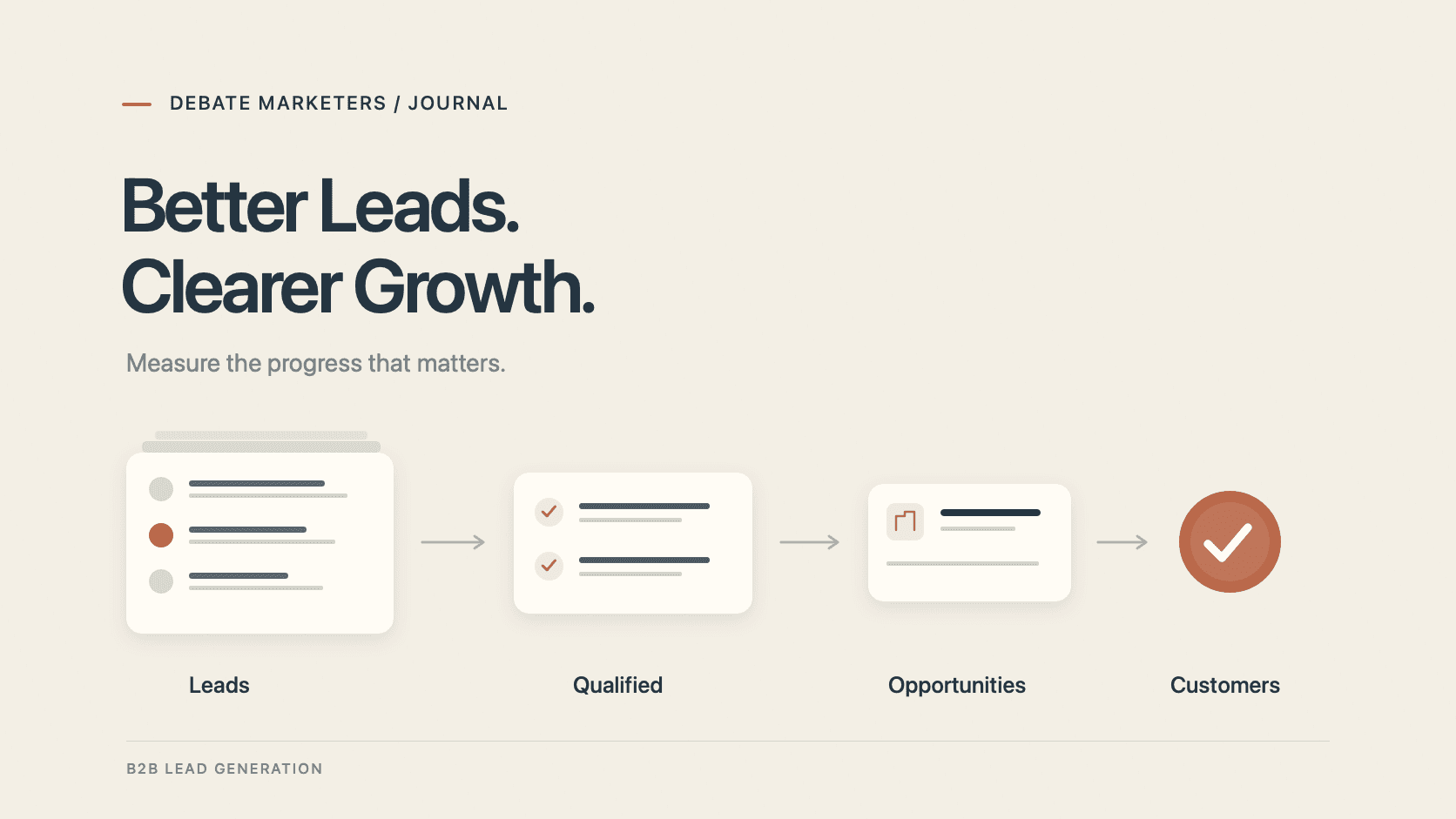
Get an AI Summary:
ChatGPT
By Debate Marketers · 7 min read
One B2B lead generation agency quotes ₹50,000 a month. Another quotes ₹75,000. Before choosing the cheaper proposal, find out who pays for the landing page, measurement setup, software and work your own team must supply.
The decision becomes clearer when every proposal answers the same questions: what will be delivered, what will the full engagement cost, what can your business afford to acquire a customer, and what happens if the arrangement falls short?
For manufacturers and owner-led firms, this is a practical way to compare agency proposals before committing to a campaign or retainer.
Give every agency the same buying brief
A paid-search campaign, an outbound appointment-setting service and a purchased contact list deliver different things. Comparing their headline cost per lead can conceal that difference.
Send each shortlisted agency a short brief covering your priority offer, target market, sales capacity, existing website and CRM, available budget, and the first business problem to solve. Ask it to explain which work it will own and which dependencies remain with you.
Agree on the meaning of an accepted lead before discussing volume commitments. If that is unresolved, use our guide to defining a qualified B2B lead first. The proposal should reference that definition and explain how disagreements will be reviewed.
This gives agencies room to recommend different approaches while making their assumptions visible.
Compare the full cost over the same period
Build one cost sheet for the proposed initial engagement. Separate recurring fees, one-off work, media spend, software and expected internal effort. Identify optional services and usage charges rather than treating every possible add-on as mandatory.
Here is a hypothetical 90-day comparison, not a client result or market price benchmark. Assume three monthly billing periods and the same media budget:
Proposal A
Agency management: ₹50,000 per month, totalling ₹150,000
Advertising spend: ₹150,000 per month, totalling ₹450,000
Required software: ₹10,000 per month, totalling ₹30,000
Landing page and measurement setup: ₹45,000 once
Total quoted marketing cost: ₹675,000
Proposal B
Agency fee, including the agreed landing page, setup and software: ₹75,000 per month, totalling ₹225,000
Advertising spend: ₹150,000 per month, totalling ₹450,000
Total quoted marketing cost: ₹675,000
The lower monthly management fee produces the same initial quoted cost. That does not make the proposals equivalent. Compare page scope, creative capacity, support and ongoing software access. Check what each costs after the initial period, when one-off charges end.
Both examples exclude taxes and internal labour. Add applicable non-recoverable taxes and your team's required work to compare economic cost; show the full invoice cash outlay separately. Confirm payment dates and whether spend is prepaid.
For Google Ads work, request platform spend separately from agency charges. Google's transparency policy requires management-fee disclosure and says reported Google advertising costs should exclude the partner's own fees.
Test the proposal against your acquisition economics
An affordable agency fee can still support an unaffordable acquisition programme.
Set an acquisition-cost ceiling using your delivery margin, cash position, likely retention and acceptable payback period. Avoid assuming every customer renews or treating contract revenue as available profit. Reserve room for the sales work required to turn an accepted lead into a customer.
For an illustrative planning calculation, suppose your business sets:
Maximum combined marketing and sales acquisition cost: ₹120,000 per new customer
Expected sales acquisition cost: ₹40,000 per customer
Remaining marketing allowance: ₹80,000 per customer
If 10% of accepted leads become customers, the implied marketing allowance is ₹8,000 per accepted lead. If that conversion rate falls to 5%, it falls to ₹4,000.
Using the initial ₹675,000 marketing cost alone, the programme would need at least nine new customers to stay within an ₹80,000 marketing allowance per customer. Additional acquisition costs would raise that requirement. At a 10% accepted-lead-to-customer rate, nine customers corresponds to 90 accepted leads in expectation, not a promise.
Ask the agency to explain the evidence behind its volume assumptions and what it would change if those assumptions fail. Where historical evidence is weak, the first engagement should reduce uncertainty before committing to a larger budget.
Do not require all those customers to close within 90 days when the sales cycle takes longer. The economics belong to the customers eventually acquired from that spend, with later acquisition costs included. Our long-sales-cycle measurement guide explains how to preserve that connection.
Turn broad deliverables into acceptance tests
“Campaign management, creative and reporting” leaves too much interpretation until after signing. Ask for a short scope schedule describing:
Campaign work: Offers, markets and channels included, plus who approves changes
Creative and pages: Deliverable quantities or agreed team capacity, formats, revision limits and publishing responsibility
Measurement: Named systems, implementation work, verification evidence and maintenance owner
Sales handoff: Who receives enquiries, who qualifies them and who follows up
Reporting: Review frequency, accessible records and decisions the report will support
For each area, write what would count as completed work. A landing page might need approved copy, a tested enquiry path and a documented handoff. “Page designed” may leave development and launch outside the fee.
Document your obligations too. Late technical approvals, unavailable product information or an unanswered sales queue can block delivery. Ask how those delays affect dates, fees and campaign spend.
Understand what the pricing model rewards
Retainers, percentage-of-spend fees and pay-per-lead arrangements can each work. Their commercial terms need different questions.
With a retainer, establish the team's capacity, priorities and process for out-of-scope work. With a percentage-of-spend fee, calculate how the fee changes at your proposed budget and who approves increases.
With pay-per-lead or pay-per-meeting, define the billable event. Does a booked meeting count if nobody attends? Are duplicate contacts from one buying project charged separately? What happens when a lead fails the agreed acceptance criteria? If contacts are supplied, ask about sourcing, exclusivity and permitted use.
For a guarantee, examine the remedy: refund, credit, replacement leads or additional work. Check the conditions and claim process. These are materially different offers, and a replacement lead does not reimburse your team's lost selling time.
Settle account access and handover before launch
List the advertising accounts, landing pages, creative files, domains, CRM records and software the engagement will use. Record who controls each, what access your business receives, and what can be retained or exported when the relationship ends. Distinguish purchased deliverables from licensed agency tools.
In Google Ads, a manager's administrative ownership does not remove the client account's data ownership, according to Google's account-ownership guidance. Verify your actual access rather than relying on a proposal's use of the word “ownership.”
Request a handover plan covering final files, documentation, access changes, outstanding work and costs. Shared tracking or billing can require preparation: Google's unlinking guidance describes dependencies that may affect measurement or ad delivery.
Use three review gates for an initial engagement
Agree these gates before work begins. The dates below are a planning structure, not a universal deadline for profitable acquisition.
By day 30: Is the agreed launch work accepted? Review actual delivery against scope, verify responsibilities and resolve missing prerequisites before increasing media spend.
By day 60: Is the engagement being delivered as bought? Compare fees and external costs with the proposal. Check whether agreed tests, creative work and sales handoffs happened. Separate agency delivery problems from dependencies your team must resolve.
By day 90: What commitment is justified next? Choose a renewal, a bounded extension, a revised scope or an orderly exit. Record the evidence, remaining uncertainty, spending limit and next review date. Our guide to a useful monthly marketing report explains the reporting foundation.
Proceed when scope, cost, access and a plausible route to affordable acquisition are clear. Hold when a material question can be resolved. Pass when the provider will not clarify charges, acceptance criteria or access. A deadline on a proposal is insufficient reason to accept an unresolved commitment.
Frequently asked questions
Should we choose the agency with the lowest fee?
Compare the full engagement cost and the work still required from your team. A lower fee can be good value when the scope fits. It can also leave necessary work unpriced.
Is a 90-day pilot long enough?
It can establish delivery quality, working relationships and early commercial evidence. Whether it establishes acquisition economics depends on sales-cycle length and the amount of usable evidence. Agree what the pilot can realistically answer.
What should we request before signing?
Ask for a written scope, complete cost schedule, lead acceptance criteria, named responsibilities, review gates, access arrangements and handover terms. Resolve important gaps before approving the commitment.
Bring the proposal into one decision
A useful agency comparison ends with a clear picture of what your business is buying, what it must contribute and what evidence would justify continuing.
Talk with Debate Marketers about the offer you want to grow and the first piece of work it needs. Start with an agreed scope, responsibilities and review point.
More articles

Framer CMS List Fields: Keep Service Pages Easy to Update
Use Framer CMS List fields for service-page FAQs and process steps. A practical guide to content structure, safe migration, editorial checks and handover.

Social Media Calendar 2027: India & Global Dates + Free Templates
Plan 2027 social content with Indian festivals, global observances, searchable monthly dates and free editable Excel and CSV calendar templates.
ChatGPT Competitor Research: Turn Evidence into a Better Brief
Use ChatGPT to research competitors, check sources and turn buyer questions into an original brand, website or campaign brief. Includes a reusable prompt.
Get an AI Summary:
ChatGPT
By Debate Marketers · 7 min read
One B2B lead generation agency quotes ₹50,000 a month. Another quotes ₹75,000. Before choosing the cheaper proposal, find out who pays for the landing page, measurement setup, software and work your own team must supply.
The decision becomes clearer when every proposal answers the same questions: what will be delivered, what will the full engagement cost, what can your business afford to acquire a customer, and what happens if the arrangement falls short?
For manufacturers and owner-led firms, this is a practical way to compare agency proposals before committing to a campaign or retainer.
Give every agency the same buying brief
A paid-search campaign, an outbound appointment-setting service and a purchased contact list deliver different things. Comparing their headline cost per lead can conceal that difference.
Send each shortlisted agency a short brief covering your priority offer, target market, sales capacity, existing website and CRM, available budget, and the first business problem to solve. Ask it to explain which work it will own and which dependencies remain with you.
Agree on the meaning of an accepted lead before discussing volume commitments. If that is unresolved, use our guide to defining a qualified B2B lead first. The proposal should reference that definition and explain how disagreements will be reviewed.
This gives agencies room to recommend different approaches while making their assumptions visible.
Compare the full cost over the same period
Build one cost sheet for the proposed initial engagement. Separate recurring fees, one-off work, media spend, software and expected internal effort. Identify optional services and usage charges rather than treating every possible add-on as mandatory.
Here is a hypothetical 90-day comparison, not a client result or market price benchmark. Assume three monthly billing periods and the same media budget:
Proposal A
Agency management: ₹50,000 per month, totalling ₹150,000
Advertising spend: ₹150,000 per month, totalling ₹450,000
Required software: ₹10,000 per month, totalling ₹30,000
Landing page and measurement setup: ₹45,000 once
Total quoted marketing cost: ₹675,000
Proposal B
Agency fee, including the agreed landing page, setup and software: ₹75,000 per month, totalling ₹225,000
Advertising spend: ₹150,000 per month, totalling ₹450,000
Total quoted marketing cost: ₹675,000
The lower monthly management fee produces the same initial quoted cost. That does not make the proposals equivalent. Compare page scope, creative capacity, support and ongoing software access. Check what each costs after the initial period, when one-off charges end.
Both examples exclude taxes and internal labour. Add applicable non-recoverable taxes and your team's required work to compare economic cost; show the full invoice cash outlay separately. Confirm payment dates and whether spend is prepaid.
For Google Ads work, request platform spend separately from agency charges. Google's transparency policy requires management-fee disclosure and says reported Google advertising costs should exclude the partner's own fees.
Test the proposal against your acquisition economics
An affordable agency fee can still support an unaffordable acquisition programme.
Set an acquisition-cost ceiling using your delivery margin, cash position, likely retention and acceptable payback period. Avoid assuming every customer renews or treating contract revenue as available profit. Reserve room for the sales work required to turn an accepted lead into a customer.
For an illustrative planning calculation, suppose your business sets:
Maximum combined marketing and sales acquisition cost: ₹120,000 per new customer
Expected sales acquisition cost: ₹40,000 per customer
Remaining marketing allowance: ₹80,000 per customer
If 10% of accepted leads become customers, the implied marketing allowance is ₹8,000 per accepted lead. If that conversion rate falls to 5%, it falls to ₹4,000.
Using the initial ₹675,000 marketing cost alone, the programme would need at least nine new customers to stay within an ₹80,000 marketing allowance per customer. Additional acquisition costs would raise that requirement. At a 10% accepted-lead-to-customer rate, nine customers corresponds to 90 accepted leads in expectation, not a promise.
Ask the agency to explain the evidence behind its volume assumptions and what it would change if those assumptions fail. Where historical evidence is weak, the first engagement should reduce uncertainty before committing to a larger budget.
Do not require all those customers to close within 90 days when the sales cycle takes longer. The economics belong to the customers eventually acquired from that spend, with later acquisition costs included. Our long-sales-cycle measurement guide explains how to preserve that connection.
Turn broad deliverables into acceptance tests
“Campaign management, creative and reporting” leaves too much interpretation until after signing. Ask for a short scope schedule describing:
Campaign work: Offers, markets and channels included, plus who approves changes
Creative and pages: Deliverable quantities or agreed team capacity, formats, revision limits and publishing responsibility
Measurement: Named systems, implementation work, verification evidence and maintenance owner
Sales handoff: Who receives enquiries, who qualifies them and who follows up
Reporting: Review frequency, accessible records and decisions the report will support
For each area, write what would count as completed work. A landing page might need approved copy, a tested enquiry path and a documented handoff. “Page designed” may leave development and launch outside the fee.
Document your obligations too. Late technical approvals, unavailable product information or an unanswered sales queue can block delivery. Ask how those delays affect dates, fees and campaign spend.
Understand what the pricing model rewards
Retainers, percentage-of-spend fees and pay-per-lead arrangements can each work. Their commercial terms need different questions.
With a retainer, establish the team's capacity, priorities and process for out-of-scope work. With a percentage-of-spend fee, calculate how the fee changes at your proposed budget and who approves increases.
With pay-per-lead or pay-per-meeting, define the billable event. Does a booked meeting count if nobody attends? Are duplicate contacts from one buying project charged separately? What happens when a lead fails the agreed acceptance criteria? If contacts are supplied, ask about sourcing, exclusivity and permitted use.
For a guarantee, examine the remedy: refund, credit, replacement leads or additional work. Check the conditions and claim process. These are materially different offers, and a replacement lead does not reimburse your team's lost selling time.
Settle account access and handover before launch
List the advertising accounts, landing pages, creative files, domains, CRM records and software the engagement will use. Record who controls each, what access your business receives, and what can be retained or exported when the relationship ends. Distinguish purchased deliverables from licensed agency tools.
In Google Ads, a manager's administrative ownership does not remove the client account's data ownership, according to Google's account-ownership guidance. Verify your actual access rather than relying on a proposal's use of the word “ownership.”
Request a handover plan covering final files, documentation, access changes, outstanding work and costs. Shared tracking or billing can require preparation: Google's unlinking guidance describes dependencies that may affect measurement or ad delivery.
Use three review gates for an initial engagement
Agree these gates before work begins. The dates below are a planning structure, not a universal deadline for profitable acquisition.
By day 30: Is the agreed launch work accepted? Review actual delivery against scope, verify responsibilities and resolve missing prerequisites before increasing media spend.
By day 60: Is the engagement being delivered as bought? Compare fees and external costs with the proposal. Check whether agreed tests, creative work and sales handoffs happened. Separate agency delivery problems from dependencies your team must resolve.
By day 90: What commitment is justified next? Choose a renewal, a bounded extension, a revised scope or an orderly exit. Record the evidence, remaining uncertainty, spending limit and next review date. Our guide to a useful monthly marketing report explains the reporting foundation.
Proceed when scope, cost, access and a plausible route to affordable acquisition are clear. Hold when a material question can be resolved. Pass when the provider will not clarify charges, acceptance criteria or access. A deadline on a proposal is insufficient reason to accept an unresolved commitment.
Frequently asked questions
Should we choose the agency with the lowest fee?
Compare the full engagement cost and the work still required from your team. A lower fee can be good value when the scope fits. It can also leave necessary work unpriced.
Is a 90-day pilot long enough?
It can establish delivery quality, working relationships and early commercial evidence. Whether it establishes acquisition economics depends on sales-cycle length and the amount of usable evidence. Agree what the pilot can realistically answer.
What should we request before signing?
Ask for a written scope, complete cost schedule, lead acceptance criteria, named responsibilities, review gates, access arrangements and handover terms. Resolve important gaps before approving the commitment.
Bring the proposal into one decision
A useful agency comparison ends with a clear picture of what your business is buying, what it must contribute and what evidence would justify continuing.
Talk with Debate Marketers about the offer you want to grow and the first piece of work it needs. Start with an agreed scope, responsibilities and review point.
More articles
Framer CMS List Fields: Keep Service Pages Easy to Update
Use Framer CMS List fields for service-page FAQs and process steps. A practical guide to content structure, safe migration, editorial checks and handover.
Social Media Calendar 2027: India & Global Dates + Free Templates
Plan 2027 social content with Indian festivals, global observances, searchable monthly dates and free editable Excel and CSV calendar templates.
ChatGPT Competitor Research: Turn Evidence into a Better Brief
Use ChatGPT to research competitors, check sources and turn buyer questions into an original brand, website or campaign brief. Includes a reusable prompt.
Get an AI Summary:
ChatGPT
By Debate Marketers · 7 min read
One B2B lead generation agency quotes ₹50,000 a month. Another quotes ₹75,000. Before choosing the cheaper proposal, find out who pays for the landing page, measurement setup, software and work your own team must supply.
The decision becomes clearer when every proposal answers the same questions: what will be delivered, what will the full engagement cost, what can your business afford to acquire a customer, and what happens if the arrangement falls short?
For manufacturers and owner-led firms, this is a practical way to compare agency proposals before committing to a campaign or retainer.
Give every agency the same buying brief
A paid-search campaign, an outbound appointment-setting service and a purchased contact list deliver different things. Comparing their headline cost per lead can conceal that difference.
Send each shortlisted agency a short brief covering your priority offer, target market, sales capacity, existing website and CRM, available budget, and the first business problem to solve. Ask it to explain which work it will own and which dependencies remain with you.
Agree on the meaning of an accepted lead before discussing volume commitments. If that is unresolved, use our guide to defining a qualified B2B lead first. The proposal should reference that definition and explain how disagreements will be reviewed.
This gives agencies room to recommend different approaches while making their assumptions visible.
Compare the full cost over the same period
Build one cost sheet for the proposed initial engagement. Separate recurring fees, one-off work, media spend, software and expected internal effort. Identify optional services and usage charges rather than treating every possible add-on as mandatory.
Here is a hypothetical 90-day comparison, not a client result or market price benchmark. Assume three monthly billing periods and the same media budget:
Proposal A
Agency management: ₹50,000 per month, totalling ₹150,000
Advertising spend: ₹150,000 per month, totalling ₹450,000
Required software: ₹10,000 per month, totalling ₹30,000
Landing page and measurement setup: ₹45,000 once
Total quoted marketing cost: ₹675,000
Proposal B
Agency fee, including the agreed landing page, setup and software: ₹75,000 per month, totalling ₹225,000
Advertising spend: ₹150,000 per month, totalling ₹450,000
Total quoted marketing cost: ₹675,000
The lower monthly management fee produces the same initial quoted cost. That does not make the proposals equivalent. Compare page scope, creative capacity, support and ongoing software access. Check what each costs after the initial period, when one-off charges end.
Both examples exclude taxes and internal labour. Add applicable non-recoverable taxes and your team's required work to compare economic cost; show the full invoice cash outlay separately. Confirm payment dates and whether spend is prepaid.
For Google Ads work, request platform spend separately from agency charges. Google's transparency policy requires management-fee disclosure and says reported Google advertising costs should exclude the partner's own fees.
Test the proposal against your acquisition economics
An affordable agency fee can still support an unaffordable acquisition programme.
Set an acquisition-cost ceiling using your delivery margin, cash position, likely retention and acceptable payback period. Avoid assuming every customer renews or treating contract revenue as available profit. Reserve room for the sales work required to turn an accepted lead into a customer.
For an illustrative planning calculation, suppose your business sets:
Maximum combined marketing and sales acquisition cost: ₹120,000 per new customer
Expected sales acquisition cost: ₹40,000 per customer
Remaining marketing allowance: ₹80,000 per customer
If 10% of accepted leads become customers, the implied marketing allowance is ₹8,000 per accepted lead. If that conversion rate falls to 5%, it falls to ₹4,000.
Using the initial ₹675,000 marketing cost alone, the programme would need at least nine new customers to stay within an ₹80,000 marketing allowance per customer. Additional acquisition costs would raise that requirement. At a 10% accepted-lead-to-customer rate, nine customers corresponds to 90 accepted leads in expectation, not a promise.
Ask the agency to explain the evidence behind its volume assumptions and what it would change if those assumptions fail. Where historical evidence is weak, the first engagement should reduce uncertainty before committing to a larger budget.
Do not require all those customers to close within 90 days when the sales cycle takes longer. The economics belong to the customers eventually acquired from that spend, with later acquisition costs included. Our long-sales-cycle measurement guide explains how to preserve that connection.
Turn broad deliverables into acceptance tests
“Campaign management, creative and reporting” leaves too much interpretation until after signing. Ask for a short scope schedule describing:
Campaign work: Offers, markets and channels included, plus who approves changes
Creative and pages: Deliverable quantities or agreed team capacity, formats, revision limits and publishing responsibility
Measurement: Named systems, implementation work, verification evidence and maintenance owner
Sales handoff: Who receives enquiries, who qualifies them and who follows up
Reporting: Review frequency, accessible records and decisions the report will support
For each area, write what would count as completed work. A landing page might need approved copy, a tested enquiry path and a documented handoff. “Page designed” may leave development and launch outside the fee.
Document your obligations too. Late technical approvals, unavailable product information or an unanswered sales queue can block delivery. Ask how those delays affect dates, fees and campaign spend.
Understand what the pricing model rewards
Retainers, percentage-of-spend fees and pay-per-lead arrangements can each work. Their commercial terms need different questions.
With a retainer, establish the team's capacity, priorities and process for out-of-scope work. With a percentage-of-spend fee, calculate how the fee changes at your proposed budget and who approves increases.
With pay-per-lead or pay-per-meeting, define the billable event. Does a booked meeting count if nobody attends? Are duplicate contacts from one buying project charged separately? What happens when a lead fails the agreed acceptance criteria? If contacts are supplied, ask about sourcing, exclusivity and permitted use.
For a guarantee, examine the remedy: refund, credit, replacement leads or additional work. Check the conditions and claim process. These are materially different offers, and a replacement lead does not reimburse your team's lost selling time.
Settle account access and handover before launch
List the advertising accounts, landing pages, creative files, domains, CRM records and software the engagement will use. Record who controls each, what access your business receives, and what can be retained or exported when the relationship ends. Distinguish purchased deliverables from licensed agency tools.
In Google Ads, a manager's administrative ownership does not remove the client account's data ownership, according to Google's account-ownership guidance. Verify your actual access rather than relying on a proposal's use of the word “ownership.”
Request a handover plan covering final files, documentation, access changes, outstanding work and costs. Shared tracking or billing can require preparation: Google's unlinking guidance describes dependencies that may affect measurement or ad delivery.
Use three review gates for an initial engagement
Agree these gates before work begins. The dates below are a planning structure, not a universal deadline for profitable acquisition.
By day 30: Is the agreed launch work accepted? Review actual delivery against scope, verify responsibilities and resolve missing prerequisites before increasing media spend.
By day 60: Is the engagement being delivered as bought? Compare fees and external costs with the proposal. Check whether agreed tests, creative work and sales handoffs happened. Separate agency delivery problems from dependencies your team must resolve.
By day 90: What commitment is justified next? Choose a renewal, a bounded extension, a revised scope or an orderly exit. Record the evidence, remaining uncertainty, spending limit and next review date. Our guide to a useful monthly marketing report explains the reporting foundation.
Proceed when scope, cost, access and a plausible route to affordable acquisition are clear. Hold when a material question can be resolved. Pass when the provider will not clarify charges, acceptance criteria or access. A deadline on a proposal is insufficient reason to accept an unresolved commitment.
Frequently asked questions
Should we choose the agency with the lowest fee?
Compare the full engagement cost and the work still required from your team. A lower fee can be good value when the scope fits. It can also leave necessary work unpriced.
Is a 90-day pilot long enough?
It can establish delivery quality, working relationships and early commercial evidence. Whether it establishes acquisition economics depends on sales-cycle length and the amount of usable evidence. Agree what the pilot can realistically answer.
What should we request before signing?
Ask for a written scope, complete cost schedule, lead acceptance criteria, named responsibilities, review gates, access arrangements and handover terms. Resolve important gaps before approving the commitment.
Bring the proposal into one decision
A useful agency comparison ends with a clear picture of what your business is buying, what it must contribute and what evidence would justify continuing.
Talk with Debate Marketers about the offer you want to grow and the first piece of work it needs. Start with an agreed scope, responsibilities and review point.
More articles
Framer CMS List Fields: Keep Service Pages Easy to Update
Use Framer CMS List fields for service-page FAQs and process steps. A practical guide to content structure, safe migration, editorial checks and handover.
Social Media Calendar 2027: India & Global Dates + Free Templates
Plan 2027 social content with Indian festivals, global observances, searchable monthly dates and free editable Excel and CSV calendar templates.
ChatGPT Competitor Research: Turn Evidence into a Better Brief
Use ChatGPT to research competitors, check sources and turn buyer questions into an original brand, website or campaign brief. Includes a reusable prompt.