Marketers
A shared team for strategy, copy, design and campaigns, every month.
Website developmentCapability pages, useful proof and a direct path to an enquiry.
BrandingPositioning, identity and sales material that explain why you're worth choosing.
SEO and AI searchGet found on Google and in AI answers by the people who buy what you make.
Performance marketingGoogle, LinkedIn and Meta ads measured on qualified enquiries.
AI automation & CRMEvery enquiry gets an owner and a next step, with human review.
 Two minutes, no email neededFind the one thing to fix firstTake the quiz→
ChatGPT Competitor Research: Turn Evidence into a Better Brief
Use ChatGPT to research competitors, check sources and turn buyer questions into an original brand, website or campaign brief. Includes a reusable prompt.
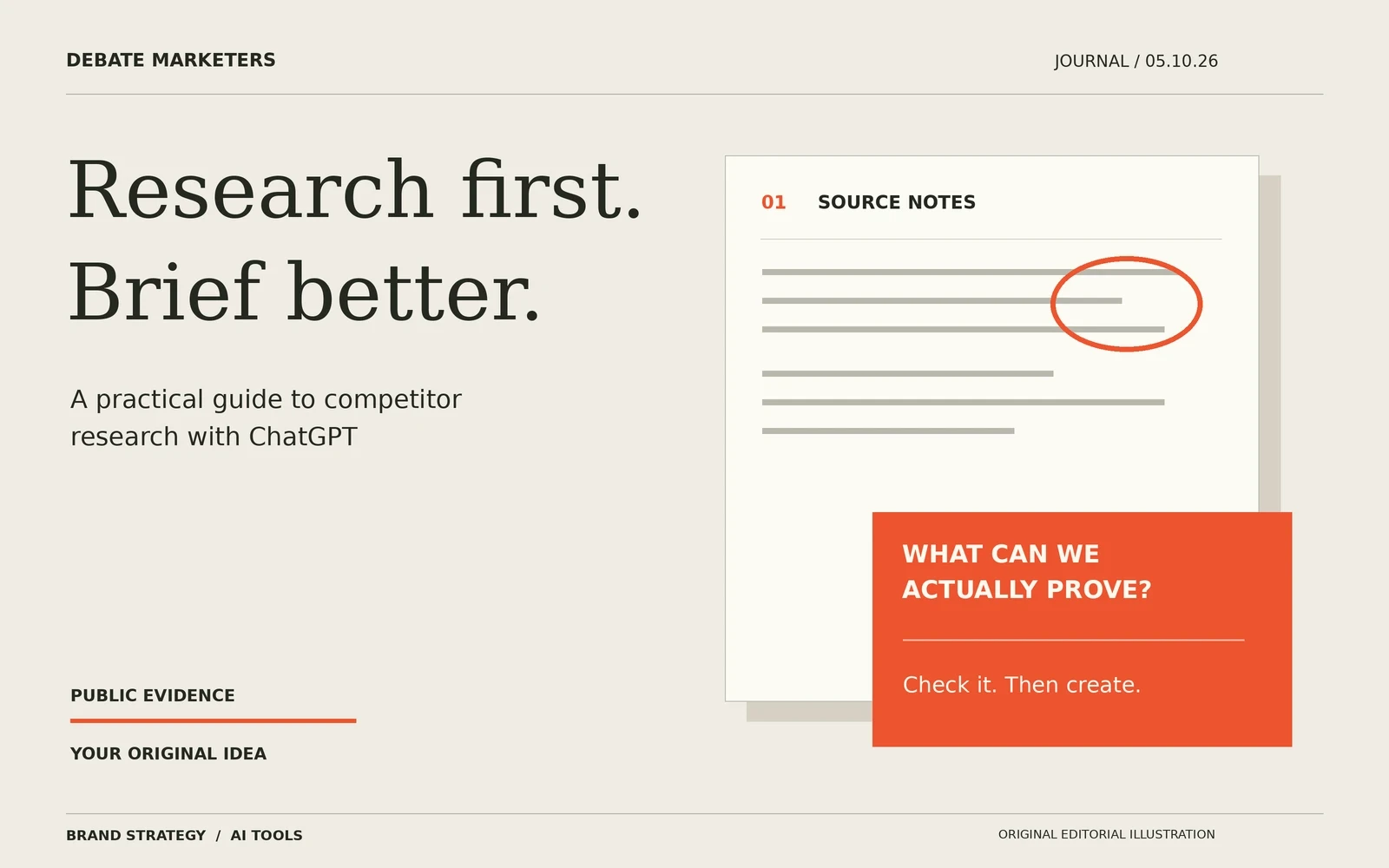
A competitor launches a sharper website. Your team collects screenshots, asks AI what makes it successful and gets a confident answer: better positioning, stronger storytelling, clearer calls to action.
Perhaps. But a public website cannot tell you how many suitable enquiries it generates. If the research starts with an assumed winner, the new brief can become a polished copy of somebody else's choices.
ChatGPT can help organise competitor research. The useful output is an evidence-backed brief: what buyers need to know, what competing businesses actually say, and what your own company can credibly do differently.
Why this is a useful AI task now
OpenAI's small-business announcement, dated 30 September 2026 on its article page, describes a partnership with America's SBDC to provide practical AI training. One example features restaurant owners Ted and Tami Taylor using ChatGPT Work to compare competitors' menu prices before changing their own. It is a vendor-published account, not evidence that the same approach will improve every business. The transferable idea is narrower: use research to inform one real decision. Read the announcement
For a marketing team, that decision could be what evidence a new service page needs, which questions a product video should answer, or whether a proposed offer is meaningfully different.
The workflow below is an editorial method, not a report of a DM client experiment.
Start with one buyer and one decision
“Analyse our competitors” is too broad. Choose a buyer, buying situation and deliverable first.
For example: “We sell office fit-out services to growing businesses in Delhi NCR. We need a service-page brief that helps an operations manager decide whether to request a consultation.” This is an illustrative business, not a Debate Marketers client.
Pick three to five relevant competitors yourself. Include businesses a customer would realistically compare, rather than simply the largest names or the most attractive websites. Keep territory, offer and customer type comparable. A global enterprise consultancy and a local installation business may solve very different buying problems.
Write down what you already know about your own delivery: scope, exclusions, process, available proof and who approves claims. Competitor research cannot supply those facts for you.
Gather evidence before asking for ideas
Use current public pages: service descriptions, product specifications, published pricing, FAQs, company announcements and case studies. Treat a company's claims as its claims, not independently verified facts.
ChatGPT Search can find web information and provide source links. OpenAI's guidance warns that results and citations may be incomplete, outdated or incorrect. Open the important links yourself. Check whether each page actually supports the statement attributed to it. Search guidance
Keep a short evidence sheet with these fields:
Company and exact page URL
Date checked, plus publication date where shown
Buyer or situation explicitly addressed
Offer, limits and next step described
Proof shown, such as a named project or documented process
Unknowns that the page does not answer
Record “price not published” rather than estimating it. Record “no delivery timeline found on the reviewed page” rather than declaring that the company is slow. Public follower counts do not establish whether a business needs marketing help.
For a deeper comparison, ChatGPT's Deep Research supports restricting or prioritising particular websites. Availability and usage depend on the account and workspace, so check the options you actually have. A small comparison can also be done with ordinary search and a manually maintained sheet. Deep Research guidance
Use this research prompt
“Compare these competitor URLs for [buyer] choosing [service] in [location]. Use current public sources. For each company, record its stated offer, limits, proof, buyer questions answered and next step. Cite the exact page for each material claim and note the date checked. Separate observation from interpretation. Mark inaccessible pages and missing facts clearly. Do not estimate revenue, enquiries, conversion rates or customer satisfaction. Finish with unanswered buyer questions worth investigating, not a ranking of the companies.”
Provide the URLs and your own approved business facts. Keep private customer records, unpublished pricing and confidential strategy out of public research queries unless your organisation has approved the data handling.
Then challenge the result: “Which conclusions rely on inference? Which citations are weak? What would we need to verify before using this in a creative brief?”
Turn a gap into a specific creative decision
Suppose the illustrative fit-out comparison finds plenty of finished-office photography but little information about working around an occupied office.
That is an observation about the pages reviewed. It does not prove that customers want a new service or that competitors cannot deliver it. Ask your own sales and delivery teams whether the question regularly comes up and what your process really supports.
If they confirm it matters, the brief becomes concrete:
Buyer question: Can the work happen without closing our office?
Evidence needed: A verified phasing plan, practical limitations and approved project photographs
Page change: A short explanation of how scheduling is agreed
Video idea: Show the sequence of an actual approved project, with its constraints
Next step: Invite the buyer to discuss their site and timing
That is more useful than “make the page premium.” It gives the writer, designer and account lead something they can check.
Our brand identity checklist helps carry the resulting message consistently across the assets you create.
Keep the final brief short enough to use
Finish with one page: audience, buying problem, supported promise, evidence, creative deliverables, next action and claim reviewer. Attach the source sheet separately.
Do not lift competitors' headlines, layouts, photography or testimonials. Extract the buyer question, then answer it using your own business's experience and original work. Avoid publishing claims such as “faster than other agencies” merely because competitors do not state their timelines.
Before release, have the relevant person check factual claims. After release, compare the enquiries with the buyer you intended to attract. Ask sales what remains unclear. A change in results can have several causes; the research document alone does not prove what caused it.
If the research will become a recurring task, our guide to choosing marketing tasks to automate can help define the review points.
The goal is not to collect the most competitor screenshots. It is to make one better-supported decision about what your brand should say and show.
Need help turning research into an original brand, website or campaign brief? Book a 30-minute call with Debate Marketers.
We plan and run admissions campaigns, websites, SEO and AI search, ads and CRM follow-up for schools, manufacturers and growing brands, from teams in New Delhi and Malta.
Published 5 October 2026.
More articles

How to Find Buyers for Export: Marketing and Branding That Win Orders
How import and export companies find buyers in 2026: buyer finder tools, trade data, B2B portals, LinkedIn and AI search, and the branding that wins orders.

AEO and GEO Best Practices for 2026: A Guide for B2B and Retail
What Google, Microsoft and OpenAI say about AEO and GEO, what studies show gets cited, and best practices for B2B pages, product feeds and measurement in 2026.

How to Choose an SEO Agency in 2026: A B2B and Retail Checklist
What to ask an SEO agency, how to score proposals, what AEO and GEO work should cover, what SEO costs in 2026 and the contract terms to agree before signing.
ChatGPT Competitor Research: Turn Evidence into a Better Brief
Use ChatGPT to research competitors, check sources and turn buyer questions into an original brand, website or campaign brief. Includes a reusable prompt.
A competitor launches a sharper website. Your team collects screenshots, asks AI what makes it successful and gets a confident answer: better positioning, stronger storytelling, clearer calls to action.
Perhaps. But a public website cannot tell you how many suitable enquiries it generates. If the research starts with an assumed winner, the new brief can become a polished copy of somebody else's choices.
ChatGPT can help organise competitor research. The useful output is an evidence-backed brief: what buyers need to know, what competing businesses actually say, and what your own company can credibly do differently.
Why this is a useful AI task now
OpenAI's small-business announcement, dated 30 September 2026 on its article page, describes a partnership with America's SBDC to provide practical AI training. One example features restaurant owners Ted and Tami Taylor using ChatGPT Work to compare competitors' menu prices before changing their own. It is a vendor-published account, not evidence that the same approach will improve every business. The transferable idea is narrower: use research to inform one real decision. Read the announcement
For a marketing team, that decision could be what evidence a new service page needs, which questions a product video should answer, or whether a proposed offer is meaningfully different.
The workflow below is an editorial method, not a report of a DM client experiment.
Start with one buyer and one decision
“Analyse our competitors” is too broad. Choose a buyer, buying situation and deliverable first.
For example: “We sell office fit-out services to growing businesses in Delhi NCR. We need a service-page brief that helps an operations manager decide whether to request a consultation.” This is an illustrative business, not a Debate Marketers client.
Pick three to five relevant competitors yourself. Include businesses a customer would realistically compare, rather than simply the largest names or the most attractive websites. Keep territory, offer and customer type comparable. A global enterprise consultancy and a local installation business may solve very different buying problems.
Write down what you already know about your own delivery: scope, exclusions, process, available proof and who approves claims. Competitor research cannot supply those facts for you.
Gather evidence before asking for ideas
Use current public pages: service descriptions, product specifications, published pricing, FAQs, company announcements and case studies. Treat a company's claims as its claims, not independently verified facts.
ChatGPT Search can find web information and provide source links. OpenAI's guidance warns that results and citations may be incomplete, outdated or incorrect. Open the important links yourself. Check whether each page actually supports the statement attributed to it. Search guidance
Keep a short evidence sheet with these fields:
Company and exact page URL
Date checked, plus publication date where shown
Buyer or situation explicitly addressed
Offer, limits and next step described
Proof shown, such as a named project or documented process
Unknowns that the page does not answer
Record “price not published” rather than estimating it. Record “no delivery timeline found on the reviewed page” rather than declaring that the company is slow. Public follower counts do not establish whether a business needs marketing help.
For a deeper comparison, ChatGPT's Deep Research supports restricting or prioritising particular websites. Availability and usage depend on the account and workspace, so check the options you actually have. A small comparison can also be done with ordinary search and a manually maintained sheet. Deep Research guidance
Use this research prompt
“Compare these competitor URLs for [buyer] choosing [service] in [location]. Use current public sources. For each company, record its stated offer, limits, proof, buyer questions answered and next step. Cite the exact page for each material claim and note the date checked. Separate observation from interpretation. Mark inaccessible pages and missing facts clearly. Do not estimate revenue, enquiries, conversion rates or customer satisfaction. Finish with unanswered buyer questions worth investigating, not a ranking of the companies.”
Provide the URLs and your own approved business facts. Keep private customer records, unpublished pricing and confidential strategy out of public research queries unless your organisation has approved the data handling.
Then challenge the result: “Which conclusions rely on inference? Which citations are weak? What would we need to verify before using this in a creative brief?”
Turn a gap into a specific creative decision
Suppose the illustrative fit-out comparison finds plenty of finished-office photography but little information about working around an occupied office.
That is an observation about the pages reviewed. It does not prove that customers want a new service or that competitors cannot deliver it. Ask your own sales and delivery teams whether the question regularly comes up and what your process really supports.
If they confirm it matters, the brief becomes concrete:
Buyer question: Can the work happen without closing our office?
Evidence needed: A verified phasing plan, practical limitations and approved project photographs
Page change: A short explanation of how scheduling is agreed
Video idea: Show the sequence of an actual approved project, with its constraints
Next step: Invite the buyer to discuss their site and timing
That is more useful than “make the page premium.” It gives the writer, designer and account lead something they can check.
Our brand identity checklist helps carry the resulting message consistently across the assets you create.
Keep the final brief short enough to use
Finish with one page: audience, buying problem, supported promise, evidence, creative deliverables, next action and claim reviewer. Attach the source sheet separately.
Do not lift competitors' headlines, layouts, photography or testimonials. Extract the buyer question, then answer it using your own business's experience and original work. Avoid publishing claims such as “faster than other agencies” merely because competitors do not state their timelines.
Before release, have the relevant person check factual claims. After release, compare the enquiries with the buyer you intended to attract. Ask sales what remains unclear. A change in results can have several causes; the research document alone does not prove what caused it.
If the research will become a recurring task, our guide to choosing marketing tasks to automate can help define the review points.
The goal is not to collect the most competitor screenshots. It is to make one better-supported decision about what your brand should say and show.
Need help turning research into an original brand, website or campaign brief? Book a 30-minute call with Debate Marketers.
We plan and run admissions campaigns, websites, SEO and AI search, ads and CRM follow-up for schools, manufacturers and growing brands, from teams in New Delhi and Malta.
Published 5 October 2026.
More articles
How to Find Buyers for Export: Marketing and Branding That Win Orders
How import and export companies find buyers in 2026: buyer finder tools, trade data, B2B portals, LinkedIn and AI search, and the branding that wins orders.
AEO and GEO Best Practices for 2026: A Guide for B2B and Retail
What Google, Microsoft and OpenAI say about AEO and GEO, what studies show gets cited, and best practices for B2B pages, product feeds and measurement in 2026.
How to Choose an SEO Agency in 2026: A B2B and Retail Checklist
What to ask an SEO agency, how to score proposals, what AEO and GEO work should cover, what SEO costs in 2026 and the contract terms to agree before signing.
ChatGPT Competitor Research: Turn Evidence into a Better Brief
Use ChatGPT to research competitors, check sources and turn buyer questions into an original brand, website or campaign brief. Includes a reusable prompt.
A competitor launches a sharper website. Your team collects screenshots, asks AI what makes it successful and gets a confident answer: better positioning, stronger storytelling, clearer calls to action.
Perhaps. But a public website cannot tell you how many suitable enquiries it generates. If the research starts with an assumed winner, the new brief can become a polished copy of somebody else's choices.
ChatGPT can help organise competitor research. The useful output is an evidence-backed brief: what buyers need to know, what competing businesses actually say, and what your own company can credibly do differently.
Why this is a useful AI task now
OpenAI's small-business announcement, dated 30 September 2026 on its article page, describes a partnership with America's SBDC to provide practical AI training. One example features restaurant owners Ted and Tami Taylor using ChatGPT Work to compare competitors' menu prices before changing their own. It is a vendor-published account, not evidence that the same approach will improve every business. The transferable idea is narrower: use research to inform one real decision. Read the announcement
For a marketing team, that decision could be what evidence a new service page needs, which questions a product video should answer, or whether a proposed offer is meaningfully different.
The workflow below is an editorial method, not a report of a DM client experiment.
Start with one buyer and one decision
“Analyse our competitors” is too broad. Choose a buyer, buying situation and deliverable first.
For example: “We sell office fit-out services to growing businesses in Delhi NCR. We need a service-page brief that helps an operations manager decide whether to request a consultation.” This is an illustrative business, not a Debate Marketers client.
Pick three to five relevant competitors yourself. Include businesses a customer would realistically compare, rather than simply the largest names or the most attractive websites. Keep territory, offer and customer type comparable. A global enterprise consultancy and a local installation business may solve very different buying problems.
Write down what you already know about your own delivery: scope, exclusions, process, available proof and who approves claims. Competitor research cannot supply those facts for you.
Gather evidence before asking for ideas
Use current public pages: service descriptions, product specifications, published pricing, FAQs, company announcements and case studies. Treat a company's claims as its claims, not independently verified facts.
ChatGPT Search can find web information and provide source links. OpenAI's guidance warns that results and citations may be incomplete, outdated or incorrect. Open the important links yourself. Check whether each page actually supports the statement attributed to it. Search guidance
Keep a short evidence sheet with these fields:
Company and exact page URL
Date checked, plus publication date where shown
Buyer or situation explicitly addressed
Offer, limits and next step described
Proof shown, such as a named project or documented process
Unknowns that the page does not answer
Record “price not published” rather than estimating it. Record “no delivery timeline found on the reviewed page” rather than declaring that the company is slow. Public follower counts do not establish whether a business needs marketing help.
For a deeper comparison, ChatGPT's Deep Research supports restricting or prioritising particular websites. Availability and usage depend on the account and workspace, so check the options you actually have. A small comparison can also be done with ordinary search and a manually maintained sheet. Deep Research guidance
Use this research prompt
“Compare these competitor URLs for [buyer] choosing [service] in [location]. Use current public sources. For each company, record its stated offer, limits, proof, buyer questions answered and next step. Cite the exact page for each material claim and note the date checked. Separate observation from interpretation. Mark inaccessible pages and missing facts clearly. Do not estimate revenue, enquiries, conversion rates or customer satisfaction. Finish with unanswered buyer questions worth investigating, not a ranking of the companies.”
Provide the URLs and your own approved business facts. Keep private customer records, unpublished pricing and confidential strategy out of public research queries unless your organisation has approved the data handling.
Then challenge the result: “Which conclusions rely on inference? Which citations are weak? What would we need to verify before using this in a creative brief?”
Turn a gap into a specific creative decision
Suppose the illustrative fit-out comparison finds plenty of finished-office photography but little information about working around an occupied office.
That is an observation about the pages reviewed. It does not prove that customers want a new service or that competitors cannot deliver it. Ask your own sales and delivery teams whether the question regularly comes up and what your process really supports.
If they confirm it matters, the brief becomes concrete:
Buyer question: Can the work happen without closing our office?
Evidence needed: A verified phasing plan, practical limitations and approved project photographs
Page change: A short explanation of how scheduling is agreed
Video idea: Show the sequence of an actual approved project, with its constraints
Next step: Invite the buyer to discuss their site and timing
That is more useful than “make the page premium.” It gives the writer, designer and account lead something they can check.
Our brand identity checklist helps carry the resulting message consistently across the assets you create.
Keep the final brief short enough to use
Finish with one page: audience, buying problem, supported promise, evidence, creative deliverables, next action and claim reviewer. Attach the source sheet separately.
Do not lift competitors' headlines, layouts, photography or testimonials. Extract the buyer question, then answer it using your own business's experience and original work. Avoid publishing claims such as “faster than other agencies” merely because competitors do not state their timelines.
Before release, have the relevant person check factual claims. After release, compare the enquiries with the buyer you intended to attract. Ask sales what remains unclear. A change in results can have several causes; the research document alone does not prove what caused it.
If the research will become a recurring task, our guide to choosing marketing tasks to automate can help define the review points.
The goal is not to collect the most competitor screenshots. It is to make one better-supported decision about what your brand should say and show.
Need help turning research into an original brand, website or campaign brief? Book a 30-minute call with Debate Marketers.
We plan and run admissions campaigns, websites, SEO and AI search, ads and CRM follow-up for schools, manufacturers and growing brands, from teams in New Delhi and Malta.
Published 5 October 2026.
More articles
How to Find Buyers for Export: Marketing and Branding That Win Orders
How import and export companies find buyers in 2026: buyer finder tools, trade data, B2B portals, LinkedIn and AI search, and the branding that wins orders.
AEO and GEO Best Practices for 2026: A Guide for B2B and Retail
What Google, Microsoft and OpenAI say about AEO and GEO, what studies show gets cited, and best practices for B2B pages, product feeds and measurement in 2026.
How to Choose an SEO Agency in 2026: A B2B and Retail Checklist
What to ask an SEO agency, how to score proposals, what AEO and GEO work should cover, what SEO costs in 2026 and the contract terms to agree before signing.
Bring your first priority.
Bring one problem: a brand that's drifted, a website that doesn't sell or enquiries going nowhere. We'll spend 30 minutes finding the first fix.
Projects & shared-team retainers
Bring your first priority.
Bring one problem: a brand that's drifted, a website that doesn't sell or enquiries going nowhere. We'll spend 30 minutes finding the first fix.
Projects & shared-team retainers