Marketers
A shared team for strategy, copy, design and campaigns, every month.
Website developmentCapability pages, useful proof and a direct path to an enquiry.
BrandingPositioning, identity and sales material that explain why you're worth choosing.
SEO and AI searchGet found on Google and in AI answers by the people who buy what you make.
Performance marketingGoogle, LinkedIn and Meta ads measured on qualified enquiries.
AI automation & CRMEvery enquiry gets an owner and a next step, with human review.
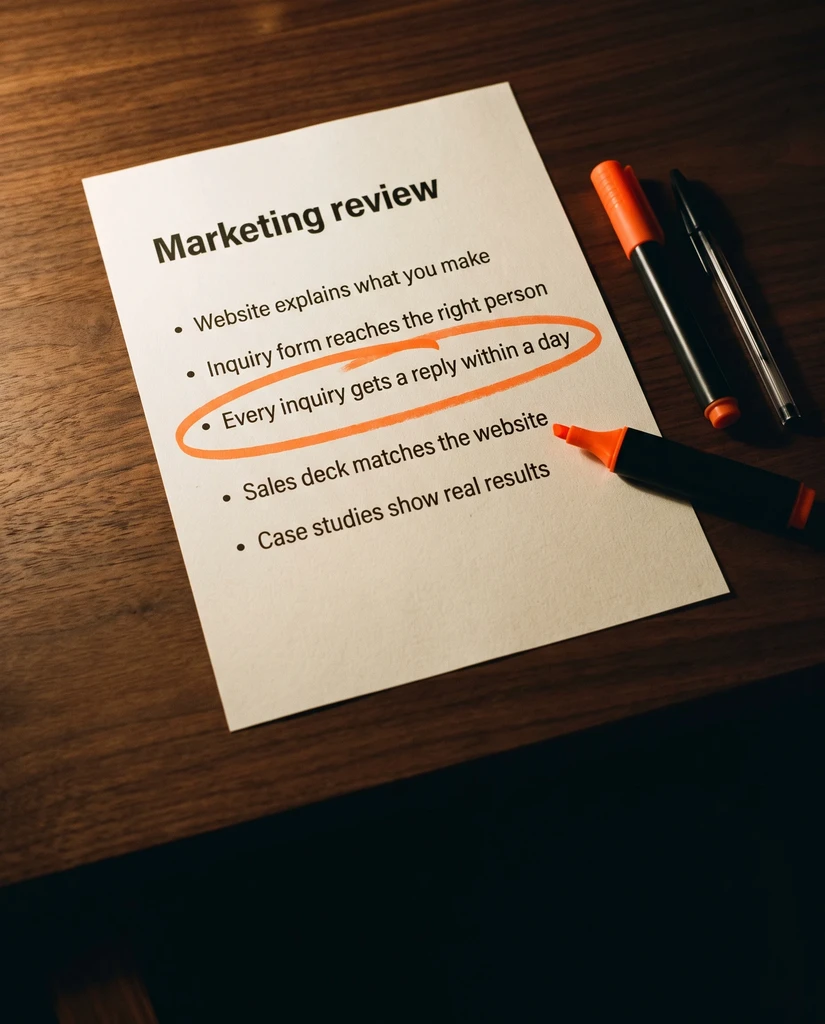 Two minutes, no email neededFind the one thing to fix firstTake the quiz→
Google AI Max Reporting: Follow the Search All the Way to the Sale
Audit Google AI Max search terms, ad claims and landing pages together. A practical B2B workflow for checking lead quality and fixing mismatched journeys.

A buyer searches for a production supplier. The ad promises a fast quote. The click lands on a broad capabilities page. Sales receives a request for a service the company does not offer.
Each part can look reasonable in a separate report. Put the search, message and destination beside one another, and the problem becomes easier to see.
Google's 23 September 2026 AI Max announcement puts that connected view in focus. Google described reporting that would bring search terms, creative assets and landing destinations together, with more availability details to follow later in the year. Its current Help Centre also documents a search-term-and-ad-combination view. Check the options in your own account before building a workflow around a particular screen. Google's announcement · AI Max reporting guidance
For a B2B advertiser, the useful question is simple: did the search, ad and page describe the same buying situation, and did that situation produce a lead sales could use?
Why the whole journey needs a review
AI Max combines search-term matching with asset optimisation. It can extend reach beyond the keywords you supplied, customise ad text and, when enabled, send a visitor to a different relevant page on your site. These are separate settings to understand before you judge the result. How AI Max works
That flexibility creates more combinations to check. A page that accurately describes one part of your business might be unsuitable for a particular campaign. A headline can be factually defensible yet omit a condition that matters to the buyer.
Consider a fictional metal fabricator that accepts production runs but does not repair household items. A query about “stainless steel fabrication” is ambiguous. The visitor's application, quantity and expectations determine whether the enquiry fits. Automatically excluding every broad term could remove useful demand; accepting every form submission as a success could hide wasted sales time.
Review the chain with someone who understands what the business can actually supply.
Start with a small, readable audit
Choose one product family or service and a period that gives sales enough time to assess the resulting enquiries. Begin with the journeys that account for meaningful spend, plus a sample associated with rejected leads. Keep the sample size manageable enough to investigate each case.
Google's reporting guidance describes a combined view under the Search terms dropdown, alongside separate asset and landing-page reports. Where available, use the combined view to inspect the search term, headline and destination together. Record only combinations the account actually shows. If you export separate reports, do not join them by date or campaign and assume you have reconstructed an individual journey. Reporting options
Your working sheet needs six things:
The search term and the campaign or ad group it belongs to
The headline or asset combination, where reported
The actual landing destination
Spend and the conversion event being counted
The relevant sales outcome, where it can be connected reliably
The finding, proposed change and person responsible
Leave missing information visibly missing. A neat spreadsheet is less useful than an honest one.
Ask three questions before changing targeting
Can this buyer become a suitable customer?
Read the search as a buying task. Is the person sourcing a component, comparing production processes, looking for a repair or applying for a job? Could the company serve the apparent location, application and order size?
Separate a clearly unsuitable request from an early-stage but relevant one. A researcher may need a technical explanation before they can brief procurement. The right response could be a better destination rather than a negative keyword.
Agree on the boundary with sales. Our guide to defining a qualified B2B lead explains how to make that decision consistent.
Does the ad promise something the team can deliver?
Check words with commercial consequences: “instant,” “certified,” “in stock,” “custom,” “nationwide” and “guaranteed.” Ask whether the statement is true for this offer and whether a necessary condition has disappeared.
If a quotation requires engineering review, an instant-quote headline creates the wrong expectation. Fix the message and the source material that may have encouraged it. Give technical claims an accountable reviewer.
Do not rely on a pinned headline without checking the configuration. Google's setup guidance says pinned responsive-search-ad assets are not respected when Final URL expansion or URL inclusions are enabled. Campaigns with essential wording need a deliberate settings review. AI Max setup guidance
Does the destination help the buyer take the next step?
Open the actual page on a phone. Can a visitor confirm the relevant capability, find its limits and understand how to make contact? Check whether a discontinued product, recruitment page or broad company overview has become an unintended destination.
A page can be useful for organic discovery and still be a poor destination for a specific paid offer. Decide which pages are appropriate before applying exclusions. Google's URL controls operate at different levels; review their current behaviour rather than treating an inclusion list as a universal lock on destinations. URL controls
For an appropriate page that needs work, use a paid-media landing-page brief to connect the promise, evidence and next step.
Add the sales outcome without inventing precision
The ad report can help explain what brought someone to the site. Your CRM is where the team should record whether that enquiry became a viable opportunity.
For the fabricator, useful rejection reasons might include household repair, unsupported material or an order outside its workable range. “Bad lead” is too vague to guide a change. Equally, an open opportunity should remain open rather than being treated as lost because it has not ordered yet.
Use a verified connection between campaign records and CRM events where your setup supports it. Otherwise, review outcomes at the campaign, landing-page or cohort level and state the limitation. Do not assign a named buyer to a search term through guesswork.
Compare groups of leads that have had similar time to progress. Keep this review separate from a claim that AI Max caused additional sales; that question requires an appropriate test. The longer measurement process is covered in connecting Google Ads enquiries to sales outcomes.
Fix the specific break and check again
Match the action to the finding. An unsuitable search may justify a carefully scoped negative keyword. An unsupported claim needs a copy correction. An inappropriate destination may need a URL exclusion. A relevant visitor leaving an unclear page calls for a page improvement.
Check tracking too. Google warns that incompatible tracking templates can break dynamically selected landing URLs. Test the expanded destinations through the configured tracking path, rather than checking only the clean URL in a browser. Tracking-template guidance
Keep a dated change log and avoid changing the budget, offer, page and targeting together when you want to learn which correction helped. Set the next review around your lead-assessment cycle, with the same conversion definitions and a clear view of unresolved enquiries.
Google recommends allowing at least two weeks after enabling AI Max before routine optimisation changes. That learning period should not become a reason to leave a broken page or an inaccurate business claim in place. Also remember that filtering search terms to AI Max omits “Other search terms,” so the visible rows do not represent every search. Reporting guidance
The first useful deliverable is a short list of evidenced mismatches and the people who will fix them. Once the search, message and destination agree, the sales team has a better basis for judging whether the enquiries are worth pursuing.
Need help reviewing that chain? Talk with Debate Marketers about your Search campaigns, landing pages and lead-quality measurement.
We plan and run admissions campaigns, websites, SEO and AI search, ads and CRM follow-up for schools, manufacturers and growing brands, from teams in New Delhi and Malta.
Published 4 October 2026.
More articles

How to Find Buyers for Export: Marketing and Branding That Win Orders
How import and export companies find buyers in 2026: buyer finder tools, trade data, B2B portals, LinkedIn and AI search, and the branding that wins orders.

AEO and GEO Best Practices for 2026: A Guide for B2B and Retail
What Google, Microsoft and OpenAI say about AEO and GEO, what studies show gets cited, and best practices for B2B pages, product feeds and measurement in 2026.

How to Choose an SEO Agency in 2026: A B2B and Retail Checklist
What to ask an SEO agency, how to score proposals, what AEO and GEO work should cover, what SEO costs in 2026 and the contract terms to agree before signing.
Google AI Max Reporting: Follow the Search All the Way to the Sale
Audit Google AI Max search terms, ad claims and landing pages together. A practical B2B workflow for checking lead quality and fixing mismatched journeys.
A buyer searches for a production supplier. The ad promises a fast quote. The click lands on a broad capabilities page. Sales receives a request for a service the company does not offer.
Each part can look reasonable in a separate report. Put the search, message and destination beside one another, and the problem becomes easier to see.
Google's 23 September 2026 AI Max announcement puts that connected view in focus. Google described reporting that would bring search terms, creative assets and landing destinations together, with more availability details to follow later in the year. Its current Help Centre also documents a search-term-and-ad-combination view. Check the options in your own account before building a workflow around a particular screen. Google's announcement · AI Max reporting guidance
For a B2B advertiser, the useful question is simple: did the search, ad and page describe the same buying situation, and did that situation produce a lead sales could use?
Why the whole journey needs a review
AI Max combines search-term matching with asset optimisation. It can extend reach beyond the keywords you supplied, customise ad text and, when enabled, send a visitor to a different relevant page on your site. These are separate settings to understand before you judge the result. How AI Max works
That flexibility creates more combinations to check. A page that accurately describes one part of your business might be unsuitable for a particular campaign. A headline can be factually defensible yet omit a condition that matters to the buyer.
Consider a fictional metal fabricator that accepts production runs but does not repair household items. A query about “stainless steel fabrication” is ambiguous. The visitor's application, quantity and expectations determine whether the enquiry fits. Automatically excluding every broad term could remove useful demand; accepting every form submission as a success could hide wasted sales time.
Review the chain with someone who understands what the business can actually supply.
Start with a small, readable audit
Choose one product family or service and a period that gives sales enough time to assess the resulting enquiries. Begin with the journeys that account for meaningful spend, plus a sample associated with rejected leads. Keep the sample size manageable enough to investigate each case.
Google's reporting guidance describes a combined view under the Search terms dropdown, alongside separate asset and landing-page reports. Where available, use the combined view to inspect the search term, headline and destination together. Record only combinations the account actually shows. If you export separate reports, do not join them by date or campaign and assume you have reconstructed an individual journey. Reporting options
Your working sheet needs six things:
The search term and the campaign or ad group it belongs to
The headline or asset combination, where reported
The actual landing destination
Spend and the conversion event being counted
The relevant sales outcome, where it can be connected reliably
The finding, proposed change and person responsible
Leave missing information visibly missing. A neat spreadsheet is less useful than an honest one.
Ask three questions before changing targeting
Can this buyer become a suitable customer?
Read the search as a buying task. Is the person sourcing a component, comparing production processes, looking for a repair or applying for a job? Could the company serve the apparent location, application and order size?
Separate a clearly unsuitable request from an early-stage but relevant one. A researcher may need a technical explanation before they can brief procurement. The right response could be a better destination rather than a negative keyword.
Agree on the boundary with sales. Our guide to defining a qualified B2B lead explains how to make that decision consistent.
Does the ad promise something the team can deliver?
Check words with commercial consequences: “instant,” “certified,” “in stock,” “custom,” “nationwide” and “guaranteed.” Ask whether the statement is true for this offer and whether a necessary condition has disappeared.
If a quotation requires engineering review, an instant-quote headline creates the wrong expectation. Fix the message and the source material that may have encouraged it. Give technical claims an accountable reviewer.
Do not rely on a pinned headline without checking the configuration. Google's setup guidance says pinned responsive-search-ad assets are not respected when Final URL expansion or URL inclusions are enabled. Campaigns with essential wording need a deliberate settings review. AI Max setup guidance
Does the destination help the buyer take the next step?
Open the actual page on a phone. Can a visitor confirm the relevant capability, find its limits and understand how to make contact? Check whether a discontinued product, recruitment page or broad company overview has become an unintended destination.
A page can be useful for organic discovery and still be a poor destination for a specific paid offer. Decide which pages are appropriate before applying exclusions. Google's URL controls operate at different levels; review their current behaviour rather than treating an inclusion list as a universal lock on destinations. URL controls
For an appropriate page that needs work, use a paid-media landing-page brief to connect the promise, evidence and next step.
Add the sales outcome without inventing precision
The ad report can help explain what brought someone to the site. Your CRM is where the team should record whether that enquiry became a viable opportunity.
For the fabricator, useful rejection reasons might include household repair, unsupported material or an order outside its workable range. “Bad lead” is too vague to guide a change. Equally, an open opportunity should remain open rather than being treated as lost because it has not ordered yet.
Use a verified connection between campaign records and CRM events where your setup supports it. Otherwise, review outcomes at the campaign, landing-page or cohort level and state the limitation. Do not assign a named buyer to a search term through guesswork.
Compare groups of leads that have had similar time to progress. Keep this review separate from a claim that AI Max caused additional sales; that question requires an appropriate test. The longer measurement process is covered in connecting Google Ads enquiries to sales outcomes.
Fix the specific break and check again
Match the action to the finding. An unsuitable search may justify a carefully scoped negative keyword. An unsupported claim needs a copy correction. An inappropriate destination may need a URL exclusion. A relevant visitor leaving an unclear page calls for a page improvement.
Check tracking too. Google warns that incompatible tracking templates can break dynamically selected landing URLs. Test the expanded destinations through the configured tracking path, rather than checking only the clean URL in a browser. Tracking-template guidance
Keep a dated change log and avoid changing the budget, offer, page and targeting together when you want to learn which correction helped. Set the next review around your lead-assessment cycle, with the same conversion definitions and a clear view of unresolved enquiries.
Google recommends allowing at least two weeks after enabling AI Max before routine optimisation changes. That learning period should not become a reason to leave a broken page or an inaccurate business claim in place. Also remember that filtering search terms to AI Max omits “Other search terms,” so the visible rows do not represent every search. Reporting guidance
The first useful deliverable is a short list of evidenced mismatches and the people who will fix them. Once the search, message and destination agree, the sales team has a better basis for judging whether the enquiries are worth pursuing.
Need help reviewing that chain? Talk with Debate Marketers about your Search campaigns, landing pages and lead-quality measurement.
We plan and run admissions campaigns, websites, SEO and AI search, ads and CRM follow-up for schools, manufacturers and growing brands, from teams in New Delhi and Malta.
Published 4 October 2026.
More articles
How to Find Buyers for Export: Marketing and Branding That Win Orders
How import and export companies find buyers in 2026: buyer finder tools, trade data, B2B portals, LinkedIn and AI search, and the branding that wins orders.
AEO and GEO Best Practices for 2026: A Guide for B2B and Retail
What Google, Microsoft and OpenAI say about AEO and GEO, what studies show gets cited, and best practices for B2B pages, product feeds and measurement in 2026.
How to Choose an SEO Agency in 2026: A B2B and Retail Checklist
What to ask an SEO agency, how to score proposals, what AEO and GEO work should cover, what SEO costs in 2026 and the contract terms to agree before signing.
Google AI Max Reporting: Follow the Search All the Way to the Sale
Audit Google AI Max search terms, ad claims and landing pages together. A practical B2B workflow for checking lead quality and fixing mismatched journeys.
A buyer searches for a production supplier. The ad promises a fast quote. The click lands on a broad capabilities page. Sales receives a request for a service the company does not offer.
Each part can look reasonable in a separate report. Put the search, message and destination beside one another, and the problem becomes easier to see.
Google's 23 September 2026 AI Max announcement puts that connected view in focus. Google described reporting that would bring search terms, creative assets and landing destinations together, with more availability details to follow later in the year. Its current Help Centre also documents a search-term-and-ad-combination view. Check the options in your own account before building a workflow around a particular screen. Google's announcement · AI Max reporting guidance
For a B2B advertiser, the useful question is simple: did the search, ad and page describe the same buying situation, and did that situation produce a lead sales could use?
Why the whole journey needs a review
AI Max combines search-term matching with asset optimisation. It can extend reach beyond the keywords you supplied, customise ad text and, when enabled, send a visitor to a different relevant page on your site. These are separate settings to understand before you judge the result. How AI Max works
That flexibility creates more combinations to check. A page that accurately describes one part of your business might be unsuitable for a particular campaign. A headline can be factually defensible yet omit a condition that matters to the buyer.
Consider a fictional metal fabricator that accepts production runs but does not repair household items. A query about “stainless steel fabrication” is ambiguous. The visitor's application, quantity and expectations determine whether the enquiry fits. Automatically excluding every broad term could remove useful demand; accepting every form submission as a success could hide wasted sales time.
Review the chain with someone who understands what the business can actually supply.
Start with a small, readable audit
Choose one product family or service and a period that gives sales enough time to assess the resulting enquiries. Begin with the journeys that account for meaningful spend, plus a sample associated with rejected leads. Keep the sample size manageable enough to investigate each case.
Google's reporting guidance describes a combined view under the Search terms dropdown, alongside separate asset and landing-page reports. Where available, use the combined view to inspect the search term, headline and destination together. Record only combinations the account actually shows. If you export separate reports, do not join them by date or campaign and assume you have reconstructed an individual journey. Reporting options
Your working sheet needs six things:
The search term and the campaign or ad group it belongs to
The headline or asset combination, where reported
The actual landing destination
Spend and the conversion event being counted
The relevant sales outcome, where it can be connected reliably
The finding, proposed change and person responsible
Leave missing information visibly missing. A neat spreadsheet is less useful than an honest one.
Ask three questions before changing targeting
Can this buyer become a suitable customer?
Read the search as a buying task. Is the person sourcing a component, comparing production processes, looking for a repair or applying for a job? Could the company serve the apparent location, application and order size?
Separate a clearly unsuitable request from an early-stage but relevant one. A researcher may need a technical explanation before they can brief procurement. The right response could be a better destination rather than a negative keyword.
Agree on the boundary with sales. Our guide to defining a qualified B2B lead explains how to make that decision consistent.
Does the ad promise something the team can deliver?
Check words with commercial consequences: “instant,” “certified,” “in stock,” “custom,” “nationwide” and “guaranteed.” Ask whether the statement is true for this offer and whether a necessary condition has disappeared.
If a quotation requires engineering review, an instant-quote headline creates the wrong expectation. Fix the message and the source material that may have encouraged it. Give technical claims an accountable reviewer.
Do not rely on a pinned headline without checking the configuration. Google's setup guidance says pinned responsive-search-ad assets are not respected when Final URL expansion or URL inclusions are enabled. Campaigns with essential wording need a deliberate settings review. AI Max setup guidance
Does the destination help the buyer take the next step?
Open the actual page on a phone. Can a visitor confirm the relevant capability, find its limits and understand how to make contact? Check whether a discontinued product, recruitment page or broad company overview has become an unintended destination.
A page can be useful for organic discovery and still be a poor destination for a specific paid offer. Decide which pages are appropriate before applying exclusions. Google's URL controls operate at different levels; review their current behaviour rather than treating an inclusion list as a universal lock on destinations. URL controls
For an appropriate page that needs work, use a paid-media landing-page brief to connect the promise, evidence and next step.
Add the sales outcome without inventing precision
The ad report can help explain what brought someone to the site. Your CRM is where the team should record whether that enquiry became a viable opportunity.
For the fabricator, useful rejection reasons might include household repair, unsupported material or an order outside its workable range. “Bad lead” is too vague to guide a change. Equally, an open opportunity should remain open rather than being treated as lost because it has not ordered yet.
Use a verified connection between campaign records and CRM events where your setup supports it. Otherwise, review outcomes at the campaign, landing-page or cohort level and state the limitation. Do not assign a named buyer to a search term through guesswork.
Compare groups of leads that have had similar time to progress. Keep this review separate from a claim that AI Max caused additional sales; that question requires an appropriate test. The longer measurement process is covered in connecting Google Ads enquiries to sales outcomes.
Fix the specific break and check again
Match the action to the finding. An unsuitable search may justify a carefully scoped negative keyword. An unsupported claim needs a copy correction. An inappropriate destination may need a URL exclusion. A relevant visitor leaving an unclear page calls for a page improvement.
Check tracking too. Google warns that incompatible tracking templates can break dynamically selected landing URLs. Test the expanded destinations through the configured tracking path, rather than checking only the clean URL in a browser. Tracking-template guidance
Keep a dated change log and avoid changing the budget, offer, page and targeting together when you want to learn which correction helped. Set the next review around your lead-assessment cycle, with the same conversion definitions and a clear view of unresolved enquiries.
Google recommends allowing at least two weeks after enabling AI Max before routine optimisation changes. That learning period should not become a reason to leave a broken page or an inaccurate business claim in place. Also remember that filtering search terms to AI Max omits “Other search terms,” so the visible rows do not represent every search. Reporting guidance
The first useful deliverable is a short list of evidenced mismatches and the people who will fix them. Once the search, message and destination agree, the sales team has a better basis for judging whether the enquiries are worth pursuing.
Need help reviewing that chain? Talk with Debate Marketers about your Search campaigns, landing pages and lead-quality measurement.
We plan and run admissions campaigns, websites, SEO and AI search, ads and CRM follow-up for schools, manufacturers and growing brands, from teams in New Delhi and Malta.
Published 4 October 2026.
More articles
How to Find Buyers for Export: Marketing and Branding That Win Orders
How import and export companies find buyers in 2026: buyer finder tools, trade data, B2B portals, LinkedIn and AI search, and the branding that wins orders.
AEO and GEO Best Practices for 2026: A Guide for B2B and Retail
What Google, Microsoft and OpenAI say about AEO and GEO, what studies show gets cited, and best practices for B2B pages, product feeds and measurement in 2026.
How to Choose an SEO Agency in 2026: A B2B and Retail Checklist
What to ask an SEO agency, how to score proposals, what AEO and GEO work should cover, what SEO costs in 2026 and the contract terms to agree before signing.
Bring your first priority.
Bring one problem: a brand that's drifted, a website that doesn't sell or enquiries going nowhere. We'll spend 30 minutes finding the first fix.
Projects & shared-team retainers
Bring your first priority.
Bring one problem: a brand that's drifted, a website that doesn't sell or enquiries going nowhere. We'll spend 30 minutes finding the first fix.
Projects & shared-team retainers