
Get an AI Summary:
ChatGPT
By Debate Marketers
The total at the bottom of a website quotation may cover the build while leaving hosting, content entry, software renewals and support elsewhere. Another quotation may include those services but put the website in an account your business cannot administer.
Before selecting either supplier, compare two things: what the website will require through its first year, and what your business will control when the work is handed over.
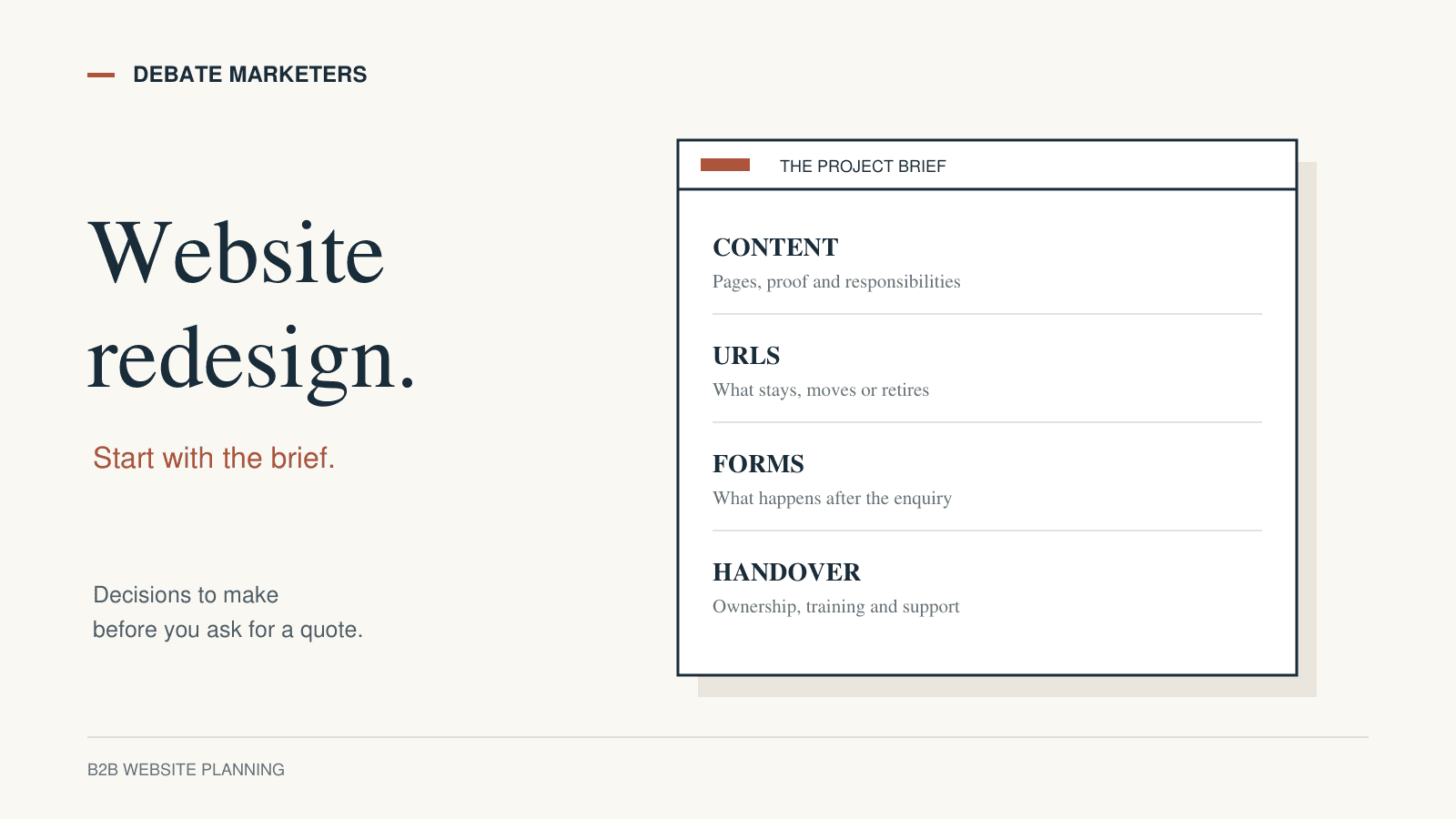
This guide is for buyers comparing website development quotations in India. If you are still deciding what to build, start with the B2B website redesign brief. Here, the job is to make competing prices and ownership arrangements comparable.
1. Put every quotation on the same basis
Give each agency the same comparison assumptions: required pages or templates, content volume, languages, integrations, CMS editing needs and launch responsibilities. Ask it to identify any assumptions it has changed.
Then define the costing period. A useful basis is the complete one-time project plus the services required to launch and operate the agreed website for its first 12 months. Record when each subscription starts; a plan activated during development may renew before the first anniversary of launch.
Use one comparison currency. Where a platform bills in another currency, retain that original amount and record the exchange-rate assumption separately. Ask whether taxes, payment charges or supplier markups are included. Confirm their treatment with your finance team rather than guessing.
An incomplete cost is “unconfirmed”, not zero.
2. Split the one-time work into priced responsibilities
Request an itemised build schedule with enough detail to show where the labour sits:
Discovery and project coordination
Design templates and development
CMS setup and initial content entry
Copywriting, photography, illustration or other content production
Forms and third-party integrations
Content migration and redirect implementation where required
Testing, launch, training and handover
Content deserves particular attention. “Ten pages included” could mean ten designed pages with all copy supplied by you. It could also include interviews, writing and upload. Record the number of content records being entered and the allowance for cleaning or reformatting old material.
For existing websites, distinguish content migration, hosting migration and SEO-related migration work. They are different tasks. Ask what each line includes and how additional records or unexpected data problems are priced.
You are looking for priced responsibility, not the longest list of technical terms.
3. Build a renewal register
Ask for the actual proposed products and plans behind “hosting included” or “premium plugins provided”.
For every recurring item, record the provider, plan, billing currency, amount, billing cycle, renewal date, account holder and person responsible for payment. Include the domain, hosting or site plan, CMS-related charges, plugins, forms, backups and maintenance where applicable.
Also record the limits that could change the price: editor seats, CMS records, storage, traffic, form usage, languages or connected services. Ask the agency to identify the relevant limits for its proposed setup rather than assuming all platforms price the same way.
Separate mandatory services from optional improvements. If an agency licence covers a plugin during the engagement, ask what you must buy when that coverage ends and what functionality, updates or support depend on renewal.
Show the expected second-year run rate too. An introductory price can be legitimate while still being a poor planning figure for future years.
4. Check control, usage rights and portability separately
“Your website” does not answer every ownership question. Review three distinct arrangements.
Account control: Who administers the domain, platform workspace, hosting and connected measurement accounts? Which business-controlled identity receives renewal and recovery notices?
Deliverable rights: What use of the design, code, copy, photographs and source files is included? Identify third-party licences and restrictions. Ask for any important rights arrangement in writing; specialist legal advice may be appropriate for consequential terms.
Portability: What can another supplier take over, and what must be recreated or bought again?
Platform details matter. WordPress's built-in export produces an XML content file containing specified content and data. That is a different deliverable from an agreed full-site backup and restoration package. Ask which handover the quotation includes. WordPress export documentation
For a Framer project transfer, Framer currently says the existing Site plan is cancelled when the recipient accepts, and the new owner must select and pay for any required Site plan. Confirm who handles that billing transition. Framer project-transfer guidance
These are different operational arrangements. Neither a CMS login nor a folder of exported content, by itself, answers every handover question.
5. Include measurement and a usable handover
Ask what “analytics setup” actually buys. Name the account or property, events being configured, verification work and documentation. A successful form submission, a button click and a page visit should not be presented as interchangeable outcomes.
Your nominated business administrator needs appropriate access. Google Analytics supports account- and property-level access management, with different roles determining what users can do. Specify the required level rather than accepting a dashboard screenshot as the complete handover. Google Analytics access guidance
Request an asset register, configuration notes and a practical editing demonstration. Your team should know how to update agreed content, where enquiries arrive, how support is requested and who controls renewals.
Keep these handover items in the priced scope and acceptance record.
6. Separate defects, maintenance and new work
A support period needs a definition of the defects it covers, its duration and how issues are reported. Maintenance should identify its actual tasks. New features and content changes need a pricing or approval process.
Ask who responds when a third-party integration fails or a licence expires. A response target should distinguish acknowledging a problem from resolving it; the latter may depend on another provider.
Payment milestones should refer to reviewable deliverables and the agreed acceptance process. Record how change requests are approved, along with cancellation and exit charges. This gives both sides a usable basis for dealing with changed requirements.
Copy this first-year cost worksheet
Download the printable worksheet (PDF)
Complete one worksheet per supplier using the same scope and launch assumption.
Comparison basis
Supplier and quote date: ______ Currency: ______
Planned launch: ______ Operating period end: ______
Included scope and client-supplied work: ______
A. One-time project charges
Design/build: ______ Content production and entry: ______
Migration/integrations: ______ Testing/training/handover: ______
Other required one-time work: ______ Subtotal A: ______
B. Required launch and first-year operating charges
Domain: ______ Hosting/site plan: ______ Licences/tools: ______
Maintenance/support: ______ Other required services: ______
For each, record billing frequency, start date and charges needed to cover the period. Count bundled items once. Subtotal B: ______
C. Adjustments
Taxes and mandatory fees not already included: ______
Confirmed discounts or credits not already deducted: ______
Comparable quoted budget = A + B + additional taxes/fees - confirmed discounts/credits.
List unpriced requirements separately: ______
Keep optional items, your team's hours and contingency separate from the quoted total. Mark the comparison incomplete until necessary unpriced work is resolved.
After year one and at exit
Expected annual renewals: ______ Renewal-price assumptions: ______
Notice period and exit charges: ______
Transfer/export work included: ______ Possible replacement licences: ______
Business-controlled accounts and missing access: ______
Finally, write down invoice amounts and payment dates. A comparable budget and an affordable payment schedule are separate checks.
Decide with the missing costs visible
A lower build price can be good value when the scope, recurring obligations and handover fit your business. A fuller quotation can save coordination work, but only if you need and can use the included services.
Use the worksheet before approving a supplier. For a discussion about your project, explore Debate Marketers' website development services or book a 30-minute conversation. Bring the quotations and the items that remain unclear.
More articles

Social Media Agency Proposal: What a Monthly Retainer Should Actually Include
Compare social media agency proposals by production, approvals, community replies, reporting and ownership. Use the scope card before choosing a retainer.
B2B Website Redesign Brief: What to Decide Before You Hire
Plan a B2B website redesign with a clear brief covering content, SEO migration, forms, ownership, testing and handover before hiring an agency.
B2B Lead Generation Agency: How to Compare Proposals
Compare B2B lead generation agency proposals on total cost, acquisition economics, deliverables, access and 90-day review gates before signing.
Get an AI Summary:
ChatGPT
By Debate Marketers
The total at the bottom of a website quotation may cover the build while leaving hosting, content entry, software renewals and support elsewhere. Another quotation may include those services but put the website in an account your business cannot administer.
Before selecting either supplier, compare two things: what the website will require through its first year, and what your business will control when the work is handed over.
This guide is for buyers comparing website development quotations in India. If you are still deciding what to build, start with the B2B website redesign brief. Here, the job is to make competing prices and ownership arrangements comparable.
1. Put every quotation on the same basis
Give each agency the same comparison assumptions: required pages or templates, content volume, languages, integrations, CMS editing needs and launch responsibilities. Ask it to identify any assumptions it has changed.
Then define the costing period. A useful basis is the complete one-time project plus the services required to launch and operate the agreed website for its first 12 months. Record when each subscription starts; a plan activated during development may renew before the first anniversary of launch.
Use one comparison currency. Where a platform bills in another currency, retain that original amount and record the exchange-rate assumption separately. Ask whether taxes, payment charges or supplier markups are included. Confirm their treatment with your finance team rather than guessing.
An incomplete cost is “unconfirmed”, not zero.
2. Split the one-time work into priced responsibilities
Request an itemised build schedule with enough detail to show where the labour sits:
Discovery and project coordination
Design templates and development
CMS setup and initial content entry
Copywriting, photography, illustration or other content production
Forms and third-party integrations
Content migration and redirect implementation where required
Testing, launch, training and handover
Content deserves particular attention. “Ten pages included” could mean ten designed pages with all copy supplied by you. It could also include interviews, writing and upload. Record the number of content records being entered and the allowance for cleaning or reformatting old material.
For existing websites, distinguish content migration, hosting migration and SEO-related migration work. They are different tasks. Ask what each line includes and how additional records or unexpected data problems are priced.
You are looking for priced responsibility, not the longest list of technical terms.
3. Build a renewal register
Ask for the actual proposed products and plans behind “hosting included” or “premium plugins provided”.
For every recurring item, record the provider, plan, billing currency, amount, billing cycle, renewal date, account holder and person responsible for payment. Include the domain, hosting or site plan, CMS-related charges, plugins, forms, backups and maintenance where applicable.
Also record the limits that could change the price: editor seats, CMS records, storage, traffic, form usage, languages or connected services. Ask the agency to identify the relevant limits for its proposed setup rather than assuming all platforms price the same way.
Separate mandatory services from optional improvements. If an agency licence covers a plugin during the engagement, ask what you must buy when that coverage ends and what functionality, updates or support depend on renewal.
Show the expected second-year run rate too. An introductory price can be legitimate while still being a poor planning figure for future years.
4. Check control, usage rights and portability separately
“Your website” does not answer every ownership question. Review three distinct arrangements.
Account control: Who administers the domain, platform workspace, hosting and connected measurement accounts? Which business-controlled identity receives renewal and recovery notices?
Deliverable rights: What use of the design, code, copy, photographs and source files is included? Identify third-party licences and restrictions. Ask for any important rights arrangement in writing; specialist legal advice may be appropriate for consequential terms.
Portability: What can another supplier take over, and what must be recreated or bought again?
Platform details matter. WordPress's built-in export produces an XML content file containing specified content and data. That is a different deliverable from an agreed full-site backup and restoration package. Ask which handover the quotation includes. WordPress export documentation
For a Framer project transfer, Framer currently says the existing Site plan is cancelled when the recipient accepts, and the new owner must select and pay for any required Site plan. Confirm who handles that billing transition. Framer project-transfer guidance
These are different operational arrangements. Neither a CMS login nor a folder of exported content, by itself, answers every handover question.
5. Include measurement and a usable handover
Ask what “analytics setup” actually buys. Name the account or property, events being configured, verification work and documentation. A successful form submission, a button click and a page visit should not be presented as interchangeable outcomes.
Your nominated business administrator needs appropriate access. Google Analytics supports account- and property-level access management, with different roles determining what users can do. Specify the required level rather than accepting a dashboard screenshot as the complete handover. Google Analytics access guidance
Request an asset register, configuration notes and a practical editing demonstration. Your team should know how to update agreed content, where enquiries arrive, how support is requested and who controls renewals.
Keep these handover items in the priced scope and acceptance record.
6. Separate defects, maintenance and new work
A support period needs a definition of the defects it covers, its duration and how issues are reported. Maintenance should identify its actual tasks. New features and content changes need a pricing or approval process.
Ask who responds when a third-party integration fails or a licence expires. A response target should distinguish acknowledging a problem from resolving it; the latter may depend on another provider.
Payment milestones should refer to reviewable deliverables and the agreed acceptance process. Record how change requests are approved, along with cancellation and exit charges. This gives both sides a usable basis for dealing with changed requirements.
Copy this first-year cost worksheet
Download the printable worksheet (PDF)
Complete one worksheet per supplier using the same scope and launch assumption.
Comparison basis
Supplier and quote date: ______ Currency: ______
Planned launch: ______ Operating period end: ______
Included scope and client-supplied work: ______
A. One-time project charges
Design/build: ______ Content production and entry: ______
Migration/integrations: ______ Testing/training/handover: ______
Other required one-time work: ______ Subtotal A: ______
B. Required launch and first-year operating charges
Domain: ______ Hosting/site plan: ______ Licences/tools: ______
Maintenance/support: ______ Other required services: ______
For each, record billing frequency, start date and charges needed to cover the period. Count bundled items once. Subtotal B: ______
C. Adjustments
Taxes and mandatory fees not already included: ______
Confirmed discounts or credits not already deducted: ______
Comparable quoted budget = A + B + additional taxes/fees - confirmed discounts/credits.
List unpriced requirements separately: ______
Keep optional items, your team's hours and contingency separate from the quoted total. Mark the comparison incomplete until necessary unpriced work is resolved.
After year one and at exit
Expected annual renewals: ______ Renewal-price assumptions: ______
Notice period and exit charges: ______
Transfer/export work included: ______ Possible replacement licences: ______
Business-controlled accounts and missing access: ______
Finally, write down invoice amounts and payment dates. A comparable budget and an affordable payment schedule are separate checks.
Decide with the missing costs visible
A lower build price can be good value when the scope, recurring obligations and handover fit your business. A fuller quotation can save coordination work, but only if you need and can use the included services.
Use the worksheet before approving a supplier. For a discussion about your project, explore Debate Marketers' website development services or book a 30-minute conversation. Bring the quotations and the items that remain unclear.
More articles
Social Media Agency Proposal: What a Monthly Retainer Should Actually Include
Compare social media agency proposals by production, approvals, community replies, reporting and ownership. Use the scope card before choosing a retainer.
B2B Website Redesign Brief: What to Decide Before You Hire
Plan a B2B website redesign with a clear brief covering content, SEO migration, forms, ownership, testing and handover before hiring an agency.
B2B Lead Generation Agency: How to Compare Proposals
Compare B2B lead generation agency proposals on total cost, acquisition economics, deliverables, access and 90-day review gates before signing.
Get an AI Summary:
ChatGPT
By Debate Marketers
The total at the bottom of a website quotation may cover the build while leaving hosting, content entry, software renewals and support elsewhere. Another quotation may include those services but put the website in an account your business cannot administer.
Before selecting either supplier, compare two things: what the website will require through its first year, and what your business will control when the work is handed over.
This guide is for buyers comparing website development quotations in India. If you are still deciding what to build, start with the B2B website redesign brief. Here, the job is to make competing prices and ownership arrangements comparable.
1. Put every quotation on the same basis
Give each agency the same comparison assumptions: required pages or templates, content volume, languages, integrations, CMS editing needs and launch responsibilities. Ask it to identify any assumptions it has changed.
Then define the costing period. A useful basis is the complete one-time project plus the services required to launch and operate the agreed website for its first 12 months. Record when each subscription starts; a plan activated during development may renew before the first anniversary of launch.
Use one comparison currency. Where a platform bills in another currency, retain that original amount and record the exchange-rate assumption separately. Ask whether taxes, payment charges or supplier markups are included. Confirm their treatment with your finance team rather than guessing.
An incomplete cost is “unconfirmed”, not zero.
2. Split the one-time work into priced responsibilities
Request an itemised build schedule with enough detail to show where the labour sits:
Discovery and project coordination
Design templates and development
CMS setup and initial content entry
Copywriting, photography, illustration or other content production
Forms and third-party integrations
Content migration and redirect implementation where required
Testing, launch, training and handover
Content deserves particular attention. “Ten pages included” could mean ten designed pages with all copy supplied by you. It could also include interviews, writing and upload. Record the number of content records being entered and the allowance for cleaning or reformatting old material.
For existing websites, distinguish content migration, hosting migration and SEO-related migration work. They are different tasks. Ask what each line includes and how additional records or unexpected data problems are priced.
You are looking for priced responsibility, not the longest list of technical terms.
3. Build a renewal register
Ask for the actual proposed products and plans behind “hosting included” or “premium plugins provided”.
For every recurring item, record the provider, plan, billing currency, amount, billing cycle, renewal date, account holder and person responsible for payment. Include the domain, hosting or site plan, CMS-related charges, plugins, forms, backups and maintenance where applicable.
Also record the limits that could change the price: editor seats, CMS records, storage, traffic, form usage, languages or connected services. Ask the agency to identify the relevant limits for its proposed setup rather than assuming all platforms price the same way.
Separate mandatory services from optional improvements. If an agency licence covers a plugin during the engagement, ask what you must buy when that coverage ends and what functionality, updates or support depend on renewal.
Show the expected second-year run rate too. An introductory price can be legitimate while still being a poor planning figure for future years.
4. Check control, usage rights and portability separately
“Your website” does not answer every ownership question. Review three distinct arrangements.
Account control: Who administers the domain, platform workspace, hosting and connected measurement accounts? Which business-controlled identity receives renewal and recovery notices?
Deliverable rights: What use of the design, code, copy, photographs and source files is included? Identify third-party licences and restrictions. Ask for any important rights arrangement in writing; specialist legal advice may be appropriate for consequential terms.
Portability: What can another supplier take over, and what must be recreated or bought again?
Platform details matter. WordPress's built-in export produces an XML content file containing specified content and data. That is a different deliverable from an agreed full-site backup and restoration package. Ask which handover the quotation includes. WordPress export documentation
For a Framer project transfer, Framer currently says the existing Site plan is cancelled when the recipient accepts, and the new owner must select and pay for any required Site plan. Confirm who handles that billing transition. Framer project-transfer guidance
These are different operational arrangements. Neither a CMS login nor a folder of exported content, by itself, answers every handover question.
5. Include measurement and a usable handover
Ask what “analytics setup” actually buys. Name the account or property, events being configured, verification work and documentation. A successful form submission, a button click and a page visit should not be presented as interchangeable outcomes.
Your nominated business administrator needs appropriate access. Google Analytics supports account- and property-level access management, with different roles determining what users can do. Specify the required level rather than accepting a dashboard screenshot as the complete handover. Google Analytics access guidance
Request an asset register, configuration notes and a practical editing demonstration. Your team should know how to update agreed content, where enquiries arrive, how support is requested and who controls renewals.
Keep these handover items in the priced scope and acceptance record.
6. Separate defects, maintenance and new work
A support period needs a definition of the defects it covers, its duration and how issues are reported. Maintenance should identify its actual tasks. New features and content changes need a pricing or approval process.
Ask who responds when a third-party integration fails or a licence expires. A response target should distinguish acknowledging a problem from resolving it; the latter may depend on another provider.
Payment milestones should refer to reviewable deliverables and the agreed acceptance process. Record how change requests are approved, along with cancellation and exit charges. This gives both sides a usable basis for dealing with changed requirements.
Copy this first-year cost worksheet
Download the printable worksheet (PDF)
Complete one worksheet per supplier using the same scope and launch assumption.
Comparison basis
Supplier and quote date: ______ Currency: ______
Planned launch: ______ Operating period end: ______
Included scope and client-supplied work: ______
A. One-time project charges
Design/build: ______ Content production and entry: ______
Migration/integrations: ______ Testing/training/handover: ______
Other required one-time work: ______ Subtotal A: ______
B. Required launch and first-year operating charges
Domain: ______ Hosting/site plan: ______ Licences/tools: ______
Maintenance/support: ______ Other required services: ______
For each, record billing frequency, start date and charges needed to cover the period. Count bundled items once. Subtotal B: ______
C. Adjustments
Taxes and mandatory fees not already included: ______
Confirmed discounts or credits not already deducted: ______
Comparable quoted budget = A + B + additional taxes/fees - confirmed discounts/credits.
List unpriced requirements separately: ______
Keep optional items, your team's hours and contingency separate from the quoted total. Mark the comparison incomplete until necessary unpriced work is resolved.
After year one and at exit
Expected annual renewals: ______ Renewal-price assumptions: ______
Notice period and exit charges: ______
Transfer/export work included: ______ Possible replacement licences: ______
Business-controlled accounts and missing access: ______
Finally, write down invoice amounts and payment dates. A comparable budget and an affordable payment schedule are separate checks.
Decide with the missing costs visible
A lower build price can be good value when the scope, recurring obligations and handover fit your business. A fuller quotation can save coordination work, but only if you need and can use the included services.
Use the worksheet before approving a supplier. For a discussion about your project, explore Debate Marketers' website development services or book a 30-minute conversation. Bring the quotations and the items that remain unclear.
More articles
Social Media Agency Proposal: What a Monthly Retainer Should Actually Include
Compare social media agency proposals by production, approvals, community replies, reporting and ownership. Use the scope card before choosing a retainer.
B2B Website Redesign Brief: What to Decide Before You Hire
Plan a B2B website redesign with a clear brief covering content, SEO migration, forms, ownership, testing and handover before hiring an agency.
B2B Lead Generation Agency: How to Compare Proposals
Compare B2B lead generation agency proposals on total cost, acquisition economics, deliverables, access and 90-day review gates before signing.