Marketers
A shared team for strategy, copy, design and campaigns, every month.
Website developmentCapability pages, useful proof and a direct path to an enquiry.
BrandingPositioning, identity and sales material that explain why you're worth choosing.
SEO and AI searchGet found on Google and in AI answers by the people who buy what you make.
Performance marketingGoogle, LinkedIn and Meta ads measured on qualified enquiries.
AI automation & CRMEvery enquiry gets an owner and a next step, with human review.
 Two minutes, no email neededFind the one thing to fix firstTake the quiz→
Framer vs WordPress in 2026: Why the 'Default' Choice Might Be Costing You
Deciding between Framer vs WordPress in 2026? We analyze why Framer is disrupting the market with superior speed and design for modern business performance.
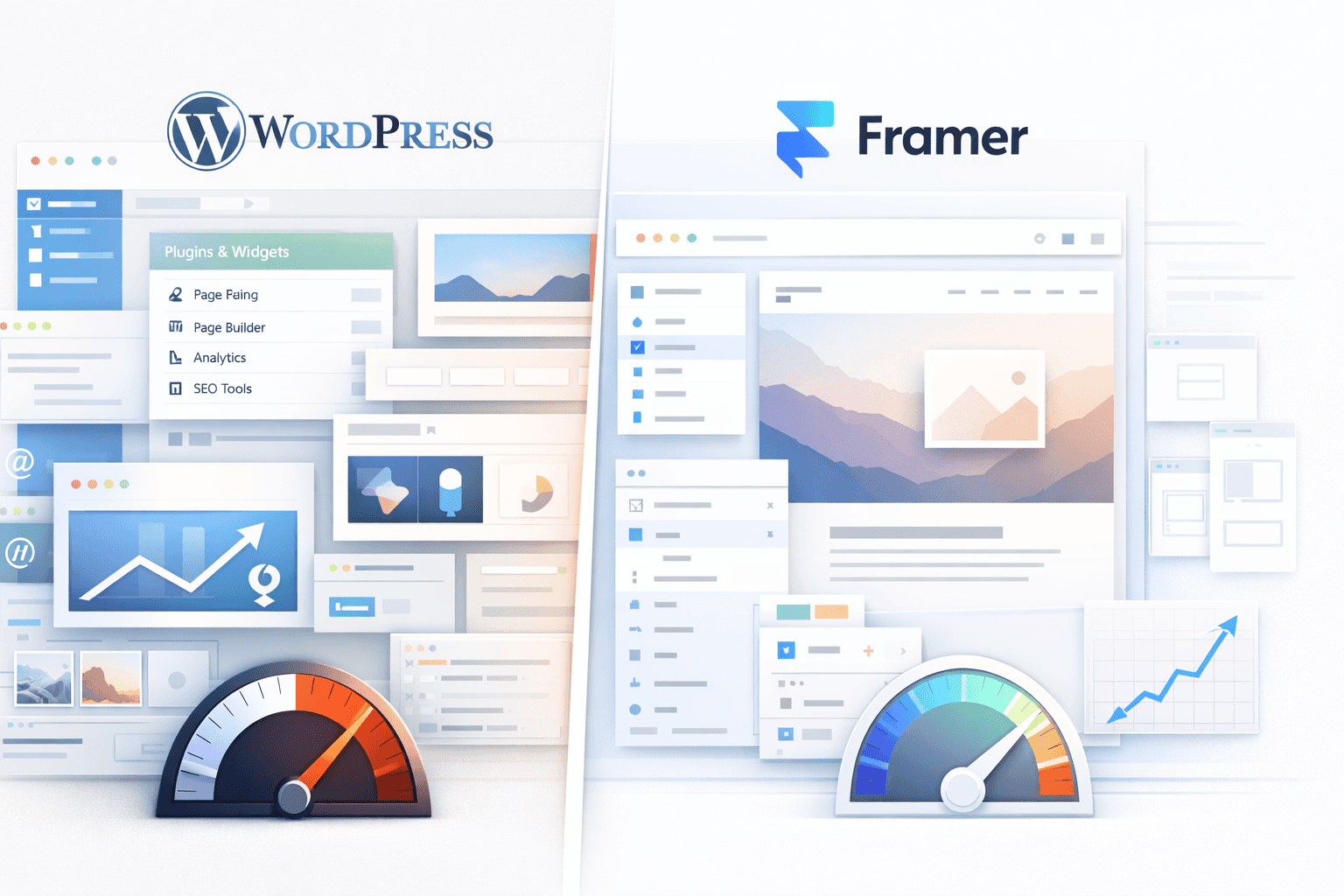
When we sit down with clients at Debate Marketers, the conversation usually starts with a shrug and a "Let’s just use WordPress." Since the early 2000s, WordPress has stood as the undisputed 'safe bet' for business owners. But here’s the thing we’ve learned after years of building: being the oldest tool in the shed doesn’t make you the sharpest.
In 2026, the Framer vs WordPress debate isn't just about picking a CMS; it's about choosing between legacy infrastructure and modern performance. We aren't just building digital brochures anymore; we are building high-conversion engines. Here is why the "old guard" is finally facing its toughest challenge yet.
1. The Speed Trap: Fast by Design vs. Fast by Force
Google’s Core Web Vitals aren't just technical jargon—they are the gatekeepers of your revenue. If your site feels sluggish, your customers will find someone else who isn't.
The Framer Advantage: Framer doesn't ask permission to be fast. It’s built on a modern, "clean-code" architecture that serves pages via a global CDN. It’s lightweight and agile, lacking the hidden "code-rot" found in older systems. In our 2026 benchmarks, Framer sites often load 35% faster than standard WordPress setups out of the box.
The WordPress Struggle: WordPress is like a backpack you keep adding rocks (plugins) to. You can make it fast, but you’ll be fighting the database, bulky themes, and constant security patches every step of the way.
The Debate Tip: If your site takes 4 seconds to load, you aren’t losing "users"—you’re losing money. In the Framer vs WordPress race, Framer wins on speed without even trying.
2. The SEO Reality Check
The million-dollar question we always hear: Will Google actually show a Framer site any love? The answer is a resounding yes, but the strategy has shifted in this AI-driven search era.
WordPress remains a powerhouse for "Programmatic SEO." If you’re a massive media house with 10,000 articles, the plugin-driven backend of WordPress is still hard to beat for sheer volume.
Framer is for the precision strikers. For service businesses and landing pages, Framer’s semantic HTML and lightning-quick indexing mean you can climb the rankings without the plugin-bloat. It’s about the quality of code over the quantity of tools.
3. Design Without the Chains
As designers at Debate Marketers, we believe your site should look like a premium brand, not a $50 template.
Framer allows us to work on a "free-form canvas." It’s the closest thing to designing in Figma and seeing it come to life instantly. You get pixel-perfect control over every animation and micro-interaction.
WordPress, by contrast, often feels like building a house out of Lego—you’re stuck within the blocks of your theme unless you want to pay for a mountain of custom development.
The Final Verdict
Feature | Framer | WordPress |
Best For | High-conversion marketing & SaaS | Large blogs & E-commerce empires |
Maintenance | Zero (Managed for you) | High (Updates & security) |
Speed | ⚡ Instant (Edge CDN) | 🐢 Variable (Depends on hosting) |
Experience | Modern & Fluid | Traditional & Structured |
We don't pick favorites; we choose what works for your bottom line. Move to Framer if you want a visually stunning site that screams "premium" and loads before the user can blink. Stick with WordPress if you are building a complex directory or a massive store with thousands of moving parts.
The "Debate" is simple: Are you bidding for 2006, or are you building for 2026?
We plan and run admissions campaigns, websites, SEO and AI search, ads and CRM follow-up for schools, manufacturers and growing brands, from teams in New Delhi and Malta.
Published 9 February 2026. Updated 3 October 2026.
More articles

How to Get Your Business Recommended by ChatGPT and AI Search
How ChatGPT, Gemini and Google’s AI answers choose which businesses to recommend, with a 10-step checklist, crawler settings and a 30-day plan.

How to Increase School Admissions: A 16-Week Plan for 2027–28
A week-by-week plan to fill seats for 2027–28: reply to enquiries faster, fix your admissions page, collect recent reviews, run better visits and follow up.
Website Development Quotation: How to Compare First-Year Cost and Ownership
Compare website development quotations in India using a first-year cost worksheet covering the build, hosting, licences, content, support and handover.
Framer vs WordPress in 2026: Why the 'Default' Choice Might Be Costing You
Deciding between Framer vs WordPress in 2026? We analyze why Framer is disrupting the market with superior speed and design for modern business performance.
When we sit down with clients at Debate Marketers, the conversation usually starts with a shrug and a "Let’s just use WordPress." Since the early 2000s, WordPress has stood as the undisputed 'safe bet' for business owners. But here’s the thing we’ve learned after years of building: being the oldest tool in the shed doesn’t make you the sharpest.
In 2026, the Framer vs WordPress debate isn't just about picking a CMS; it's about choosing between legacy infrastructure and modern performance. We aren't just building digital brochures anymore; we are building high-conversion engines. Here is why the "old guard" is finally facing its toughest challenge yet.
1. The Speed Trap: Fast by Design vs. Fast by Force
Google’s Core Web Vitals aren't just technical jargon—they are the gatekeepers of your revenue. If your site feels sluggish, your customers will find someone else who isn't.
The Framer Advantage: Framer doesn't ask permission to be fast. It’s built on a modern, "clean-code" architecture that serves pages via a global CDN. It’s lightweight and agile, lacking the hidden "code-rot" found in older systems. In our 2026 benchmarks, Framer sites often load 35% faster than standard WordPress setups out of the box.
The WordPress Struggle: WordPress is like a backpack you keep adding rocks (plugins) to. You can make it fast, but you’ll be fighting the database, bulky themes, and constant security patches every step of the way.
The Debate Tip: If your site takes 4 seconds to load, you aren’t losing "users"—you’re losing money. In the Framer vs WordPress race, Framer wins on speed without even trying.
2. The SEO Reality Check
The million-dollar question we always hear: Will Google actually show a Framer site any love? The answer is a resounding yes, but the strategy has shifted in this AI-driven search era.
WordPress remains a powerhouse for "Programmatic SEO." If you’re a massive media house with 10,000 articles, the plugin-driven backend of WordPress is still hard to beat for sheer volume.
Framer is for the precision strikers. For service businesses and landing pages, Framer’s semantic HTML and lightning-quick indexing mean you can climb the rankings without the plugin-bloat. It’s about the quality of code over the quantity of tools.
3. Design Without the Chains
As designers at Debate Marketers, we believe your site should look like a premium brand, not a $50 template.
Framer allows us to work on a "free-form canvas." It’s the closest thing to designing in Figma and seeing it come to life instantly. You get pixel-perfect control over every animation and micro-interaction.
WordPress, by contrast, often feels like building a house out of Lego—you’re stuck within the blocks of your theme unless you want to pay for a mountain of custom development.
The Final Verdict
Feature | Framer | WordPress |
Best For | High-conversion marketing & SaaS | Large blogs & E-commerce empires |
Maintenance | Zero (Managed for you) | High (Updates & security) |
Speed | ⚡ Instant (Edge CDN) | 🐢 Variable (Depends on hosting) |
Experience | Modern & Fluid | Traditional & Structured |
We don't pick favorites; we choose what works for your bottom line. Move to Framer if you want a visually stunning site that screams "premium" and loads before the user can blink. Stick with WordPress if you are building a complex directory or a massive store with thousands of moving parts.
The "Debate" is simple: Are you bidding for 2006, or are you building for 2026?
We plan and run admissions campaigns, websites, SEO and AI search, ads and CRM follow-up for schools, manufacturers and growing brands, from teams in New Delhi and Malta.
Published 9 February 2026. Updated 3 October 2026.
More articles
How to Get Your Business Recommended by ChatGPT and AI Search
How ChatGPT, Gemini and Google’s AI answers choose which businesses to recommend, with a 10-step checklist, crawler settings and a 30-day plan.
How to Increase School Admissions: A 16-Week Plan for 2027–28
A week-by-week plan to fill seats for 2027–28: reply to enquiries faster, fix your admissions page, collect recent reviews, run better visits and follow up.
Website Development Quotation: How to Compare First-Year Cost and Ownership
Compare website development quotations in India using a first-year cost worksheet covering the build, hosting, licences, content, support and handover.
Framer vs WordPress in 2026: Why the 'Default' Choice Might Be Costing You
Deciding between Framer vs WordPress in 2026? We analyze why Framer is disrupting the market with superior speed and design for modern business performance.
When we sit down with clients at Debate Marketers, the conversation usually starts with a shrug and a "Let’s just use WordPress." Since the early 2000s, WordPress has stood as the undisputed 'safe bet' for business owners. But here’s the thing we’ve learned after years of building: being the oldest tool in the shed doesn’t make you the sharpest.
In 2026, the Framer vs WordPress debate isn't just about picking a CMS; it's about choosing between legacy infrastructure and modern performance. We aren't just building digital brochures anymore; we are building high-conversion engines. Here is why the "old guard" is finally facing its toughest challenge yet.
1. The Speed Trap: Fast by Design vs. Fast by Force
Google’s Core Web Vitals aren't just technical jargon—they are the gatekeepers of your revenue. If your site feels sluggish, your customers will find someone else who isn't.
The Framer Advantage: Framer doesn't ask permission to be fast. It’s built on a modern, "clean-code" architecture that serves pages via a global CDN. It’s lightweight and agile, lacking the hidden "code-rot" found in older systems. In our 2026 benchmarks, Framer sites often load 35% faster than standard WordPress setups out of the box.
The WordPress Struggle: WordPress is like a backpack you keep adding rocks (plugins) to. You can make it fast, but you’ll be fighting the database, bulky themes, and constant security patches every step of the way.
The Debate Tip: If your site takes 4 seconds to load, you aren’t losing "users"—you’re losing money. In the Framer vs WordPress race, Framer wins on speed without even trying.
2. The SEO Reality Check
The million-dollar question we always hear: Will Google actually show a Framer site any love? The answer is a resounding yes, but the strategy has shifted in this AI-driven search era.
WordPress remains a powerhouse for "Programmatic SEO." If you’re a massive media house with 10,000 articles, the plugin-driven backend of WordPress is still hard to beat for sheer volume.
Framer is for the precision strikers. For service businesses and landing pages, Framer’s semantic HTML and lightning-quick indexing mean you can climb the rankings without the plugin-bloat. It’s about the quality of code over the quantity of tools.
3. Design Without the Chains
As designers at Debate Marketers, we believe your site should look like a premium brand, not a $50 template.
Framer allows us to work on a "free-form canvas." It’s the closest thing to designing in Figma and seeing it come to life instantly. You get pixel-perfect control over every animation and micro-interaction.
WordPress, by contrast, often feels like building a house out of Lego—you’re stuck within the blocks of your theme unless you want to pay for a mountain of custom development.
The Final Verdict
Feature | Framer | WordPress |
Best For | High-conversion marketing & SaaS | Large blogs & E-commerce empires |
Maintenance | Zero (Managed for you) | High (Updates & security) |
Speed | ⚡ Instant (Edge CDN) | 🐢 Variable (Depends on hosting) |
Experience | Modern & Fluid | Traditional & Structured |
We don't pick favorites; we choose what works for your bottom line. Move to Framer if you want a visually stunning site that screams "premium" and loads before the user can blink. Stick with WordPress if you are building a complex directory or a massive store with thousands of moving parts.
The "Debate" is simple: Are you bidding for 2006, or are you building for 2026?
We plan and run admissions campaigns, websites, SEO and AI search, ads and CRM follow-up for schools, manufacturers and growing brands, from teams in New Delhi and Malta.
Published 9 February 2026. Updated 3 October 2026.
More articles
How to Get Your Business Recommended by ChatGPT and AI Search
How ChatGPT, Gemini and Google’s AI answers choose which businesses to recommend, with a 10-step checklist, crawler settings and a 30-day plan.
How to Increase School Admissions: A 16-Week Plan for 2027–28
A week-by-week plan to fill seats for 2027–28: reply to enquiries faster, fix your admissions page, collect recent reviews, run better visits and follow up.
Website Development Quotation: How to Compare First-Year Cost and Ownership
Compare website development quotations in India using a first-year cost worksheet covering the build, hosting, licences, content, support and handover.
Bring your first priority.
Bring one problem: a brand that's drifted, a website that doesn't sell or enquiries going nowhere. We'll spend 30 minutes finding the first fix.
Projects & shared-team retainers
Bring your first priority.
Bring one problem: a brand that's drifted, a website that doesn't sell or enquiries going nowhere. We'll spend 30 minutes finding the first fix.
Projects & shared-team retainers