Marketers
A shared team for strategy, copy, design and campaigns, every month.
Website developmentCapability pages, useful proof and a direct path to an enquiry.
BrandingPositioning, identity and sales material that explain why you're worth choosing.
SEO and AI searchGet found on Google and in AI answers by the people who buy what you make.
Performance marketingGoogle, LinkedIn and Meta ads measured on qualified enquiries.
AI automation & CRMEvery enquiry gets an owner and a next step, with human review.
 Two minutes, no email neededFind the one thing to fix firstTake the quiz→
- Journal
- SEO & AI Search
How to Get Your Business Recommended by ChatGPT and AI Search
How ChatGPT, Gemini and Google’s AI answers choose which businesses to recommend, with a 10-step checklist, crawler settings and a 30-day plan.

The short answer
AI assistants recommend businesses they can find, understand and trust. Let their search crawlers in, describe what you do, for whom and where in the same words everywhere, publish pages that answer buyers’ questions with facts, earn recent reviews and mentions on other sites, and retest the same prompts every month.
Key points
- ChatGPT has 900 million weekly users, and Google’s AI Mode passed 1 billion monthly users in 2026.
- 45% of consumers now use AI tools to find local businesses, up from 6% a year earlier (BrightLocal, 2026).
- Brand mentions across the web correlate with AI Overview visibility (0.664) far more than backlinks do (0.218) (Ahrefs).
- Adding quotations and statistics lifted visibility in AI answers by up to 41% in a KDD 2024 study.
Ask ChatGPT for “a digital marketing agency for schools in Delhi” or “an ISO-certified die-casting supplier in Europe” and you won’t get ten blue links. You get three to five names, a sentence about each and a few sources. If your business isn’t one of those names, the buyer may never reach your website.
This guide explains how ChatGPT, Gemini, Google’s AI Overviews and AI Mode, Perplexity, Claude and Copilot choose what to recommend, and gives you a checklist you can work through in 30 days. Every figure links to its source at the end.
Why do AI recommendations matter now?
ChatGPT reached 900 million weekly active users in February 2026, according to OpenAI.
Google says AI Mode passed 1 billion monthly users after its global expansion, and it has merged AI Overviews and AI Mode into one search experience. The Gemini app has 950 million monthly users.
BrightLocal’s 2026 survey found that 45% of consumers now use ChatGPT or other AI tools to find local businesses, up from 6% in 2025.
Clicks are moving too. In Pew Research Center’s study of 900 US adults’ browsing, people clicked a traditional search result on 8% of visits when Google showed an AI summary, against 15% when it didn’t, and clicked a link inside the summary on just 1% of visits. When the answer itself names businesses, being one of the names matters more than ranking fifth underneath it.
How do AI assistants decide which businesses to recommend?
An AI assistant answers from two places: what the model learned in training, and what it finds by searching the web while it writes. For recommendations (“best”, “near me”, “which supplier”), the live search matters most, because the assistant needs current facts.
The live process works like this:
The assistant turns the question into one or more searches.
It retrieves results from a search index. Google’s AI features use Google Search. ChatGPT search launched using third-party search providers, including Microsoft Bing, together with content from partners, and OpenAI runs its own search crawler. Copilot uses Bing. Perplexity and Anthropic also run their own search crawlers.
It reads the pages it found and writes an answer, usually citing a few of them. Pew found that 88% of Google’s AI summaries cited three or more sources.
So the businesses that get named are the ones that appear, clearly and consistently, in the pages the assistant reads. Four signals come up again and again (our guide to generative engine optimization covers the content side in more depth):
Access. The assistant’s crawler can reach and index your pages.
Clarity. Your website says plainly what you do, for whom and where, and other sites say the same.
Corroboration. Other sites mention you. Ahrefs’ study of 75,000 brands found that branded web mentions had the strongest correlation with appearing in Google’s AI Overviews (0.664), far ahead of the number of backlinks (0.218).
Evidence. Your pages contain facts worth quoting. In the GEO study presented at KDD 2024, adding quotations lifted a page’s visibility in AI answers by about 41%, adding statistics by about 31% and citing sources by about 27%, while keyword stuffing made it about 8% worse.
What you can’t do is pay your way into the answer. OpenAI says ads “do not influence the answers ChatGPT gives you”, and its guidance for publishers is about access, not payment: let OAI-SearchBot crawl your site.
The 10-step checklist
1. Let the AI search crawlers in
Open your robots.txt file (yoursite.com/robots.txt) and check your firewall or CDN bot settings too. Most AI companies run separate crawlers for search and for model training. Blocking a training crawler does not remove you from search answers. Blocking a search crawler can.
Company | Allow this crawler to appear in answers | Separate training crawler (your choice) |
|---|---|---|
OpenAI (ChatGPT) | OAI-SearchBot | GPTBot |
Google (AI Overviews, AI Mode) | Googlebot | Google-Extended (Gemini training and grounding outside Search) |
Anthropic (Claude) | Claude-SearchBot and Claude-User | ClaudeBot |
Perplexity | PerplexityBot | None (Perplexity says PerplexityBot is not used for training) |
Microsoft (Copilot) | Bingbot | Not applicable |
2. Make sure Google and Bing have indexed your key pages
Google says there are no extra technical requirements for AI Overviews and AI Mode: a page has to be indexed and eligible to show a snippet in Google Search. Verify your site in Google Search Console and Bing Webmaster Tools, submit your sitemap, and check that your service, location and pricing pages are indexed. Bing deserves more attention than its market share suggests, because Copilot runs on it and ChatGPT search launched with it as a provider.
3. Write one sentence that defines your business, and use it everywhere
AI answers are assembled from many sources, so contradictions hurt. Write one plain sentence that says who you are, what you do, for whom and where. Ours is: “Debate Marketers is a digital marketing agency with teams in New Delhi and Malta, working with schools, manufacturers and growing brands.” Use the same facts on your website, Google Business Profile, Bing Places, LinkedIn, directories and press bios.
4. Build a page for every question your buyers ask
List the 10 to 20 questions your buyers type into AI tools: “best X for Y in Z”, “X vs Y”, “how much does X cost”, “who supplies X with certification Y”. Make sure one page on your site answers each of them. Put the direct answer in the first two sentences, then the detail: prices or price ranges, timelines, locations served, credentials and who the offer is not for. Question headings, short paragraphs, lists and tables are easy for an assistant to extract and quote.
5. Add facts an AI can quote
Generic claims such as “quality service” or “an experienced team” give an assistant nothing to repeat. Specifics do: years in business, the number of clients served, certifications, turnaround times, results with dates, and quotes from named customers who agreed to be quoted. Cite the source of every statistic. This is exactly what the GEO study rewarded.
6. Get mentioned on the sites AI reads
Your website is one source. Assistants trust a business more when independent sites agree with it. Aim for mentions in industry associations and directories, credible “best of” lists, local and trade news, partner and supplier pages, podcasts and event pages. Run your key prompts and open the sources the answers cite: those are the sites to approach first. In Pew’s study, Wikipedia, YouTube and Reddit were the most cited sources in Google’s AI summaries, so a useful video or a genuine forum answer can do more than another blog post.
7. Collect recent reviews and reply to them
For local recommendations, reviews are evidence. BrightLocal found that 74% of consumers only care about reviews from the last three months, and 89% expect owners to reply. Ask every customer, every month, through a direct link, and reply to every review. Don’t offer rewards for reviews: Google’s policy prohibits it.
8. Complete your Google Business Profile and Bing Places listing
Google’s own guidance on AI features tells businesses to keep their Business Profile information current. Fill in categories, services, hours, service areas, photos and a description that matches your one-sentence definition. Do the same on Bing Places for Business.
9. Use structured data that matches the page
Google says AI features need no special schema, and structured data should always match the visible text. It still helps machines read your facts without guessing. Add Organization or LocalBusiness markup to your home and contact pages, Service or Product markup to your offer pages, and Article markup to your guides.
10. Measure, then retest the same prompts every month
Keep a sheet of 15 prompts your buyers would use, and run them every month in ChatGPT, Gemini, Google’s AI Mode, Perplexity and Copilot. Record which businesses are named and which sources are cited. Then check your traffic:
ChatGPT adds utm_source=chatgpt.com to the links it sends, so those visits show up in Google Analytics.
Google counts clicks from AI Overviews and AI Mode in Search Console, under the Web search type.
Bing Webmaster Tools has an AI Performance report, released as a preview in February 2026, that shows how often Copilot cites your pages.
For a fuller method, see how to check AI search visibility without inventing a score.
What doesn’t work
Keyword stuffing. In the GEO study it made pages less visible, not more.
An llms.txt file as a shortcut. Google says AI features need no special files or markup. Treat llms.txt as optional.
Hundreds of thin AI-written pages. If a page adds no new facts, there is nothing to cite.
Fake or paid reviews. They break Google’s rules and destroy trust when they are found.
Blocking every AI bot and still expecting to be recommended.
A 30-day plan
Week | What to do |
|---|---|
1 | Check robots.txt and bot settings, confirm indexing in Search Console and Bing Webmaster Tools, and run your 15-prompt baseline |
2 | Write your one-sentence definition and update your website, Google Business Profile, Bing Places, LinkedIn and directories |
3 | Rewrite or create the three pages that answer your most valuable buyer questions, with facts, quotes and sources |
4 | Ask for reviews, pitch three third-party mentions, set up tracking and rerun your prompts |
What this looks like for schools, manufacturers and service firms
Schools. Parents ask for “the best CBSE school near Dwarka with transport”. The answer draws on admissions pages, Google profiles, reviews and local news. Publish fees, transport routes and results, and keep your reviews recent. Our 16-week school admissions plan covers the rest of the season.
Manufacturers. Buyers ask for “an aluminium die-casting supplier in Europe with ISO 9001”. Build capability pages that list processes, tolerances, materials, certifications and export markets, and get listed in the trade directories your buyers use. Our guide to manufacturing websites that buyers and search can understand shows the page structure.
Service firms. Buyers ask for “a digital marketing agency in Malta for schools”. Name your industries and locations on your service pages, publish case studies with numbers, and collect reviews on Google and the directories your buyers trust.
If you want a team to run this for you, our SEO and AI search service starts with the prompt baseline above. Or book a 30-minute call and we’ll test your top five prompts together.
Sources
OpenAI, Publishers and developers FAQ
OpenAI, Our approach to advertising and expanding access, January 2026
TechCrunch, ChatGPT reaches 900M weekly active users, February 2026
Google, Q2 2026 earnings call: remarks from our CEO, July 2026
Google Search Central, AI features and your website
Pew Research Center, Google users are less likely to click on links when an AI summary appears in the results, July 2025
BrightLocal, Local Consumer Review Survey 2026, February 2026
Ahrefs, An analysis of AI Overview brand visibility factors (75K brands studied)
Pranjal Aggarwal and others, GEO: Generative Engine Optimization, KDD 2024
MarTech, ChatGPT search officially launches, October 2024
Anthropic, Does Anthropic crawl data from the web, and how can site owners block the crawler?
Perplexity, Perplexity crawlers
Search Influence, Inside Bing’s new AI Performance report, February 2026
Google, Maps user-contributed content policy: prohibited and restricted content
Questions people ask
No. OpenAI says ads do not influence the answers ChatGPT gives, and the ads it tests are labelled and kept separate from the answer. The way into the answer is to be easy to find, understand and corroborate.
Answers that use live search can change within days or weeks of your pages being indexed and mentioned elsewhere. What a model learned in training only changes when a new model is released, which can take months.
It builds on the same foundation: Google says standard SEO practices apply to AI Overviews and AI Mode. The difference is emphasis. Mentions on other sites, reviews and quotable facts matter more, and success means being named in the answer, not holding a position.
Not for Google, which says AI features need no special files. Other assistants have not committed to using it, so treat it as optional and never as a substitute for clear pages.
That is a separate decision. GPTBot collects content for model training, while OAI-SearchBot powers ChatGPT search. You can block GPTBot and still allow OAI-SearchBot, so your pages can appear in ChatGPT search answers.
ChatGPT adds utm_source=chatgpt.com to the links it sends, so those visits show in Google Analytics under that source. For Copilot, use the AI Performance report in Bing Webmaster Tools.
Usually because more sources mention them, their reviews are more recent, or they have a page that answers the exact question. Run the same prompt, open the sources it cites, and work on being mentioned there.
We plan and run admissions campaigns, websites, SEO and AI search, ads and CRM follow-up for schools, manufacturers and growing brands, from teams in New Delhi and Malta.
Published 12 October 2026.
More articles

How to Increase School Admissions: A 16-Week Plan for 2027–28
A week-by-week plan to fill seats for 2027–28: reply to enquiries faster, fix your admissions page, collect recent reviews, run better visits and follow up.
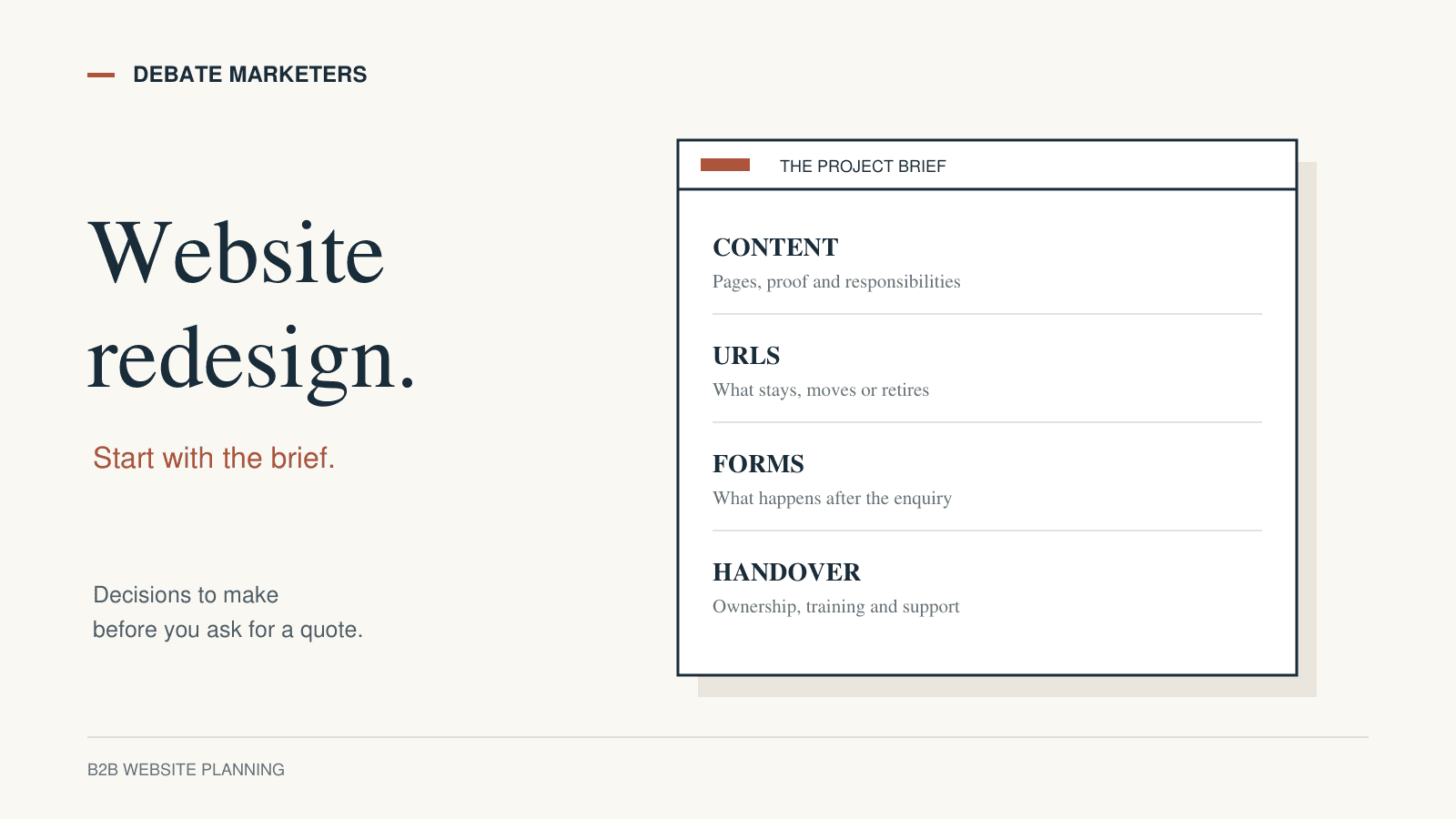
Website Development Quotation: How to Compare First-Year Cost and Ownership
Compare website development quotations in India using a first-year cost worksheet covering the build, hosting, licences, content, support and handover.

Social Media Agency Proposal: What a Monthly Retainer Should Actually Include
Compare social media agency proposals by production, approvals, community replies, reporting and ownership. Use the scope card before choosing a retainer.
- Journal
- SEO & AI Search
How to Get Your Business Recommended by ChatGPT and AI Search
How ChatGPT, Gemini and Google’s AI answers choose which businesses to recommend, with a 10-step checklist, crawler settings and a 30-day plan.
The short answer
AI assistants recommend businesses they can find, understand and trust. Let their search crawlers in, describe what you do, for whom and where in the same words everywhere, publish pages that answer buyers’ questions with facts, earn recent reviews and mentions on other sites, and retest the same prompts every month.
Key points
- ChatGPT has 900 million weekly users, and Google’s AI Mode passed 1 billion monthly users in 2026.
- 45% of consumers now use AI tools to find local businesses, up from 6% a year earlier (BrightLocal, 2026).
- Brand mentions across the web correlate with AI Overview visibility (0.664) far more than backlinks do (0.218) (Ahrefs).
- Adding quotations and statistics lifted visibility in AI answers by up to 41% in a KDD 2024 study.
Ask ChatGPT for “a digital marketing agency for schools in Delhi” or “an ISO-certified die-casting supplier in Europe” and you won’t get ten blue links. You get three to five names, a sentence about each and a few sources. If your business isn’t one of those names, the buyer may never reach your website.
This guide explains how ChatGPT, Gemini, Google’s AI Overviews and AI Mode, Perplexity, Claude and Copilot choose what to recommend, and gives you a checklist you can work through in 30 days. Every figure links to its source at the end.
Why do AI recommendations matter now?
ChatGPT reached 900 million weekly active users in February 2026, according to OpenAI.
Google says AI Mode passed 1 billion monthly users after its global expansion, and it has merged AI Overviews and AI Mode into one search experience. The Gemini app has 950 million monthly users.
BrightLocal’s 2026 survey found that 45% of consumers now use ChatGPT or other AI tools to find local businesses, up from 6% in 2025.
Clicks are moving too. In Pew Research Center’s study of 900 US adults’ browsing, people clicked a traditional search result on 8% of visits when Google showed an AI summary, against 15% when it didn’t, and clicked a link inside the summary on just 1% of visits. When the answer itself names businesses, being one of the names matters more than ranking fifth underneath it.
How do AI assistants decide which businesses to recommend?
An AI assistant answers from two places: what the model learned in training, and what it finds by searching the web while it writes. For recommendations (“best”, “near me”, “which supplier”), the live search matters most, because the assistant needs current facts.
The live process works like this:
The assistant turns the question into one or more searches.
It retrieves results from a search index. Google’s AI features use Google Search. ChatGPT search launched using third-party search providers, including Microsoft Bing, together with content from partners, and OpenAI runs its own search crawler. Copilot uses Bing. Perplexity and Anthropic also run their own search crawlers.
It reads the pages it found and writes an answer, usually citing a few of them. Pew found that 88% of Google’s AI summaries cited three or more sources.
So the businesses that get named are the ones that appear, clearly and consistently, in the pages the assistant reads. Four signals come up again and again (our guide to generative engine optimization covers the content side in more depth):
Access. The assistant’s crawler can reach and index your pages.
Clarity. Your website says plainly what you do, for whom and where, and other sites say the same.
Corroboration. Other sites mention you. Ahrefs’ study of 75,000 brands found that branded web mentions had the strongest correlation with appearing in Google’s AI Overviews (0.664), far ahead of the number of backlinks (0.218).
Evidence. Your pages contain facts worth quoting. In the GEO study presented at KDD 2024, adding quotations lifted a page’s visibility in AI answers by about 41%, adding statistics by about 31% and citing sources by about 27%, while keyword stuffing made it about 8% worse.
What you can’t do is pay your way into the answer. OpenAI says ads “do not influence the answers ChatGPT gives you”, and its guidance for publishers is about access, not payment: let OAI-SearchBot crawl your site.
The 10-step checklist
1. Let the AI search crawlers in
Open your robots.txt file (yoursite.com/robots.txt) and check your firewall or CDN bot settings too. Most AI companies run separate crawlers for search and for model training. Blocking a training crawler does not remove you from search answers. Blocking a search crawler can.
Company | Allow this crawler to appear in answers | Separate training crawler (your choice) |
|---|---|---|
OpenAI (ChatGPT) | OAI-SearchBot | GPTBot |
Google (AI Overviews, AI Mode) | Googlebot | Google-Extended (Gemini training and grounding outside Search) |
Anthropic (Claude) | Claude-SearchBot and Claude-User | ClaudeBot |
Perplexity | PerplexityBot | None (Perplexity says PerplexityBot is not used for training) |
Microsoft (Copilot) | Bingbot | Not applicable |
2. Make sure Google and Bing have indexed your key pages
Google says there are no extra technical requirements for AI Overviews and AI Mode: a page has to be indexed and eligible to show a snippet in Google Search. Verify your site in Google Search Console and Bing Webmaster Tools, submit your sitemap, and check that your service, location and pricing pages are indexed. Bing deserves more attention than its market share suggests, because Copilot runs on it and ChatGPT search launched with it as a provider.
3. Write one sentence that defines your business, and use it everywhere
AI answers are assembled from many sources, so contradictions hurt. Write one plain sentence that says who you are, what you do, for whom and where. Ours is: “Debate Marketers is a digital marketing agency with teams in New Delhi and Malta, working with schools, manufacturers and growing brands.” Use the same facts on your website, Google Business Profile, Bing Places, LinkedIn, directories and press bios.
4. Build a page for every question your buyers ask
List the 10 to 20 questions your buyers type into AI tools: “best X for Y in Z”, “X vs Y”, “how much does X cost”, “who supplies X with certification Y”. Make sure one page on your site answers each of them. Put the direct answer in the first two sentences, then the detail: prices or price ranges, timelines, locations served, credentials and who the offer is not for. Question headings, short paragraphs, lists and tables are easy for an assistant to extract and quote.
5. Add facts an AI can quote
Generic claims such as “quality service” or “an experienced team” give an assistant nothing to repeat. Specifics do: years in business, the number of clients served, certifications, turnaround times, results with dates, and quotes from named customers who agreed to be quoted. Cite the source of every statistic. This is exactly what the GEO study rewarded.
6. Get mentioned on the sites AI reads
Your website is one source. Assistants trust a business more when independent sites agree with it. Aim for mentions in industry associations and directories, credible “best of” lists, local and trade news, partner and supplier pages, podcasts and event pages. Run your key prompts and open the sources the answers cite: those are the sites to approach first. In Pew’s study, Wikipedia, YouTube and Reddit were the most cited sources in Google’s AI summaries, so a useful video or a genuine forum answer can do more than another blog post.
7. Collect recent reviews and reply to them
For local recommendations, reviews are evidence. BrightLocal found that 74% of consumers only care about reviews from the last three months, and 89% expect owners to reply. Ask every customer, every month, through a direct link, and reply to every review. Don’t offer rewards for reviews: Google’s policy prohibits it.
8. Complete your Google Business Profile and Bing Places listing
Google’s own guidance on AI features tells businesses to keep their Business Profile information current. Fill in categories, services, hours, service areas, photos and a description that matches your one-sentence definition. Do the same on Bing Places for Business.
9. Use structured data that matches the page
Google says AI features need no special schema, and structured data should always match the visible text. It still helps machines read your facts without guessing. Add Organization or LocalBusiness markup to your home and contact pages, Service or Product markup to your offer pages, and Article markup to your guides.
10. Measure, then retest the same prompts every month
Keep a sheet of 15 prompts your buyers would use, and run them every month in ChatGPT, Gemini, Google’s AI Mode, Perplexity and Copilot. Record which businesses are named and which sources are cited. Then check your traffic:
ChatGPT adds utm_source=chatgpt.com to the links it sends, so those visits show up in Google Analytics.
Google counts clicks from AI Overviews and AI Mode in Search Console, under the Web search type.
Bing Webmaster Tools has an AI Performance report, released as a preview in February 2026, that shows how often Copilot cites your pages.
For a fuller method, see how to check AI search visibility without inventing a score.
What doesn’t work
Keyword stuffing. In the GEO study it made pages less visible, not more.
An llms.txt file as a shortcut. Google says AI features need no special files or markup. Treat llms.txt as optional.
Hundreds of thin AI-written pages. If a page adds no new facts, there is nothing to cite.
Fake or paid reviews. They break Google’s rules and destroy trust when they are found.
Blocking every AI bot and still expecting to be recommended.
A 30-day plan
Week | What to do |
|---|---|
1 | Check robots.txt and bot settings, confirm indexing in Search Console and Bing Webmaster Tools, and run your 15-prompt baseline |
2 | Write your one-sentence definition and update your website, Google Business Profile, Bing Places, LinkedIn and directories |
3 | Rewrite or create the three pages that answer your most valuable buyer questions, with facts, quotes and sources |
4 | Ask for reviews, pitch three third-party mentions, set up tracking and rerun your prompts |
What this looks like for schools, manufacturers and service firms
Schools. Parents ask for “the best CBSE school near Dwarka with transport”. The answer draws on admissions pages, Google profiles, reviews and local news. Publish fees, transport routes and results, and keep your reviews recent. Our 16-week school admissions plan covers the rest of the season.
Manufacturers. Buyers ask for “an aluminium die-casting supplier in Europe with ISO 9001”. Build capability pages that list processes, tolerances, materials, certifications and export markets, and get listed in the trade directories your buyers use. Our guide to manufacturing websites that buyers and search can understand shows the page structure.
Service firms. Buyers ask for “a digital marketing agency in Malta for schools”. Name your industries and locations on your service pages, publish case studies with numbers, and collect reviews on Google and the directories your buyers trust.
If you want a team to run this for you, our SEO and AI search service starts with the prompt baseline above. Or book a 30-minute call and we’ll test your top five prompts together.
Sources
OpenAI, Publishers and developers FAQ
OpenAI, Our approach to advertising and expanding access, January 2026
TechCrunch, ChatGPT reaches 900M weekly active users, February 2026
Google, Q2 2026 earnings call: remarks from our CEO, July 2026
Google Search Central, AI features and your website
Pew Research Center, Google users are less likely to click on links when an AI summary appears in the results, July 2025
BrightLocal, Local Consumer Review Survey 2026, February 2026
Ahrefs, An analysis of AI Overview brand visibility factors (75K brands studied)
Pranjal Aggarwal and others, GEO: Generative Engine Optimization, KDD 2024
MarTech, ChatGPT search officially launches, October 2024
Anthropic, Does Anthropic crawl data from the web, and how can site owners block the crawler?
Perplexity, Perplexity crawlers
Search Influence, Inside Bing’s new AI Performance report, February 2026
Google, Maps user-contributed content policy: prohibited and restricted content
Questions people ask
No. OpenAI says ads do not influence the answers ChatGPT gives, and the ads it tests are labelled and kept separate from the answer. The way into the answer is to be easy to find, understand and corroborate.
Answers that use live search can change within days or weeks of your pages being indexed and mentioned elsewhere. What a model learned in training only changes when a new model is released, which can take months.
It builds on the same foundation: Google says standard SEO practices apply to AI Overviews and AI Mode. The difference is emphasis. Mentions on other sites, reviews and quotable facts matter more, and success means being named in the answer, not holding a position.
Not for Google, which says AI features need no special files. Other assistants have not committed to using it, so treat it as optional and never as a substitute for clear pages.
That is a separate decision. GPTBot collects content for model training, while OAI-SearchBot powers ChatGPT search. You can block GPTBot and still allow OAI-SearchBot, so your pages can appear in ChatGPT search answers.
ChatGPT adds utm_source=chatgpt.com to the links it sends, so those visits show in Google Analytics under that source. For Copilot, use the AI Performance report in Bing Webmaster Tools.
Usually because more sources mention them, their reviews are more recent, or they have a page that answers the exact question. Run the same prompt, open the sources it cites, and work on being mentioned there.
We plan and run admissions campaigns, websites, SEO and AI search, ads and CRM follow-up for schools, manufacturers and growing brands, from teams in New Delhi and Malta.
Published 12 October 2026.
More articles
How to Increase School Admissions: A 16-Week Plan for 2027–28
A week-by-week plan to fill seats for 2027–28: reply to enquiries faster, fix your admissions page, collect recent reviews, run better visits and follow up.
Website Development Quotation: How to Compare First-Year Cost and Ownership
Compare website development quotations in India using a first-year cost worksheet covering the build, hosting, licences, content, support and handover.
Social Media Agency Proposal: What a Monthly Retainer Should Actually Include
Compare social media agency proposals by production, approvals, community replies, reporting and ownership. Use the scope card before choosing a retainer.
- Journal
- SEO & AI Search
How to Get Your Business Recommended by ChatGPT and AI Search
How ChatGPT, Gemini and Google’s AI answers choose which businesses to recommend, with a 10-step checklist, crawler settings and a 30-day plan.
The short answer
AI assistants recommend businesses they can find, understand and trust. Let their search crawlers in, describe what you do, for whom and where in the same words everywhere, publish pages that answer buyers’ questions with facts, earn recent reviews and mentions on other sites, and retest the same prompts every month.
Key points
- ChatGPT has 900 million weekly users, and Google’s AI Mode passed 1 billion monthly users in 2026.
- 45% of consumers now use AI tools to find local businesses, up from 6% a year earlier (BrightLocal, 2026).
- Brand mentions across the web correlate with AI Overview visibility (0.664) far more than backlinks do (0.218) (Ahrefs).
- Adding quotations and statistics lifted visibility in AI answers by up to 41% in a KDD 2024 study.
Ask ChatGPT for “a digital marketing agency for schools in Delhi” or “an ISO-certified die-casting supplier in Europe” and you won’t get ten blue links. You get three to five names, a sentence about each and a few sources. If your business isn’t one of those names, the buyer may never reach your website.
This guide explains how ChatGPT, Gemini, Google’s AI Overviews and AI Mode, Perplexity, Claude and Copilot choose what to recommend, and gives you a checklist you can work through in 30 days. Every figure links to its source at the end.
Why do AI recommendations matter now?
ChatGPT reached 900 million weekly active users in February 2026, according to OpenAI.
Google says AI Mode passed 1 billion monthly users after its global expansion, and it has merged AI Overviews and AI Mode into one search experience. The Gemini app has 950 million monthly users.
BrightLocal’s 2026 survey found that 45% of consumers now use ChatGPT or other AI tools to find local businesses, up from 6% in 2025.
Clicks are moving too. In Pew Research Center’s study of 900 US adults’ browsing, people clicked a traditional search result on 8% of visits when Google showed an AI summary, against 15% when it didn’t, and clicked a link inside the summary on just 1% of visits. When the answer itself names businesses, being one of the names matters more than ranking fifth underneath it.
How do AI assistants decide which businesses to recommend?
An AI assistant answers from two places: what the model learned in training, and what it finds by searching the web while it writes. For recommendations (“best”, “near me”, “which supplier”), the live search matters most, because the assistant needs current facts.
The live process works like this:
The assistant turns the question into one or more searches.
It retrieves results from a search index. Google’s AI features use Google Search. ChatGPT search launched using third-party search providers, including Microsoft Bing, together with content from partners, and OpenAI runs its own search crawler. Copilot uses Bing. Perplexity and Anthropic also run their own search crawlers.
It reads the pages it found and writes an answer, usually citing a few of them. Pew found that 88% of Google’s AI summaries cited three or more sources.
So the businesses that get named are the ones that appear, clearly and consistently, in the pages the assistant reads. Four signals come up again and again (our guide to generative engine optimization covers the content side in more depth):
Access. The assistant’s crawler can reach and index your pages.
Clarity. Your website says plainly what you do, for whom and where, and other sites say the same.
Corroboration. Other sites mention you. Ahrefs’ study of 75,000 brands found that branded web mentions had the strongest correlation with appearing in Google’s AI Overviews (0.664), far ahead of the number of backlinks (0.218).
Evidence. Your pages contain facts worth quoting. In the GEO study presented at KDD 2024, adding quotations lifted a page’s visibility in AI answers by about 41%, adding statistics by about 31% and citing sources by about 27%, while keyword stuffing made it about 8% worse.
What you can’t do is pay your way into the answer. OpenAI says ads “do not influence the answers ChatGPT gives you”, and its guidance for publishers is about access, not payment: let OAI-SearchBot crawl your site.
The 10-step checklist
1. Let the AI search crawlers in
Open your robots.txt file (yoursite.com/robots.txt) and check your firewall or CDN bot settings too. Most AI companies run separate crawlers for search and for model training. Blocking a training crawler does not remove you from search answers. Blocking a search crawler can.
Company | Allow this crawler to appear in answers | Separate training crawler (your choice) |
|---|---|---|
OpenAI (ChatGPT) | OAI-SearchBot | GPTBot |
Google (AI Overviews, AI Mode) | Googlebot | Google-Extended (Gemini training and grounding outside Search) |
Anthropic (Claude) | Claude-SearchBot and Claude-User | ClaudeBot |
Perplexity | PerplexityBot | None (Perplexity says PerplexityBot is not used for training) |
Microsoft (Copilot) | Bingbot | Not applicable |
2. Make sure Google and Bing have indexed your key pages
Google says there are no extra technical requirements for AI Overviews and AI Mode: a page has to be indexed and eligible to show a snippet in Google Search. Verify your site in Google Search Console and Bing Webmaster Tools, submit your sitemap, and check that your service, location and pricing pages are indexed. Bing deserves more attention than its market share suggests, because Copilot runs on it and ChatGPT search launched with it as a provider.
3. Write one sentence that defines your business, and use it everywhere
AI answers are assembled from many sources, so contradictions hurt. Write one plain sentence that says who you are, what you do, for whom and where. Ours is: “Debate Marketers is a digital marketing agency with teams in New Delhi and Malta, working with schools, manufacturers and growing brands.” Use the same facts on your website, Google Business Profile, Bing Places, LinkedIn, directories and press bios.
4. Build a page for every question your buyers ask
List the 10 to 20 questions your buyers type into AI tools: “best X for Y in Z”, “X vs Y”, “how much does X cost”, “who supplies X with certification Y”. Make sure one page on your site answers each of them. Put the direct answer in the first two sentences, then the detail: prices or price ranges, timelines, locations served, credentials and who the offer is not for. Question headings, short paragraphs, lists and tables are easy for an assistant to extract and quote.
5. Add facts an AI can quote
Generic claims such as “quality service” or “an experienced team” give an assistant nothing to repeat. Specifics do: years in business, the number of clients served, certifications, turnaround times, results with dates, and quotes from named customers who agreed to be quoted. Cite the source of every statistic. This is exactly what the GEO study rewarded.
6. Get mentioned on the sites AI reads
Your website is one source. Assistants trust a business more when independent sites agree with it. Aim for mentions in industry associations and directories, credible “best of” lists, local and trade news, partner and supplier pages, podcasts and event pages. Run your key prompts and open the sources the answers cite: those are the sites to approach first. In Pew’s study, Wikipedia, YouTube and Reddit were the most cited sources in Google’s AI summaries, so a useful video or a genuine forum answer can do more than another blog post.
7. Collect recent reviews and reply to them
For local recommendations, reviews are evidence. BrightLocal found that 74% of consumers only care about reviews from the last three months, and 89% expect owners to reply. Ask every customer, every month, through a direct link, and reply to every review. Don’t offer rewards for reviews: Google’s policy prohibits it.
8. Complete your Google Business Profile and Bing Places listing
Google’s own guidance on AI features tells businesses to keep their Business Profile information current. Fill in categories, services, hours, service areas, photos and a description that matches your one-sentence definition. Do the same on Bing Places for Business.
9. Use structured data that matches the page
Google says AI features need no special schema, and structured data should always match the visible text. It still helps machines read your facts without guessing. Add Organization or LocalBusiness markup to your home and contact pages, Service or Product markup to your offer pages, and Article markup to your guides.
10. Measure, then retest the same prompts every month
Keep a sheet of 15 prompts your buyers would use, and run them every month in ChatGPT, Gemini, Google’s AI Mode, Perplexity and Copilot. Record which businesses are named and which sources are cited. Then check your traffic:
ChatGPT adds utm_source=chatgpt.com to the links it sends, so those visits show up in Google Analytics.
Google counts clicks from AI Overviews and AI Mode in Search Console, under the Web search type.
Bing Webmaster Tools has an AI Performance report, released as a preview in February 2026, that shows how often Copilot cites your pages.
For a fuller method, see how to check AI search visibility without inventing a score.
What doesn’t work
Keyword stuffing. In the GEO study it made pages less visible, not more.
An llms.txt file as a shortcut. Google says AI features need no special files or markup. Treat llms.txt as optional.
Hundreds of thin AI-written pages. If a page adds no new facts, there is nothing to cite.
Fake or paid reviews. They break Google’s rules and destroy trust when they are found.
Blocking every AI bot and still expecting to be recommended.
A 30-day plan
Week | What to do |
|---|---|
1 | Check robots.txt and bot settings, confirm indexing in Search Console and Bing Webmaster Tools, and run your 15-prompt baseline |
2 | Write your one-sentence definition and update your website, Google Business Profile, Bing Places, LinkedIn and directories |
3 | Rewrite or create the three pages that answer your most valuable buyer questions, with facts, quotes and sources |
4 | Ask for reviews, pitch three third-party mentions, set up tracking and rerun your prompts |
What this looks like for schools, manufacturers and service firms
Schools. Parents ask for “the best CBSE school near Dwarka with transport”. The answer draws on admissions pages, Google profiles, reviews and local news. Publish fees, transport routes and results, and keep your reviews recent. Our 16-week school admissions plan covers the rest of the season.
Manufacturers. Buyers ask for “an aluminium die-casting supplier in Europe with ISO 9001”. Build capability pages that list processes, tolerances, materials, certifications and export markets, and get listed in the trade directories your buyers use. Our guide to manufacturing websites that buyers and search can understand shows the page structure.
Service firms. Buyers ask for “a digital marketing agency in Malta for schools”. Name your industries and locations on your service pages, publish case studies with numbers, and collect reviews on Google and the directories your buyers trust.
If you want a team to run this for you, our SEO and AI search service starts with the prompt baseline above. Or book a 30-minute call and we’ll test your top five prompts together.
Sources
OpenAI, Publishers and developers FAQ
OpenAI, Our approach to advertising and expanding access, January 2026
TechCrunch, ChatGPT reaches 900M weekly active users, February 2026
Google, Q2 2026 earnings call: remarks from our CEO, July 2026
Google Search Central, AI features and your website
Pew Research Center, Google users are less likely to click on links when an AI summary appears in the results, July 2025
BrightLocal, Local Consumer Review Survey 2026, February 2026
Ahrefs, An analysis of AI Overview brand visibility factors (75K brands studied)
Pranjal Aggarwal and others, GEO: Generative Engine Optimization, KDD 2024
MarTech, ChatGPT search officially launches, October 2024
Anthropic, Does Anthropic crawl data from the web, and how can site owners block the crawler?
Perplexity, Perplexity crawlers
Search Influence, Inside Bing’s new AI Performance report, February 2026
Google, Maps user-contributed content policy: prohibited and restricted content
Questions people ask
No. OpenAI says ads do not influence the answers ChatGPT gives, and the ads it tests are labelled and kept separate from the answer. The way into the answer is to be easy to find, understand and corroborate.
Answers that use live search can change within days or weeks of your pages being indexed and mentioned elsewhere. What a model learned in training only changes when a new model is released, which can take months.
It builds on the same foundation: Google says standard SEO practices apply to AI Overviews and AI Mode. The difference is emphasis. Mentions on other sites, reviews and quotable facts matter more, and success means being named in the answer, not holding a position.
Not for Google, which says AI features need no special files. Other assistants have not committed to using it, so treat it as optional and never as a substitute for clear pages.
That is a separate decision. GPTBot collects content for model training, while OAI-SearchBot powers ChatGPT search. You can block GPTBot and still allow OAI-SearchBot, so your pages can appear in ChatGPT search answers.
ChatGPT adds utm_source=chatgpt.com to the links it sends, so those visits show in Google Analytics under that source. For Copilot, use the AI Performance report in Bing Webmaster Tools.
Usually because more sources mention them, their reviews are more recent, or they have a page that answers the exact question. Run the same prompt, open the sources it cites, and work on being mentioned there.
We plan and run admissions campaigns, websites, SEO and AI search, ads and CRM follow-up for schools, manufacturers and growing brands, from teams in New Delhi and Malta.
Published 12 October 2026.
More articles
How to Increase School Admissions: A 16-Week Plan for 2027–28
A week-by-week plan to fill seats for 2027–28: reply to enquiries faster, fix your admissions page, collect recent reviews, run better visits and follow up.
Website Development Quotation: How to Compare First-Year Cost and Ownership
Compare website development quotations in India using a first-year cost worksheet covering the build, hosting, licences, content, support and handover.
Social Media Agency Proposal: What a Monthly Retainer Should Actually Include
Compare social media agency proposals by production, approvals, community replies, reporting and ownership. Use the scope card before choosing a retainer.
Bring your first priority.
Bring one problem: a brand that's drifted, a website that doesn't sell or enquiries going nowhere. We'll spend 30 minutes finding the first fix.
Projects & shared-team retainers
Bring your first priority.
Bring one problem: a brand that's drifted, a website that doesn't sell or enquiries going nowhere. We'll spend 30 minutes finding the first fix.
Projects & shared-team retainers